
Excellent Reasons Why You Need to Discover Cloud-Watching
The Right Type of Cloud Is Easy to Identify — Hypnotic, Article 1 of a 3-article series.
Introduction
Thank you, Sahil Patel for the writing prompt used to create this article. In his article https://readmedium.com/the-sublime-art-of-cloud-watching-5b512bd6f229, he provided the prompt, “Imagine lying on a grassy field, looking up at the sky. Describe the clouds you see. What shapes or stories do they tell? How does watching them make you feel?”
After reading this writing prompt, my first reaction was: Wow, this writing prompt can be taken in many different directions. As a child, I learned how much fun it was gazing at the clouds as they drifted by. I have carried that throughout my life and still enjoy it today.
The mind is a wonderful tool when used to do important things and also when relaxing. The activity of cloud-watching can help you relax and let your mind take you on a trip to a faraway land. Letting your mind drift with the clouds is so much fun.
Before we go there, though, as an adult, I need to understand better what a cloud is, why it appears, and what makes it appear in different shapes and sizes. We will start with a definition and then look at what a cloud can tell us, why they form, what makes one different from another, and perhaps even more.
Cloud Definition
For this article, I chose to go with the following as the definition. A cloud is a visible mass of particles of condensed water (water or ice) suspended in a planet’s atmosphere, a vapor floating in the atmosphere, high above the ground. A cloud is a light, filmy, puffy, or billowing mass that seems to float in the air. There are other definitions for “cloud,” but I chose not to discuss them here. Cloud Definition & Meaning — Merriam-Webster
Cumulus Clouds and Convection
Cumulous Clouds and Convection
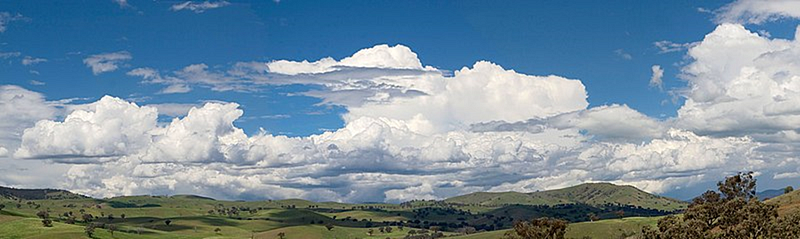
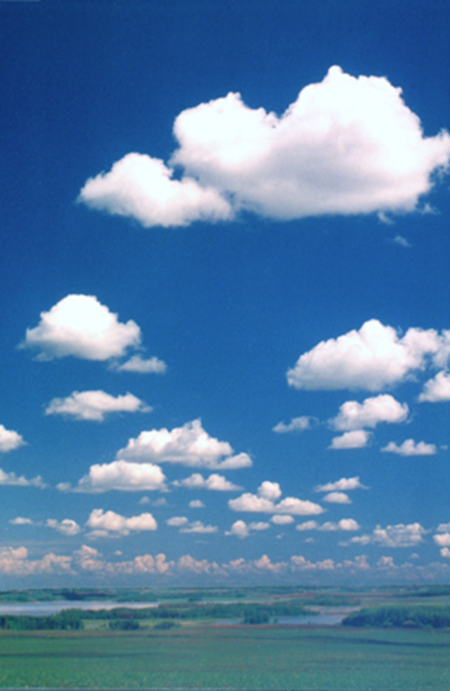
Are you aware that there are several different types of clouds? Were you aware that the type of clouds you see indicates the weather the area is about to experience? The most well-known clouds are cumulus clouds.
These clouds form from convection when air parcels rise vertically. Convection is movement caused within a fluid by the tendency of hotter, less dense material to rise and colder material to sink under the influence of gravity. The result is a transfer of heat. Convection. (2023, September 24). In Wikipedia. https://en.wikipedia.org/wiki/Convection
Convection works because the sun heats the earth. As ground temperatures warm, it heats the layer of air directly above it. Conduction means the transfer of heat from one substance to another.
Because of the different surfaces of the earth, the sun warms surfaces such as sand, rocks, pavement, or concrete quickly, and the air at or near the surface heats unevenly. Ground covered with water or vegetation heats slower than these other surfaces. Convection creates pockets that warm faster than others. Convection. (2023, September 24). In Wikipedia. https://en.wikipedia.org/wiki/Convection
The faster-warming pockets are less dense than the cooler air surrounding them, so they rise. Rising columns or currents of air are called “thermals.” Heat and moisture rise when the air rises into the atmosphere. The stronger the surface heats, the more substantial and increased vertical rise into the atmosphere. Convection. (2023, September 24). In Wikipedia. https://en.wikipedia.org/wiki/Convection
Cumulous Clouds
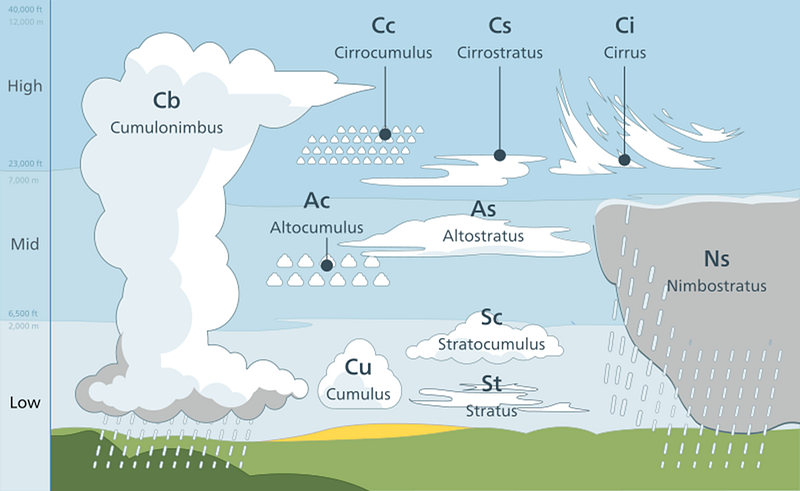
Different scenarios occur after the convection process, each making its own weather type. Cumulous clouds are formed when the air cools, reaches lower air pressures, and reaches the point of water vapor condensation. The cumulous cloud has a lot of moisture and is hot. It grows vertical until it becomes a towering cumulus or a cumulonimbus. Cloud. (2023, October 6). In Wikipedia. https://en.wikipedia.org/wiki/Cloud
Cumulus, Towering cumulus, Cumulonimbus, and Altocumulus Castellanus clouds are all visible forms of convection. They are also “moist” convection, where the excess water vapor in the rising air condenses to form a cloud. If convective clouds have enough cloud droplets, they will produce convective precipitation. Cloud. (2023, October 6). In Wikipedia. https://en.wikipedia.org/wiki/Cloud
Convective precipitation requires instability or the ability for air to continue rising. Convection is associated with lightning, thunder, and bursts of heavy rain. The only time that convection stops is when the pocket of warm rising air has cooled to the same temperature as the surrounding air. Cloud. (2023, October 6). In Wikipedia. https://en.wikipedia.org/wiki/Cloud
Cumulonimbus Clouds
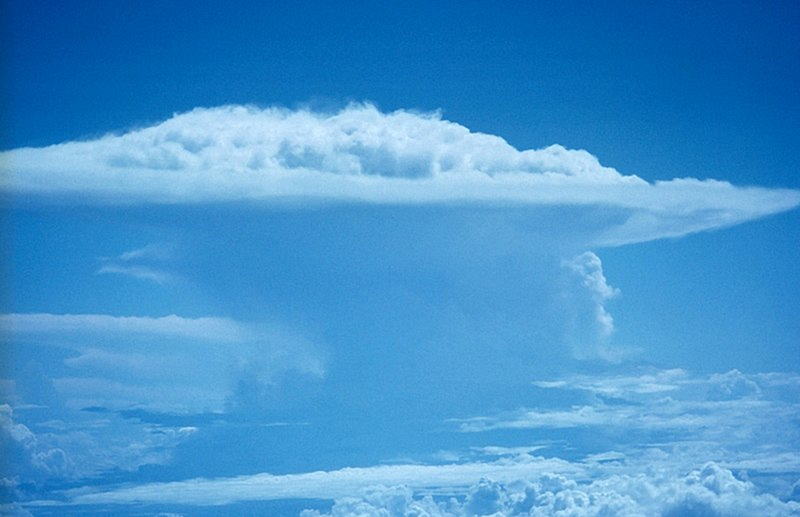
The next type of cloud I would like to inform you about is the Cumulonimbus cloud. These are cumulus clouds but with stronger updrafts. They can grow so tall that they are then called cumulonimbus clouds.
The Cumulonimbus cloud is breathtaking and may even look threatening. It is observed in the summer months and can indicate thunderstorms nearby or getting ready to occur. These clouds include lightning, hail, heavy rain, and even tornadoes. Thunderstorms can grow these clouds that tower up to 60,000 feet. Cloud. (2023, October 6). In Wikipedia. https://en.wikipedia.org/wiki/Cloud
Stratus Clouds
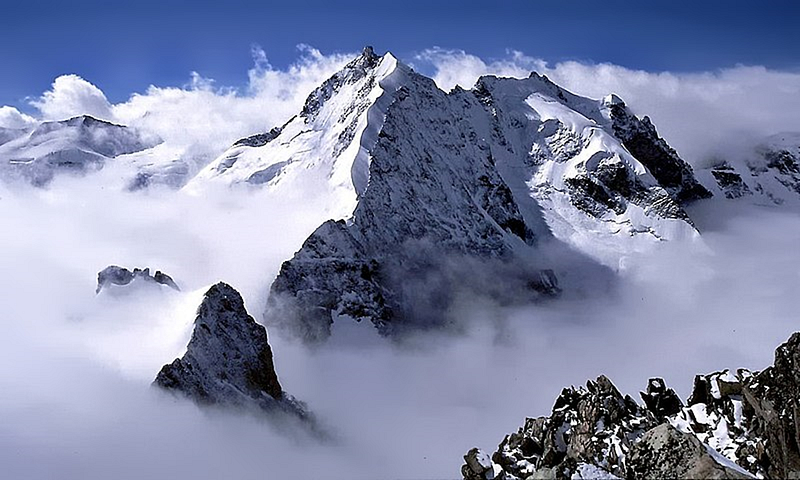
This flat or sometimes ragged non-convective stratiform type cloud looks like fog. It can bring weak precipitation in the form of drizzle or snow grains. The clouds may last days, bringing cooler temperatures, persistent rain, drizzle, or snow. Cloud. (2023, October 6). In Wikipedia. https://en.wikipedia.org/wiki/Cloud
Stratocumulus Clouds
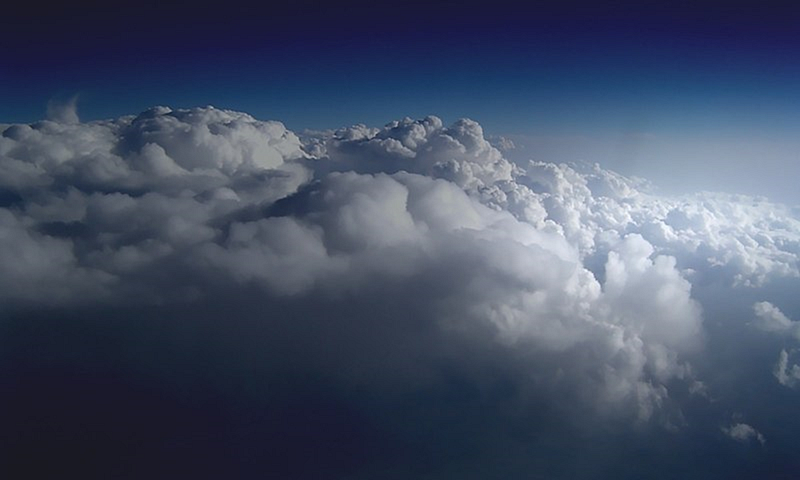
These clouds are stratocumuli and form a layer of limited convection. They come in irregular patches or more extensive sheets like stratocumulus they have limited convection. These clouds appear during wet weather and come from other rain clouds. Still, they can only produce very light precipitation if they appear independently. Cloud. (2023, October 6). In Wikipedia. https://en.wikipedia.org/wiki/Cloud
Cirrus Clouds
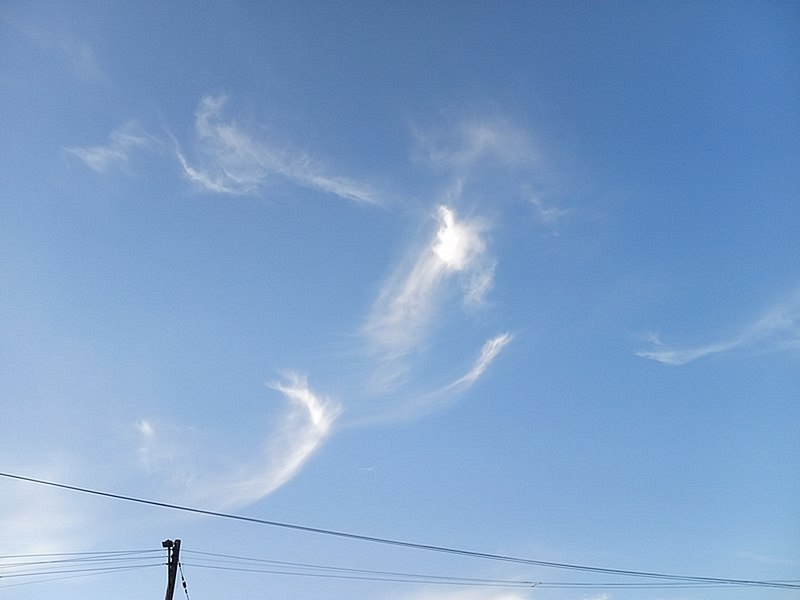
These are wisps of delicate, white, cirriform, ice-crystal clouds that appear clearly in the blue sky. These clouds are formed high up in altitude. These clouds form at the very leading edge of a frontal or low-pressure disturbance, where they may merge with cirrostratus clouds.
Most of the time, when you see these clouds, you need to know that they represent a beautiful day because they don’t produce precipitation. Cloud. (2023, October 6). In Wikipedia. https://en.wikipedia.org/wiki/Cloud
Cirrostratus
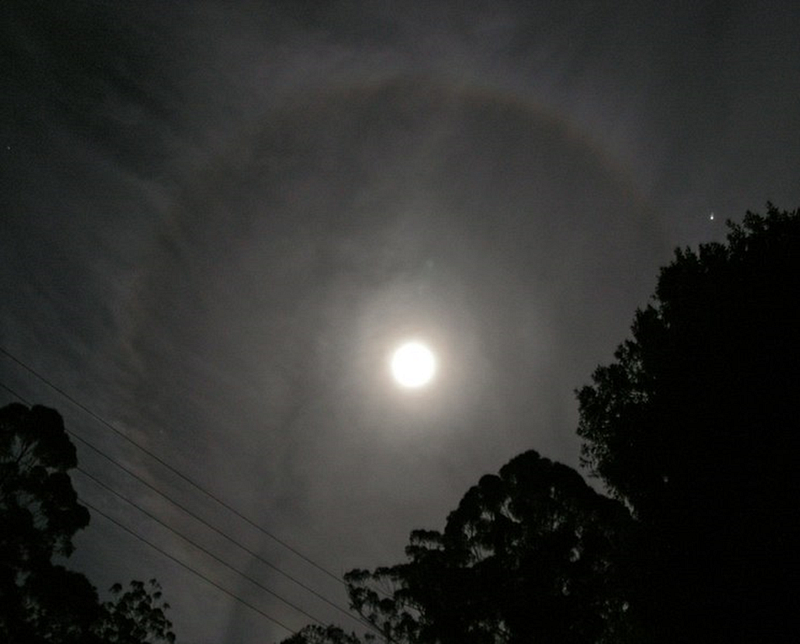
This cloud is a thin, non-convective stratiform ice crystal veil that can give rise to halos caused by the refraction of the sun’s rays. This cloud is another that does not produce precipitation. Found at or above 18,000 feet. It can thicken into altostratus clouds ahead of a warm front or low-pressure area. Cloud. (2023, October 6). In Wikipedia. https://en.wikipedia.org/wiki/Cloud
Cirrocumulus
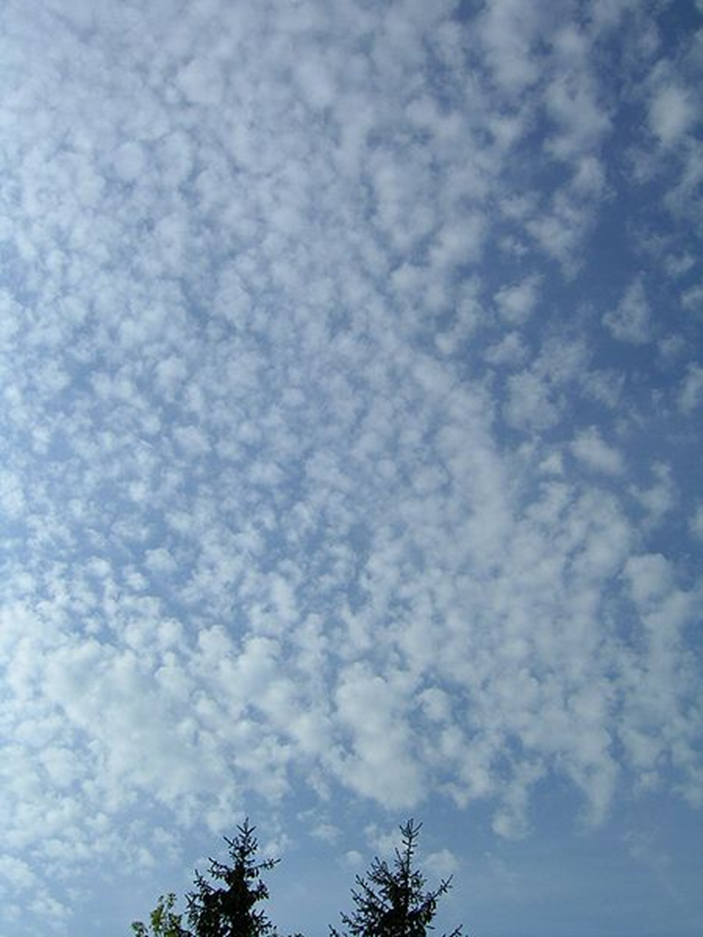
This cloud is a pure white high-latitude layer of limited convection. It is made up of ice crystals or supercooled water droplets that appear as small, unshaded round masses or flakes in groups or lines with ripples like sand on a beach. It may appear with cirrus clouds and be seen together with or replaced by cirrostratus clouds near the leading edge of a weather system.
These clouds can produce virga or precipitation that occurs below the base of the cloud. Cloud. (an observable streak or shaft of precipitation falling from a cloud that evaporates or sublimates before reaching the ground) Cloud. (2023, October 6). In Wikipedia. https://en.wikipedia.org/wiki/Cloud
Altocumulus
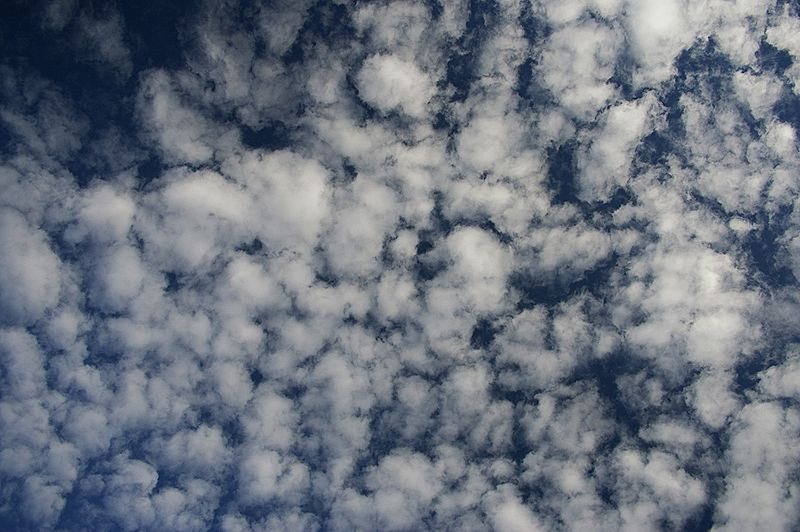
The Altocumulus cloud is a middle-altitude (2,000 to 7,000 feet) cloud of limited convection. It appears as irregular patches or more extensive sheets arranged in groups, lines, or waves. These clouds can resemble cirrocumulus clouds, but they are thicker and composed of a mixture of water droplets and ice crystals. They can produce virga or light precipitation. Virga. (2022, October 25). In Wikipedia. https://en.wikipedia.org/wiki/Virga. Cloud. (2023, October 6). In Wikipedia. https://en.wikipedia.org/wiki/Cloud
This is the end of article one of our three-article series. In this article, we provided a definition of a cloud, the different types of clouds, what they look like, and what makes them form. We hope you enjoyed reading about them and will continue to follow our series.
You will enjoy reading all of the articles. There are two more articles titled the same as this article, except that you will see article X of a 3-article series at the end of the subtitle. The X indicates the article number.
I would love to give a Big Shout Out to Patrick OConnell for his article https://readmedium.com/crafting-your-novel-mastering-macro-and-micro-edits-for-perfection-part-6-3530822c2f63. His article tells writers how to edit and polish the novel that they are writing. This was the sixth part of his series on crafting your novel. I found it interesting and helpful for anyone who is writing a novel. Great job on this article, Patrick!
I would love to give a Big Shout Out to Tamil for the article https://readmedium.com/you-can-never-be-forgotten-507850dda1f6. This is an inspirational article about how a person is remembered for what they say and do. I found it curious that a person could remember that long ago, but I have no doubt it happens. This article capitalized on the need to be kind and treat others well. All readers would benefit from reading this article. Great job on this article, Tamil!


