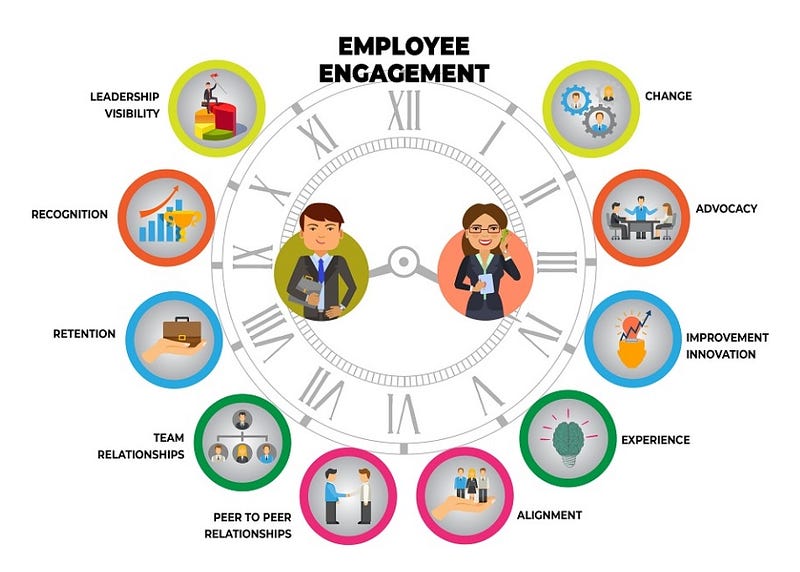
Exactly What is Employee Engagement?
The Case of Many Definitions In Search of Clarity

The concept of employee engagement is increasingly becoming popular as the main pre-occupation of people management. It has become conventional wisdom that effective employee engagement is the key sustainable performance driver for the organization concerning productivity, profitability, shareholders’ return, employee retention and customer loyalty.
Employee engagement is responsible for corporate success from within the organisation when transforming it to align with the digital age in the modern world. It is the new competitive advantage manifested as the definitive value proposition of a customer-centric, people-centric and stakeholders-centric organisation.
Through employee engagement, companies come to understand better the possible driving and hindering factors of success at the level of engagement. The driving factors of engagement have included achievement, recognition for achievement, work itself, responsibilities and growth or advancement. Likewise, the hindering factors include supervision, interpersonal relationships, working conditions, salary, status, security and personal life. The roots of these ideas can of course be traced to Herzberg’s 2-Factor Motivation Theory of Hygiene vs Motivators.
To experienced managers, the art (or science?) of employee engagement is simply a matter of managing contingencies through motivational behavioral systems in the operational managerial processes.
Employee engagement remains a new and hazy construct which has yet to be clearly defined. It attracts opportunistic interest from an organizational behaviour perspective, by focusing on ambiguous employees’ “passion”, “energy”, “discretionary efforts” and “vigour”.
There is as yet no consensus among authors and thinkers on a generally acceptable and holistic definition of employee engagement. The following illustrates some attempts at providing clarity to the concept of employee engagement:
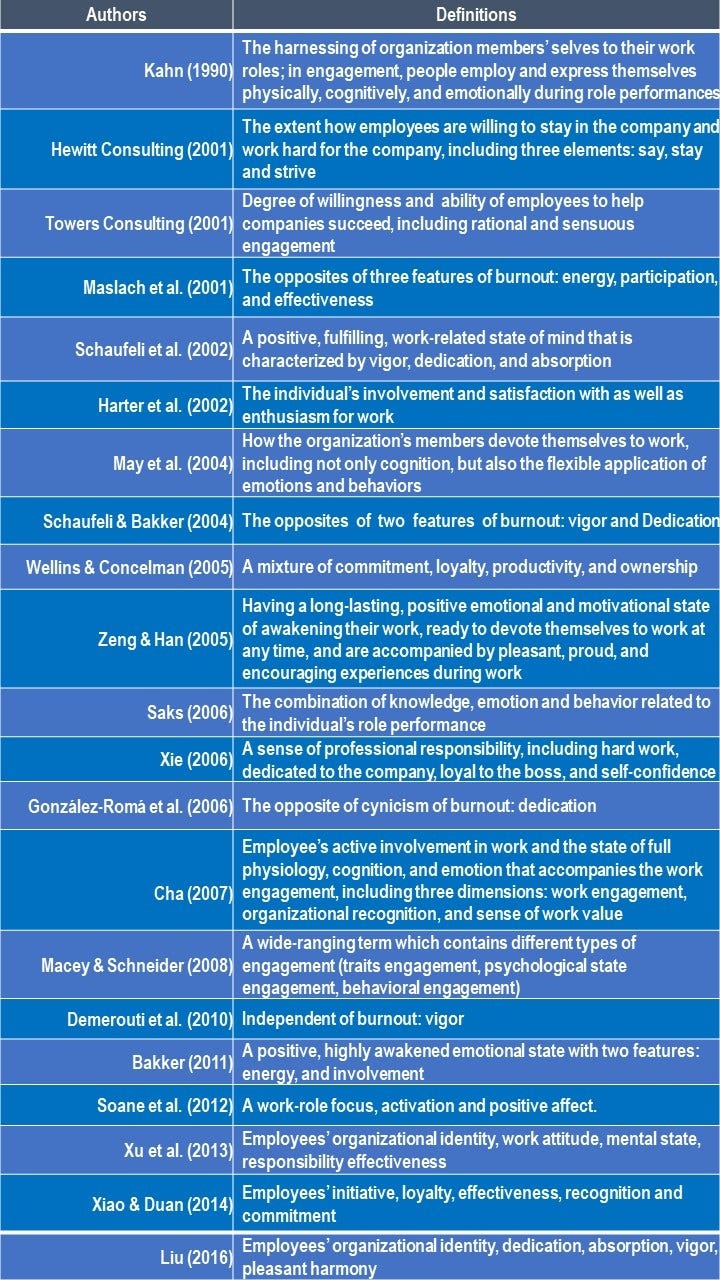
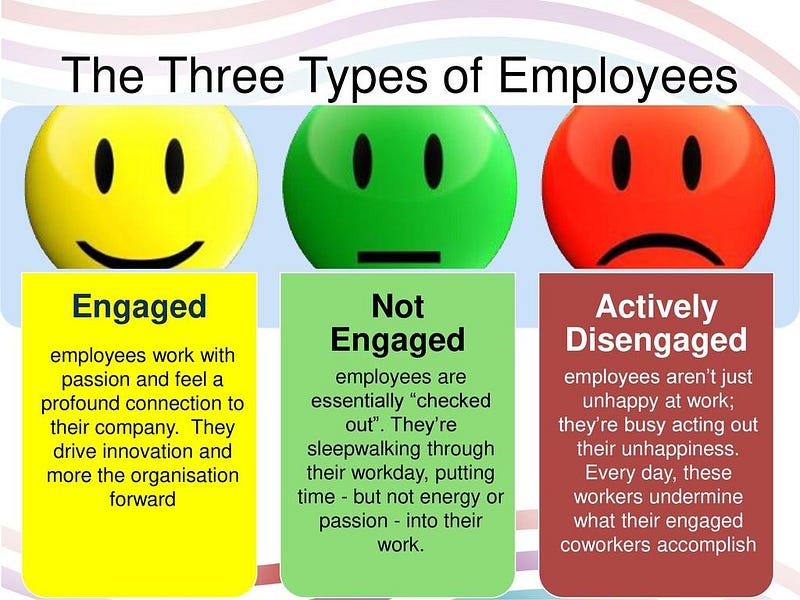
Many authors see employee engagement as a multi-dimensional and multi-faceted construct. Others view it as composing aspects of a positive mindset. Some see it as simply the degree of engagement by 3 types of employees:
Many definitions see the psychological states of employee engagement to correlate with involvement, job satisfaction, attachment, mood, commitment and positive affectivity. These are also aspects of rational and emotional engagement with people and bosses in the organisation which further create meaningfulness. Generally, they can be classified as organizational citizenship which are also influenced by job characteristics eg challenging work, work autonomy, work significance and career growth opportunities, which have also been well documented by the grounded Job Characteristic Model and the Expectancy Theory of Motivation Model.
It is however unclear if these psychological states lead to engagement, or if engagement leads to these states, or if these states all covary with other variable(s) altogether (e.g. market, competition, company success … etc).
It is also unclear whether employee engagement creates the successful organizations or if successful organizations make employees more engaged or if both are a result of, say, managerial behavior.
It should be noted that management behavior moderates the relationship between engagement and organizational/business outcomes, and which in turn influences employee behavior. Many studies also conclude that management who are more customer focused, compassionate, more communicative effectively and have the employees’ care and well-being as a high priority, tends to produce engaged employees because they have nurture and built “trust”. Other conducive organizational variables related to engagement also include human resources practices, policies, values, culture, technology … etc. that promote both individual and collective perception and feelings of fairness, equity and procedural justice.
Clearly, the causal directionality and “third/other variable(s)” problem is problematic in the various models and studies on employee engagement. Such is the challenge in the search for clarity given the absence of consensus in its theoretical and operational definition.
The primary problem with the concept of employee engagement is the fact that it is currently a non-scientific and non-specific term used to describe the characteristics of a positive workplace climate full of reinforcement for voluntary value-added productive behaviors.
At best, it refers to various cocktails of related theoretical constructs which have some common dimensional overlaps. At worse, it merely regurgitates variables already discussed in earlier motivation models eg job satisfaction, communication, management care and organizational commitment.
The good news about employee engagement are the many correlational research which suggests the outcomes of employee engagement, however defined, speak directly to impressive business results. A Fortune 100 manufacturing company reported reduced turnover from 14.5% to 4.1%, while absenteeism dropped from 8% to 4.8%. Employee engagement has been shown to be positively correlated to higher growth, a lower cost of goods sold, and negatively correlated with intentions to leave the organisation. Organizations in the top quartile of employee engagement accrued 1% to 4% more in organizational profits annually. A study of 64 organizations revealed that organizations with highly engaged employees achieve twice the annual net income of organizations whose employees lag behind on engagement. Another study conducted across 39 organizations indicates that organizations with highly engaged employees achieve seven times greater 5-year Total Shareholder Return than other organisations whose employees are less engaged. However, the causality or directionality of such statements remain suspect.
The relentless search for clarity and better definition(s) of employee engagement continues for the sake of its own sustainable usefulness in management research and practice.