
Everything You Need to Know About the Human-Induced Extinction Event
Our little blue planet has experienced five mass extinction events in its history, and scientists believe we are in the middle of the sixth.
The history of life on Earth is long and not particularly well documented. We largely rely on the fossil record to give us a picture of what life once existed on Earth, however, fossilization is a rare event. Most organisms will decompose quickly after death, leaving behind no trace. The only reason we find the number of fossils we do is because life has existed on Earth for approximately 3.5 billion years and during that time an extraordinary amount of animals have roamed the planet.
Scientists can examine the fossil record and observe that during some periods of life’s history huge numbers of species have fallen out of existence, dropping off the fossil record suddenly.
A Brief Overview of the Five Mass Extinction Events
Ordovician-Silurian Extinction
When: 450–440 million years ago
85% of all Ordovician species became extinct. The extinction event appears to have occurred in several distinct phases, starting with graptolite extinction, then brachiopods, and eventually trilobites, who narrowly missed going extinct.
The Late Devonian Extinction
When: 375 million years ago
Around 75% of species became extinct. The late Devonian mass extinction is somewhat controversial among scientists since it’s thought that this event was actually 8 to 10 extinction events. Trilobites were the major casualty in this period — going from one of the most abundant creatures to almost non-existent. The extinctions in this period are thought to be caused by a few factors. Vascular plants had roots that broke up the land and created soil, complete with minerals and nutrients. This soil was washed into rivers and oceans where it led to a boom in algae, sheets of which would cover the ocean surface and starve marine life of oxygen. This period also experienced warming and cooling which left some species unable to adapt.
End Permian or Permian-Triassic Extinction
When: 250 million years ago
This was a mass extinction of colossal scale and severity — 96% of species became extinct. The Permian-Triassic extinction is sometimes called “the great dying” due to the extreme loss in Earth's life and biodiversity. Nearly all trees died, nearly all sea life died, and trilobites, who managed to survive two mass extinctions prior, also met their end. All life today are descendants of that 4% that survived against the odds.
End Triassic or Triassic-Jurassic Extinction
When: 200 million years ago
Around 80% of species were lost during this mass extinction. This is another somewhat controversial extinction event since many scientists believe it shouldn’t be on the list at all. Lawrence Tanner, Professor of Environmental Science Systems as Le Moyne College said:
“Certainly there was an environmental crisis, but it’s not a mass extinction per se…It’s misleading to continue to call it one.”
This period experienced a spate of volcanic eruptions that triggered global warming and acid rains.
End Cretaceous or Cretaceous-Paleogene Extinction (the dinosaurs one)
When: 65 million years ago
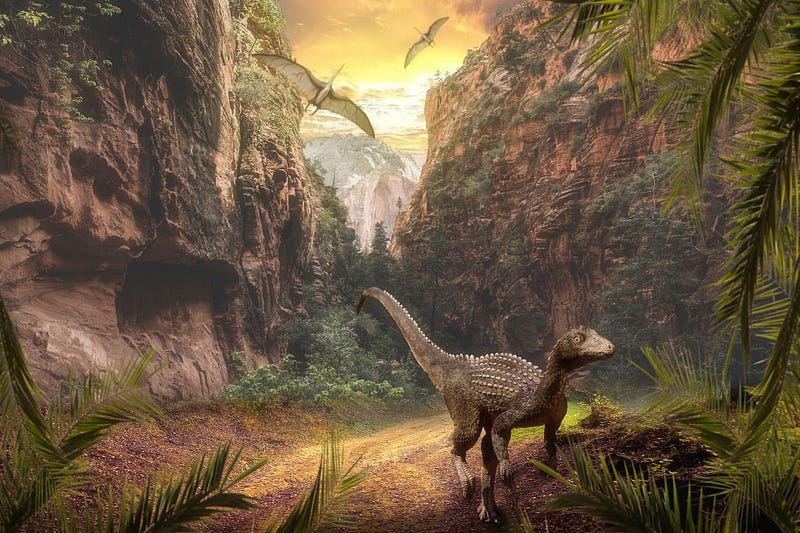
This is probably the most well-known extinction event because it’s the one that obliterated the non-avian dinosaurs. Around 76% of all species were lost in this mass extinction. This mass extinction is thought to be caused by an asteroid since levels of iridium are low in the Earth’s crust, but high in asteroids, and significant levels of iridium is found in the geological layers from this time period.
The Sixth Extinction: Holocene Extinction or Anthropocene Extinction
Biological diversity is messy. It walks, it crawls, it swims, it swoops, it buzzes. But extinction is silent, and it has no voice other than our own.
- Paul Hawken

Scientists believe that we are already experiencing Earth’s sixth mass extinction, and this one is caused by humans. Firstly, we should ask what counts as a mass extinction? Mass extinction is when the planet loses more than three quarters (75%) of its species within a geologically short time period.
Extinctions are common even when asteroids aren’t flying into Earth, and volcanoes aren’t clouding the sky with ash. They are a natural phenomenon that we expect to happen, it’s the rate of extinction that is concerning. Palaeobiologist at the University of California, Berkely, Anthony Barnosky, estimates that the extinction rate is currently 1000 higher than it should be.
This “should be” rate, is called the background extinction rate. The background extinct rate is the number of species we expect to go extinct naturally, not due to human factors. By studying the fossil record Scientists estimate the background extinction rate, as well as the average species lifespan of certain groups. For example, we should expect one mammalian species to go extinct every 200–700 years. However, in the last 400 years, 89 species of mammals have gone extinct. For amphibians, it’s 1 extinction every 1000 years, and yet we have seen 90 extinctions in the last 50 years!
Humans have been altering the landscape for thousands of years by hunting and settling in new lands, but for the last few hundred years, we’ve taken it to a new level. We have destroyed habitats, decimating populations. We have inflated the numbers of other populations, for example with mice, farm animals, and popular pets such as cats and dogs. We have been very careless about moving species around the planet, introducing species into new environments where they often out-compete the native species. We are warming the planet which is pushing some species to breaking point, for example, the bats that died on a “biblical scale” in Australia when temperatures reached a record 48C.
Record high CO2 levels are making the oceans more acidic, and it’s estimated that if the oceans reach pH7.8 by the end of the century, then one-third of marine creatures with a calcium-based shell will go extinct.
“We’ll lose more species of plants and animals between 2000 and 2065 than we’ve lost in the last 65 million years. If we don’t find answers to these problems, we’re gonna be victims of this extinction event that we’re at fault for.”
-Paul Watson
What Are We Doing to Stop Mass Extinction?

If you feel alarmed by what you’ve read so far, then good — you should feel alarmed. But you shouldn’t feel hopeless. Many people all over the world are taking steps to slow or even stop this extinction event in its tracks. Here are the ways scientists think we can start to reverse this process:
Letting Nature Take Control
This is about creating more protected areas that are free from human intervention, or at least the kind of human intervention that changes ecosystems and environments. At present, around 3% of oceans and 15% of lands are considered protected areas. We should look at increasing this and loosening our involvement in many areas.
Shifting Minds and Policies
One of the main threats to nature is economic expansion and policies that look to make use of the abundant resources in nature. We live in a world where economic growth is a major indicator of success for both businesses and governments, and this doesn’t look to change anytime soon. Instead, we need a more holistic view of the value of nature where the long term costs of changes to the environment are factored in.
If we start weighing up the cost of damaging biodiversity (and potentially harming our food security in the future) vs the benefits of new development, we can create this shift. We can start to more consciously factor in how we achieve both goals. Do we need housing developments to have pristine landscaping that is incompatible with the local wildlife? Or can we accommodate both?
A United Front
This is already happening but needs to happen on a larger scale. We need to stop seeing environmental issues as the issue of individual nations and as a more global issue. If you shift the waste from one country to another, then Earth still has to deal with that waste — It’s just gone from one spreadsheet to another. This problem is exacerbated by human inequality and the economic disparity between nations.
Eating Less Meat
This one tends to be controversial with some people because they feel they are being proselytized to by hippies. Professor of Integrative Biology at UC Berkeley, Anthony Barnosky, says that if we eat less meat, then we would see less deforestation. Why? Because we clear an awful lot of land to grow food for animals when that land could be used to grow food for people.
Conscious Buying and Sparking Change
This can be things like refusing to buy environmentally destructive animal products like Elephant ivory. It can also mean refusing to buy from companies who play an active role in deforestation or other harmful practices. We’ve recently seen the ant fast fashion movement gain some traction in this area. Companies are often accused of being the most to blame in these areas, and while this is true, they will alter their practices based on consumer demand. People today are more conscious than ever about the companies they support with their money, and this could help spark the change necessary to get this situation more under control.


