
Everything I Know About Cooking and Life, I Learned in My Grandma’s Kitchen
On growing up, learning to love, and scrambled eggs
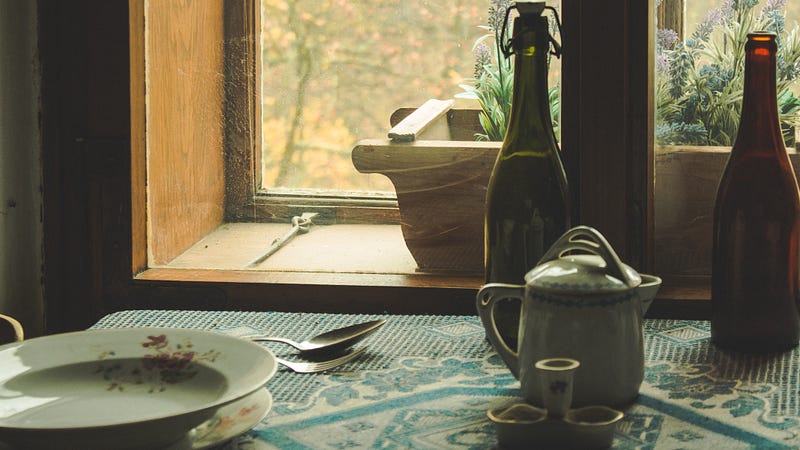
Admittedly, I don’t have a lot of good childhood memories. I didn’t come from a family blessed with money. My parents did alright—a bookkeeper and a teacher, but I didn’t live like kids whose parents did well for themselves.
I didn’t grow up athletically gifted. Didn’t have a wonderful, loving extended family, like others. What I did have, was books. Books came to define my life—my life is built around them. The objects and the manuscripts. I’m a bookseller, editor, and generally, whatever authors can talk me into doing for them.
My childhood, though, was a pretty lonely one. I don’t say this for sympathy fishing or misery porn—don’t get me wrong. I say this to explain why the clicking of a gas stove trying to light, and the smell of fresh peas, the feeling of garden dirt on my hands, is distinctly intertwined with my happiest memories.
Because, growing up, I had three interests—music, books, and cooking.
All of those came from the same place. My grandparents’ place. And particularly, my grandma’s kitchen.
Let me tell you something about my grandma—my Nanny, and Miss Maxine to the church family. She was an interesting woman. I’ve seen pictures of her when she was young—she was stunning. Tall, beautiful, kind, and a smartass. Her husband, my Pop, always said she was the lucky one, with tongue firmly in cheek—but even he knew.
A brilliant woman too—the first in her family to attend any kind of school after high school. She was a business school graduate, back when correspondence courses were just pencil and paper, to be mailed in. She became a factory worker, during World War II—when her then-boyfriend Paul took a trip over the Atlantic (and earned his nickname, Chuck, from that experience— “I had a great view of the Atlantic the whole way, looking down off the side the whole time”).
And, at the time, people could read for engineering exams. No degrees, nothing like that. And she did—became our family’s first licensed engineer. Spent the rest of her career in mechanical and industrial engineering. But, she worked for a cannery. It was decent money, but nothing they got rich off of. They lived in a small apartment when Pop came back, and Pop had the interesting fortune to be offered what had been a small military barracks for a song. They paid about $1,000 for that, and it became their home and would be their home, until their deaths.
I learned to cook in a renovated and retrofitted Army barracks, faced in brick, by my Pop’s hand—because he couldn’t afford to pay a bricklayer. He did it himself, after bartering some carpentry work for a spare load of brick.
And it was in that kitchen, that I learned to make scrambled eggs.
I was absolutely ruined for anyone else’s eggs. My Nanny could make restaurant-quality eggs without a second thought. And she taught me the secret, and one that’s stuck with me: mix the eggs with about a tablespoon of milk and a pinch of sugar and salt. Beat them until they’re completely smooth—and beat them a little more.
That’s it.
That was her first, deep lesson to me:
- Sometimes, the best answer to something isn’t what you expected at all.
We get wrapped up in how things are “supposed to,” be. And sometimes we forget that even if it isn’t readily apparent—the answer’s still probably right in front of us the whole time. And other times, all it takes is one last, big push, until you get to something great. Don’t give up too soon. Do it right the first time.
Miss Maxine was…something else. She was a church pianist. My mom learned to play from her, and became an organist. Mom at least tried to teach me piano. I learned anyway, and I’m the third pianist of the family.
She also really, really loved her pressure cooker.
I don’t mean one of the nice ones now, no. Not the electric ones that do all the work for you, when you’re canning vegetables. I mean the full-size, industrial-strength, cast aluminum monstrosities that would perch atop her gas stove—and sound like the inside of a steel pipe filled with Legos. Magnificent bastard of a piece of kitchen equipment (mom was always terrified it’d blast the lid off into the ceiling—which, if you didn’t know, can actually happen).
Also blows steam when you release pressure—ridiculously hot steam.
And my Nanny…she was many things, but not what you’d call a calm woman. She was a little high-strung—don’t sneak up behind her in the kitchen when she’s cutting something. I learned that one early when a 10-inch kitchen knife actually became embedded in the ceiling.
Another time, my Pop had come to be his usual sweetheart self and wrap his arms around her, and she turned around real quick and came pretty close to stabbing him. Pop took it in stride, gently removing the knife from her hand, “Jesus, if you wanted to kill me you could’ve done it before I proposed to you.”
“I just wanted to make sure you felt safe first.”
And y’all wonder why I’m like this.
No, by the way—I didn’t forget the pressure cooker. It was rattling on the stove. “You shoo, I need to check that,” she said, pushing him out of the way.
“No, I’ll check it,” and he went to the stove.
“Don’t touch that! It’s hot!”
“Well shit, I guess you can check it then. I wouldn’t want to burn myself.”
And there goes my Nanny, hovering her whole face over the pressure cooker and spinning valves with her bare hands—only holding them long enough to spin and not burn herself. My Pop just shook his head and smiled.
My Pop, for all his best qualities—also had severe PTSD, even until I was growing up in the 90s. But for her, and for my mom, her brother, and for me, he’d learned to manage some of his symptoms.
And I learned something about relationships that day.
- We all have our issues. The people who love us with our issues are the ones who really love us. They don’t expect us to change—but they’re the ones worth making changes for. Love is knowing you could accidentally get stabbed and still being happy it was them doing it.
Shortly thereafter, I had my second round of culinary education—pancakes. Something else I was ruined for everyone else with. She taught me that the secret to perfect pancakes, made in the grand Southern tradition is:
- More butter than you think you need.
- Buttermilk
For those of y’all who aren’t familiar with buttermilk—it’s really just, “milk that’s gone a little bad.” It’s milk that’s fermented, and traditionally, it was milk left behind in a churn, after separating butter from cultured cream.
As a concept, it’s kinda gross. As a baking ingredient—it’s hard to beat.
You get the fat, you get leavening from fermenting, you get the richness of cream, and you get a slight acidic bite.
And it makes wonderfully fluffy pancakes.
You can actually make your own in a pinch, too. She taught me that, too. One of the first science experiments I got to witness. She didn’t have any buttermilk that day—only whole milk, and fresh.
She taught me that, if you take a lemon, or some vinegar, and put about a teaspoon of liquid into a cup of milk—and let it set for a few minutes—it’ll work very nearly the same (pro tip: yes, works with milk substitutes too).
And that taught me something, too.
- Things may not sit right with you, on their own. Sometimes it just takes a different perspective—a mix with something that does feel right. The sweetness of a victory often includes something that, in the moment, seems very bitter.
These moments—and many like them—made an imperfect childhood something I treasure. Made by two imperfect people, for another one that they loved.
Shortly before she died—I was having a particularly bad day. And…while Pop was the emotionally-helpful one, she managed that day. She sat next to me, wrapped her arms around me, and said (god help her), the best thing she could think of—she quoted her favorite song: “Smile, and the whole world smiles with you.”
And as stupid as that was, and we both knew it, she just hugged me for a while. And I hugged her back. And there’s been few things in a life lived as imperfectly as I possibly can, that have comforted me quite so much.
It’s the effort. It’s the presence. Even if she didn’t know how to help me—she still did. More than she’ll ever know.
It’s why I write, really. The hope that, somewhere out there, there’s someone that needs the presence my words give—even if they’re not the best, and certainly not perfect, or even the right ones for the right time.
It’s my, “Smile and the whole world smiles with you.”
Of all people, I know much a gift that can be.
Almost as good as my pancakes.