
Everyone Has ‘The Me You Can’t See’ That Makes Life a Struggle
Oprah didn’t know PTSD affects people who suffer from childhood trauma.
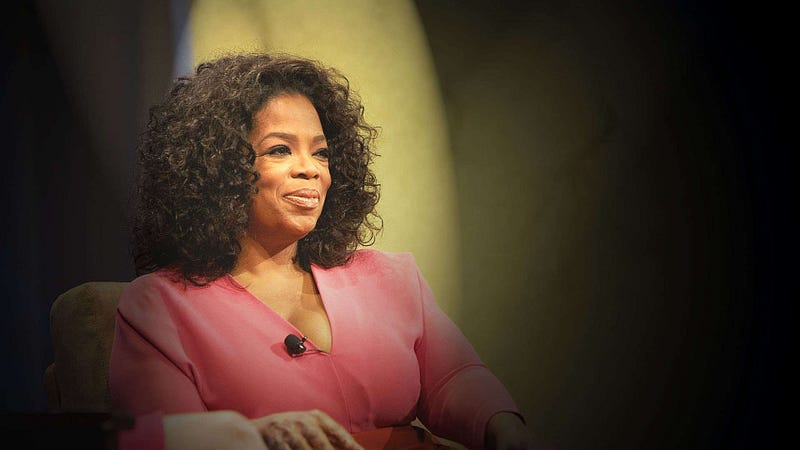
I thought Oprah knew everything. I thought Oprah knew everything about emotional pain. Especially when talking about childhood trauma and emotional abuse.
Oprah has been open and honest about the abuse she suffered as a child at the hands of several family members. She has done countless shows on depression, domestic violence, and childhood trauma, both sexual, physical, and emotional abuse.
I watched her latest special on Apple TV+, The Me You Can’t See, Oprah candidly admits (like only Oprah knows how to with humility and authenticity) that she didn’t know people can, and often do, suffer from post-traumatic stress disorder (PTSD) — the same veterans of war come home with — from childhood trauma, neglect and abuse.
I’m no neuroscientist, but I had a rocky childhood with a volatile father that taught me a lot about PTSD.
Oprah believes from her experience that if you just have one person who truly sees you and gets you, you can find value in yourself.
A teacher gave that value to Oprah.
When Oprah was around 9-years-old, Oprah’s mother made her sleep on the porch because the white woman she worked for didn’t want Oprah inside. Oprah’s mother and step sister’s skin was lighter than Oprah’s; thus, Oprah was made to sleep outside on the porch while her sister and mother were allowed to sleep inside. Her mother didn’t balk at this, or say one word, probably because she didn’t want to lose her job.
Oprah credits a teacher who believed in her, it was only when she met that teacher did she start to see value in herself. Oprah still acknowledges that teacher for everything Oprah is today. Her mission is to give that to other girls and women.
I used to watch The Oprah Winfrey Show a lot. Way before CEOs and heads of studios tuned in. When the show was raw and not as shiny and overproduced. Before the Oprah Book Club and Oprah’s Favorite Things List.
Towards the end of the long life of the show, it ran for over 25 years, Oprah gave away cars to people in desperate need. She selected girls from African orphanages to give them a private school education in a school Oprah built located in South Africa, The Oprah Winfrey Leadership Academy for Girls, aiming to send these girls to prestigious colleges around the world.
I sometimes thought when witnessing these events (often through tears because the receivers were so touched, as was Oprah), this isn’t going to turn out well.
You can’t cover up pain with things. If you could, I’d have the best mental health in the world. You should see my closet.
You can’t heal trauma by simply changing the situation, altering the atmosphere, or making life more comfortable with a new car or a new school, even if all your financial needs are taken care of by Oprah. The pain we suffer in the past comes with us until we heal it for ourselves. No one can do it for you.
Yes, you can meet a kind teacher or a mentor who can give you that bit of courage to believe in yourself — the seed necessary for survival — if you aren’t getting what you need from your primary caregivers, but you need to do the inside work yourself.
The pain we suffer in the past comes with us until we heal it for ourselves. No one can do it for you.
If you don’t wrestle with the past, it will color the future in many ways.
The Darkness of the Past
Oprah continues to live in integrity by exhibiting high emotional intelligence.
She admits she missed some things when she opened her private school for girls, personally handpicking each girl to receive an education.
During the second episode of The Me You Can’t See, Oprah acknowledges she wasn’t prepared for everything those girls lived through before she plucked them out of huts and traumatic experiences. Even Oprah didn’t know all there was to know about trauma and the life-long effects of PTSD, especially on girls of sexual abuse. She says she was ill-equipped and not ready when many of those same girls wanted to commit suicide when they later entered college.
Oprah has the biggest heart. It’s gut-wrenching watching her talk about this. Something she poured her soul into in an act of kindness, starting a school for girls, and then to have many of them not be able to get out from under the darkness of their past.
With her new series, she is tackling mental health, how it often lives in the darkness, how so many of us struggle with it, and what it really means to live with PTSD.
Her aim to take off the mask hiding mental health issues, is admirable. It is a huge problem in American. Only exacerbated by the recent pandemic.
Anxiety disorders are:
- The most common mental illness in the U.S.
- Affecting 40 million adults in the United States age 18 and older.
- 18.1% of the population every year.
‘The Me You Can’t See’
Oprah has teamed up with Prince Harry, Duke of Sussex, son of Prince Charles and Diana, Princess of Wales, in the series. The first episode features Lady Gaga sharing her mental health traumas and how she’s coped since, how she gets through it each day.
Oprah shines when trying to get to the bottom of these difficult topics that people rarely talk about openly and honestly.
Prince Harry appears extremely candid about the effect the death of his mother, Diana, had on him at the age of 13. He has new freedom to talk openly due to living across the pond from his overbearing family, near the beach in California with his Meghan Markle and their two children. I can’t think of a greater contrast than sunny Southern California and grey London. Having a handsome Prince talk about depression and anxiety with the Queen of talk is a great service.
I’m more than 100 percent positive they are saving lives.
PTSD — Hard to Control
PTSD is tricky.
A doctor on the show describes it like this,
When two things co-occur, a sight and a sound, your brain connect them. Literally, it makes a physical connection in your brain — pathways. It makes a memory.
But the lower part of the brain can’t tell time, so people who have developmental trauma from when they are younger, they’ve got all these little landmines in the lower parts of their brain, certain evocative cues, any reminder of the event will make them feel anxious and overwhelmed. They are very hard to get around.
PTSD is hard to get past but not impossible to cure.
Trauma gets trapped in the body. In our muscles, it is visceral.
You can become fully in control of your life if you acknowledge the reality of your body and all its dimensions.
Trauma isn’t all in one’s head but has a physiological basis.
Unresolved trauma almost always makes it difficult to engage in healthy intimate relationships. Whether someone has done something unspeakable to you or you’ve done something unspeakable to yourself, how do you trust again? How do you trust yourself and your decisions?
There are complicated reasons that have to do with the way the brain gets wired during traumatic events in childhood — that I won’t bore you with here. They have to do with the amygdala and the prefrontal cortex — and why those later in life who suffer from PTSD find it hard to control emotion.
That’s why mindfulness is often recommended to strengthen one’s capacity to monitor the body’s sensations first. It is how the body responds that is the first cue to how you will handle emotional stress.
If you tune into the body, you have a better chance of getting a handle on an automatic emotional reaction.
How?
One can access the nervous system through breath, movement, or touch.
That is why things like mindfulness meditation, yoga, and deep tissue massage are powerful antidotes to PTSD and everyday stress and anxiety. Breathing is one of the few bodily functions under both conscious and autonomic control.
For those who have suffered childhood abuse and trauma, their brains are literally re-wired, the threat-perception of the brain has changed. Physical reactions are dictated by the imprint of the past. That is why those who suffer from PTSD are often easily scared by an unexpected loud noise, like fireworks, someone scaring them for “fun,” or loud cars and sirens.
According to Bessel Van Der Kolk, M.D., author of The Body Keeps the Score,
The challenge is not so much to accept the terrible things that have happened but to learn how to gain mastery over one’s internal sensations and emotions. Sensing, naming, and identifying what is going on inside is the first step to recovery.
As boring and cliché as it sounds, learning to live in the present is one of the best practices to finding balance again and one of the hardest challenges for people with PTSD.
One reason that traumatic memories become dominant in PTSD is that it’s so difficult to feel truly alive right now. When you can’t be fully here, you go to places where you did feel alive — even if those places are filled with horror and misery.
Any practice that brings you into the moment; breathing, mindfulness, meditation, yoga, massage, exercise, anything that brings you joy, is one of the best practices to re-wiring the brain to a place not hijacked by trauma from the past.
Even Oprah didn’t know how PTDS can affect those who suffered from childhood trauma years after the incident if not resolved. Just like soldiers suffer with it, it is the same exact condition. Oprah is once again educating people by admitting what she didn’t know.
I’m not a therapist. I have had a lot of therapy. I practice mindfulness and nonreaction through meditation, yoga, weekly massage, hiking, being in nature to help me live in the now.
Resources
If you suffer from PTSD from past trauma and want to live a fuller life and not have your past dictate your moments, talk to a therapist. I highly suggest reading the book The Body Keeps the Score. It’s not light reading, but the information in it is powerful.
I also recommend checking the resources Tim Ferriss gives in his podcast detailing his childhood trauma, My Healing Journey After Childhood Abuse (Includes Extensive Resource List). I’ve read many of the books he recommends and know of the therapies he’s experimented with, and they work. Some of the exercises in the books are actually kind of fun.
By reading and educating yourself, you get to know yourself, and that is freedom.
Here is a list of resources.
Jessica is a writer, an online entrepreneur, and a recovering type-A personality. She lives in Los Angeles with her extrovert daughter, two dogs, and two cats.


