avatarNoorain Ali

Free AI web copilot to create summaries, insights and extended knowledge, download it at here

2257

Abstract

alogical</a> and focuses on things that are true. For example, in the above case, it would be:</p><p id="faab"><b>Who told you that you shouldn’t wear white at the wedding if you’re not the bride? Is it proven?</b></p><p id="f0fd">In this case, the person went into two or three levels deep into thinking rather than blindly accepting what others have to say. Aristotle found the “First Principles,” which means questioning everything until you find the truth.</p><h2 id="30e9">Step 2: Questioning, questioning, and questioning</h2><p id="574d">You must know if what you know is 100% true. For that reason, dig deeper down to the most fundamental truths. Talk about the white wedding dress, for example — find out where this idea came from, who came up with this, and why it is like that.</p><p id="699f"><a href="https://readmedium.com/5-life-altering-teachings-id-happily-give-my-younger-self-to-make-my-20s-worth-every-moment-ce8c195ca957">Dig deeper</a> into what you know. Elon Musk used the same principle for this SpaceX technology.</p><p id="61e6">When he was stuck with aerospace rocket manufacturers demanding 65 million to make rockets, he knew that he had to do something. Elon didn’t have a lot of capital to start buying rockets at 65 million and send them to Mars. So he indulged in the first principles and asked himself questions such as:</p><ul><li>What is a rocket made of?</li><li>What is the value of those materials?</li></ul><p id="236d">Rockets are made up of aerospace-grade aluminum alloys, titanium and copper, and carbon fibers, and they cost 2% of what the aerospace manufacturing company demands. Then, Elon Musk found an idea to find a rocket-making manufacturing business on his own.</p><h2 id="c6ba">Step 3: Push beyond your thinking limits</h2><p id="d2ca">The idea is to reconstruct and deconstruct.</p><p id="528f">In the above case:</p><figure id="1b8c"><img src="https://cdn-images-1.readmedium.com/v2/resize:fit:800/1*Loo0BkWJZYnYvyqniCDMnQ.png"><figcaption>Image by author</figcaption></figure><p id="159c">Start with the information you have and boil it down until you hit research that proves reality. In this case, Babylon’s tradition makes sense as to why white is only the color for the brides.</p><p id="7663"

Options

When making companies, you just don’t believe what others tell you. You do your own research. Hence, you dig deep into things and peel the layers until you are free from assumptions, myths, and lies. Proper research helps you to craft solutions properly, and those solutions are now based on research and scientific facts.</p><p id="3505">They basically let you see unique <b>opportunities that others miss.</b></p><h2 id="3903">Summary</h2><p id="6b27">Aristotle’s first principle is not a new concept but something that people practiced with Rene Descartes, the Roman Empire, Elon Musk, Peter Thiel, Steve Jobs, and many more.</p><p id="fa00">And it all started with erasing what you already know. Start from scratch. <b>Research, research, and research.</b></p><p id="75b1">Maybe that’s why smart businessmen often take research and psychology into action before making a product or service. Smart companies use polls and customer feedback to shape their systems because research is a solid foundation that can help you achieve remarkable things in life.</p><h2 id="c700">Final thoughts:</h2><p id="3f91">The best solution is not where everyone is already looking. Think differently because even ChatGPT can find a solution, but if all you do is Google and look at others’ work to find a unique solution, you won’t find the right thing.</p><p id="33eb">Ironically, perhaps the best way to develop cutting-edge ideas is to start by breaking things down to the fundamentals.</p><p id="f99a">Surprisingly, only a mere 1% of people truly understand the art of problem-solving, taking guidance from Aristotle’s principle. The rest still have trouble making solutions.</p><p id="c8dc"><b>Reference:</b></p><p id="2333"><a href="https://www.playforthoughts.com/blog/peter-thiels-principles">https://www.playforthoughts.com/blog/peter-thiels-principles</a></p><p id="6e1c"><a href="https://jamesclear.com/first-principles">https://jamesclear.com/first-principles</a></p><p id="a306"><b><i>Join 1,260+ writers and get your next writing inspiration <a href="https://noorainali.ck.page/2123325ad5">right now</a>.</i></b></p><p id="f4fd"><b><i>Or join Medium with my <a href="https://noorainali.medium.com/membership">referral link</a>.</i></b></p></article></body>

Everyone Faces Problems, But 99% Don’t Know How Aristotle Solved Them Effectively

Find the “why,” and you’ll find your “way.”

Photo by Hayes Potter on Unsplash

Elon Musk, Steve Jobs, and Peter Thiel inspired us with their inventions, but have you ever thought about who inspired them?

There was one person who initiated that, and that was Aristotle. Born in Athens, Aristotle was an ancient Greek philosopher.

From the beginning, Aristotle was fascinated by psychology and regarded it as the philosophy of the mind. Aristotle adopted his teachings from Plato, who was tutored by Socrates, creating a lineage of philosophical ideas passed down through the generations.

Aristotle is recognized as an influential person in the West due to his intellectual revolution and logical techniques. 2300 years ago, Aristotle came up with the “first principles” model, influenced by his tutors, to help people with complex problem-solving.

Here are four tips for integrating this 6th-century ancient model into our modern lives.

Step 1: Working deeper

There are two ways of thinking:

  • Analogical
  • Logical

Analogies focus on using widely accepted beliefs to make decisions. For instance, refraining from wearing white to your friend’s wedding because it’s a generally accepted practice to avoid drawing attention away from the bride.

Logical is entirely different from analogical and focuses on things that are true. For example, in the above case, it would be:

Who told you that you shouldn’t wear white at the wedding if you’re not the bride? Is it proven?

In this case, the person went into two or three levels deep into thinking rather than blindly accepting what others have to say. Aristotle found the “First Principles,” which means questioning everything until you find the truth.

Step 2: Questioning, questioning, and questioning

You must know if what you know is 100% true. For that reason, dig deeper down to the most fundamental truths. Talk about the white wedding dress, for example — find out where this idea came from, who came up with this, and why it is like that.

Dig deeper into what you know. Elon Musk used the same principle for this SpaceX technology.

When he was stuck with aerospace rocket manufacturers demanding $65 million to make rockets, he knew that he had to do something. Elon didn’t have a lot of capital to start buying rockets at $65 million and send them to Mars. So he indulged in the first principles and asked himself questions such as:

  • What is a rocket made of?
  • What is the value of those materials?

Rockets are made up of aerospace-grade aluminum alloys, titanium and copper, and carbon fibers, and they cost 2% of what the aerospace manufacturing company demands. Then, Elon Musk found an idea to find a rocket-making manufacturing business on his own.

Step 3: Push beyond your thinking limits

The idea is to reconstruct and deconstruct.

In the above case:
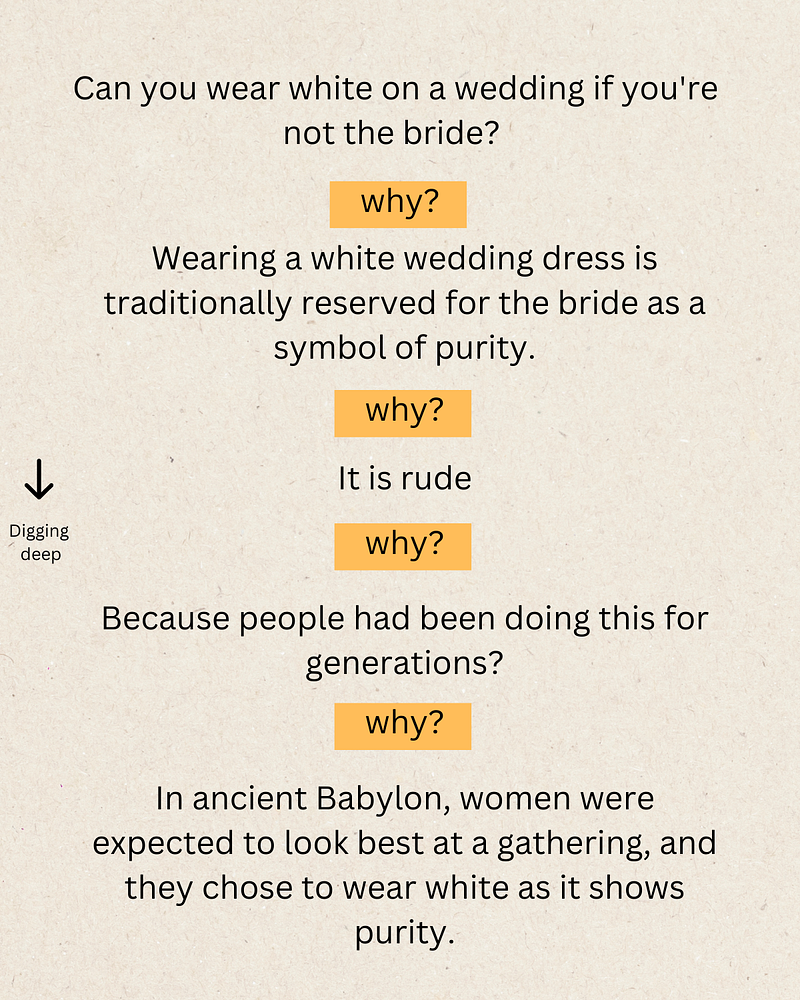
Image by author

Start with the information you have and boil it down until you hit research that proves reality. In this case, Babylon’s tradition makes sense as to why white is only the color for the brides.

When making companies, you just don’t believe what others tell you. You do your own research. Hence, you dig deep into things and peel the layers until you are free from assumptions, myths, and lies. Proper research helps you to craft solutions properly, and those solutions are now based on research and scientific facts.

They basically let you see unique opportunities that others miss.

Summary

Aristotle’s first principle is not a new concept but something that people practiced with Rene Descartes, the Roman Empire, Elon Musk, Peter Thiel, Steve Jobs, and many more.

And it all started with erasing what you already know. Start from scratch. Research, research, and research.

Maybe that’s why smart businessmen often take research and psychology into action before making a product or service. Smart companies use polls and customer feedback to shape their systems because research is a solid foundation that can help you achieve remarkable things in life.

Final thoughts:

The best solution is not where everyone is already looking. Think differently because even ChatGPT can find a solution, but if all you do is Google and look at others’ work to find a unique solution, you won’t find the right thing.

Ironically, perhaps the best way to develop cutting-edge ideas is to start by breaking things down to the fundamentals.

Surprisingly, only a mere 1% of people truly understand the art of problem-solving, taking guidance from Aristotle’s principle. The rest still have trouble making solutions.

Reference:

https://www.playforthoughts.com/blog/peter-thiels-principles

https://jamesclear.com/first-principles

Join 1,260+ writers and get your next writing inspiration right now.

Or join Medium with my referral link.

Self Improvement
Life Lessons
Psychology
Productivity
Mental Health
Recommended from ReadMedium