
Every Wedding Is a Low-Key Funeral
Prince Harry was right: An “I do” is also a “goodbye”
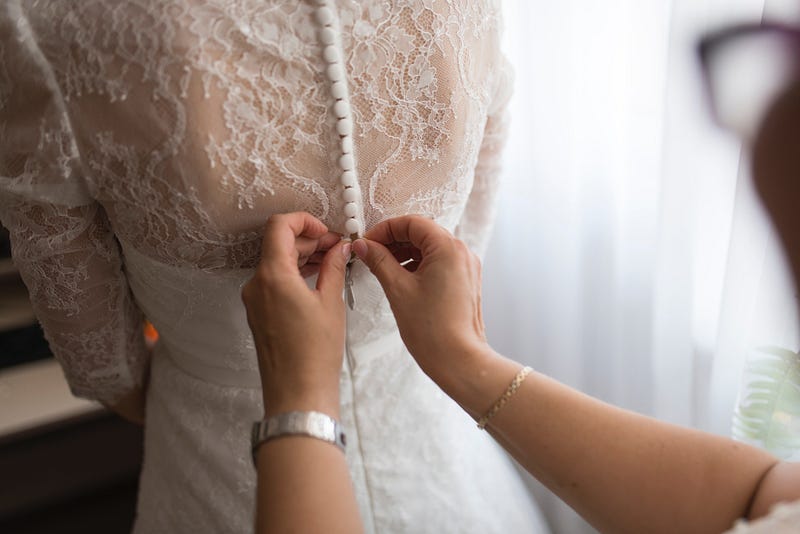
Goodbye. It was a sentiment Prince Harry felt at the weddings of both his father and his brother, as he shared in his recent memoir, Spare. He wrote, “…after saying their vows, people tended to disappear.”
It felt like such a relief to hear someone say it out loud. No one really admits this, after all. We love to pretend that weddings are the beginning of absolutely everything. The first day of the couple’s happily ever after. The beginning of their family. Their first step into forever.
But after nearly half a century, I’ve found that weddings signal much less happy beginnings for those surrounding the happy couple. How many of us will still be in their lives a year, two years, five years after they say “I do?”
Or perhaps it’s more accurate to ask what’s the likelihood of them still being in our lives in the future? It’s not typical that friends or family members suddenly fade away from a married couple’s life.
It’s more like what Prince Harry noted: It’s the people saying “I do” who tend to disappear.
If there’s one thing I regret in my life, it’s not (believe it or not) spending seven years with a man who ended up leaving me for a younger woman — it’s prioritizing him and our relationship above all else.
When I moved in with Lee that fateful October in 2009, my life drastically changed. His, interestingly, did not.
I gave up many of my hobbies because I felt I didn’t have enough time to pursue them and be a good housewife-in-training after I got home from work. Many of my friendships faded away because I wanted to spend as much time as possible with my partner and didn’t see any problem in canceling social plans if Lee suddenly decided he wanted to hang out.
Even if he hadn’t left me for a younger woman, I still would make very different choices if I could do it all over.
However, I feel no guilt about it even though I regret those decisions. After all, it was the water in which I was swimming, so to speak. That’s just the way it was.
By the time I was 35, there was one thing I knew for sure: My single friends would always be there for me. Until a new man came into their lives.
One of the saddest memories I have is the eighteen months that immediately followed Lee’s departure. Yes, part of that was grieving the loss of our relationship — and more to the point, the incredibly cruel way he ended things. But that time was also marked by a handful of friendships that ended in rapid succession.
Maybe there’s something about your mid-thirties that inspires breakups. Something like the seven-year itch? The almost-40 identity crisis? Who knows.
But it seemed to be a thing in my circle. At the time Lee left me, several of my friends had just gone through a divorce or breakup — and a few were about to begin that journey.
Despite the pain of it all, we found each other’s company to be a panacea for our woes. We were all going through the same thing and together, it felt like we could make it through the painful days of grieving to come.
Our friendships were strengthened. And during that time, I realized the mistakes I had made. I never should have thrown myself so wholeheartedly into the creation of my nuclear family ideal — one that hadn’t even come to fruition. All relationships were important, I came to understand. And relying on just one — a romantic relationship — for all my emotional needs, was not only foolish but detrimental.
I vowed to never make that mistake again and marinated in the closeness I was building with these friends.
And then one of them met a new man. As if a light had been switched off, she was suddenly gone from my life, only checking in via text every now and then. Six months later, she was walking down the aisle during an impromptu ceremony, and like Prince Harry, all I felt in my heart was: Goodbye.
I never heard from her again.
Like dominoes, each one of these friendships fell. I was deeply committed to all of them, but the moment a man entered the scene, the friends disappeared.
All of them were married within eighteen months of their divorces and breakups. And their weddings were the last time we saw one another.
When people ask if I’m close with my sister, I often joke, “Not really. I lost her to marriage and motherhood.” It always gets a laugh but a strained one from those who are married. Only other single people really get it.
Despite my bad jokes, the truth is, it’s not easy. It’s not easy to live in a world where we encourage people to disappear into couplehood. It’s hard on the people who once loved those individual members and no longer have access to the person they once knew. And it’s hard on the people in the couples, who are often pressured to give up parts of themselves in order to fit into typical standards of couplehood.
I’ve made a lot of changes in my life — and in my heart — to be more balanced in my relationships. When I dated after Lee, I kept prioritizing my friendships and made it clear to the men in my life that I wasn’t going to put my friends on the back-burner.
But I’ve found myself largely alone in this endeavor. It doesn’t seem to be an issue for most.
Knowing that, I found myself battling fear and insecurity when my dear friend Sunny met a man last year. I wanted it to work out — she deserves to be happy — but I didn’t want to lose her.
As the months went on, my opportunities to see her vastly diminished. She spent three weekends a month with her boyfriend and reserved the fourth weekend for friends and family. As such, if I wanted to see her, I’d have to fit into whatever window of time she had available. It was both frustrating and scary.
I shared my worries on three different occasions. “I’m afraid I’m going to lose you to this relationship,” I said, assuming my words would inspire a deep conversation that might reassure me. But each time, she laughed and said, “That’s ridiculous.”
I didn’t press her on the issue.
Things got super serious between her and the boyfriend this past spring, a time I needed my friends more than ever. She wasn’t there.
We haven’t spoken since.
I’m not sure she’s even noticed.
This is something I want to talk about. There is grief in the way we do relationships.
But people don’t seem to like to talk about this. They either deny it’s an issue, or they remind me that being a spouse and a parent is hard, isolating work.
I realize there is truth in that…but I don’t think it has to be that way. We know how isolating the nuclear family structure is — and how damaging that can be to our mental health. (It’s not doing our financial health any favors, either.)
We don’t have to live this way. We choose to.
We could return to family structures that include members of the extended family. We could choose to keep our friends closer and allow them to participate in our family life, as we participate in theirs.
Instead, we keep an insistent grasp on the status quo, holding everyone but spouse and children at arm’s length. It’s almost as if we’re afraid that piercing the membrane of the nuclear family in order to expand our definition of family will somehow destroy our sense of security. (As if we ever really had any.)
And if that’s too much to ask, then maybe we could just make room for the inherent grief that comes with our friends’ and family members’ entrance into marriage. Because in this culture, it is, as Prince Harry said, a “low-key funeral.” If everyone plays their part, those outside the partnership are about to lose a loved one. Someone is going to disappear.
Let us weep about it. Maybe even give us a shoulder to cry upon.
Because a wedding is never just a beginning. It’s an ending, too.
© Yael Wolfe 2023
Yael Wolfe is a writer, artist, and photographer. You can find more of her work at yaelwolfe.com. If you love her writing, leave her a tip over at Ko-fi.
More on friendship:


