
Every Photographer Should Read “On Photography”
An Amateur Revisits Susan Sontag
In 1977, Susan Sontag published On Photography, a series of essays that had appeared from 1973–77 in The New York Review of Books. This noted writer, essayist, and general “public intellectual,” upended photographic criticism. I have found nothing like it since. It is dense with insight, epigrammatic in her typical style, yet approaches its subject like a series of military sorties. It returns from each attack with new insights, yet these don’t necessarily follow an arc of argument. It’s been called a series of meditations on its subject, and I think that is accurate. It’s the most important book on photography I’ve ever read, despite being something of a struggle to get your mind around.
For many who read it shortly after its publication, it was a revelation, approaching photography on its own mysterious terms. Cornell Capa, director of the International Center of Photography, wrote in 1978, that “the whole volume shakes from anger and frustration. It tries to wake us up to the fact that 150 years after photography’s discovery, we still do not know the power and the failure of what we have.”[i]
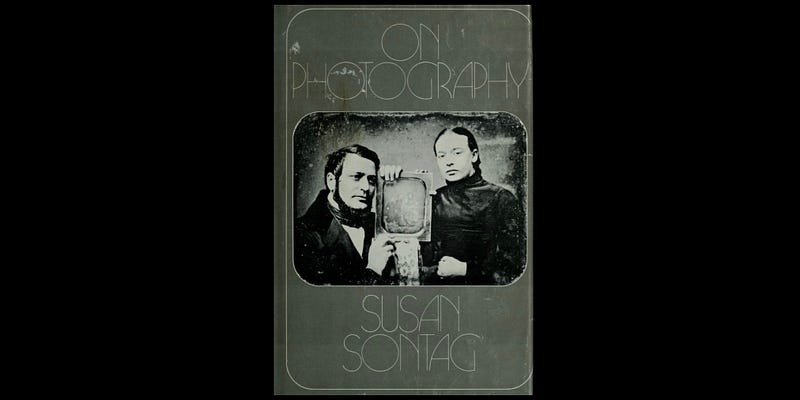
On Photography won the 1977 National Book Critics Circle Award for Criticism and appeared on the New York Times list of the top 20 books for that year. In 1998, however, Michael Starenko wrote in the magazine AfterImage that the book’s critical legacy was certainly mixed. With 20 years’ hindsight, he asserted that the diminishing number of citations of the book “show that On Photography is not a book that today’s critics, scholars and anthology editors feel they must cite or otherwise credit… On Photography has little or no recognized standing within the theory and criticism field.” Yet he admitted that “allusions” to the book still permeated criticism.
Who knows? Photography is not an esoteric subject, and any single book still quoted today, almost 50 years later — and which is still such a part of the literature on such a topic of general interest — certainly made a dent.
I’ve searched in vain, however, for any discussion of Sontag’s own involvement in photography. She writes as a critic, not as a practitioner. Part of her argument is how ubiquitous photography is in everyone’s life, yet it doesn’t seem to have been a part of hers.
In 1989, Sontag met Annie Leibovitz. They never lived together, but the two were lovers and partners until Sontag’s death from cancer in 2004 at the age of 71. I’ve listened to interviews with them both. Still no mention of Sontag’s personal involvement in photography. In another article, I wrote that she sees cameras “as instruments of aggression, seduction, obligation, documentation, commemoration, and so on,” but not as objects of lust in themselves. She is not attracted to the camera itself. It’s fair that we practitioners might conclude that hers is the voice of a critic or observer, not really one of us.
I’m not sure exactly how that matters, but I think it does. It provides distance. Her thoughts are about the sea of images in which modern society swims. She talks about the process of creating images as a social force. She talks about individual photographers as explorers in a larger territory.
Maybe I’m reading into this more than she says, but what Sontag does seem to appreciate, even as a non-participant, is the photographer’s ambivalence about, frustration with, and delight in, the whole photographic enterprise. Is it art? Is it craft? Is it technology? Does it trivialize its subjects? Does it ennoble them? Is it real? Is it imaginary? Yes. All of that.
She gets there through criticism and analysis. We photographers get there through experience.
This is why I think that all serious photographers, especially amateurs (who are, after all, in this game only for themselves), owe it to themselves to read her book. Sontag does not address photography as a photographer, so that kind of familiarity doesn’t bias her judgments. She discusses the photographic world as shared reality, as a layer imposed over all human experience, like language. No single analytical line can do it justice, and she doesn’t attempt one.
The Essays
For the rest of this article, I’m going to try to summarize Sontag’s book for those who have not read it. As in her book, there are no illustrations. I admit her ideas can be heavy going. I certainly admit I may be wrong in my interpretations. For those who care to join me, however, I hope it’s worth the time.
In Plato’s Cave was the first essay, published in 1973. As the title suggests, it is about the relationship between photography and reality — photographs are like the shadows of real things projected on the wall of Plato’s imagined cave. This essay is the most fun to read. It can hit you with the shock of seeing something familiar as if for the first time.
In the first pages, she says “[t]o collect photographs is to collect the world,” and “[t]o photograph is to appropriate the thing photographed.” This is the old superstition of the stealing of souls.
She talks about the “aggression” of photography: “[i]mages which idealize (like most fashion and animal photography) are no less aggressive than work which makes a virtue of plainness (like class pictures, still lifes of the bleaker sort, and mug shots).” She is acknowledging the complete atomization of life through still images.
Sontag also discusses the difference between still and moving images, how that famous picture of the naked napalmed girl in Viet Nam is more powerful than a video. “Photographs may be more memorable than moving images, because they are a neat slice of time, not a flow.” The picture of that girl “probably did more to increase the public revulsion against the war than a hundred hours of televised barbarities.”
As a photographer, I feel this too. Each photographic image, no matter how bad, can be emotionally important, as if it has a life of its own. I have always hesitated to erase any file or throw away any print, especially if it is of someone I know, especially if it is of family, especially if it is a picture of a departed one.
On travel, she gleefully nails how photography has transformed the vacation. “Travel becomes a strategy for accumulating photographs.” “[S]top, take a photograph, and move on. The method especially appeals to people handicapped by a ruthless work ethic — Germans, Japanese, and Americans. Using a camera appeases the anxiety which the work-driven feel about not working when they are on vacation and supposed to be having fun.” How true.
America, Seen through Photographs, Darkly, the second essay, begins her exploration of the optimism and the pessimism of photography. Sontag starts with Walt Whitman’s blurring of the line between what is beautiful and what is ugly — the heroic promise of American reality, that everything is new and full of potential. That photography can idealize anything, she says, like Edward Steichen’s milk bottle on a tenement fire escape. “There is probably no subject that cannot be beautified; moreover, there is no way to suppress the tendency inherent in all photographs to accord value to their subjects.”
“I do not doubt but the majesty & beauty of the world are latent in any iota of the world.” Walt Whitman, Leaves of Grass
We have all taken a close-up of a leaf, a shell, a broken bottle. As photographers, we all know how easy this is. Sometimes the result is good, often it’s indifferent, sometimes just pretentious. This attempt to find the beautiful and meaningful in every subject is a perennial theme in photography, but that ambition is doomed by photography’s opposite, pessimistic tendency.
The rest of this essay is mostly about Diane Arbus, a photographer discussed perhaps more than any other in this book. Sontag’s immediate purpose is to contrast Whitman’s optimism with the dystopia that followed WWII, a dystopia Arbus incorporates in an entirely personal, non-intellectual way. Arbus’s obsession with the private, the hidden, and the dangerous isn’t moralistic. Arbus isn’t moralizing about her freaks and nudists and mad people. They are just there. She concentrates on victims and the unfortunate, “but without the compassionate purpose that such a project is expected to serve. Her work shows people who are pathetic, pitiable, as well as repulsive, but it does not arouse any compassionate feelings.” Sontag concludes that Whitman’s heroic vision of photography isn’t necessarily inherent in the photographic enterprise after all.
I think Sontag’s larger purpose in dwelling on Arbus, aside from chronicling the disenchantment with photography that inevitably followed the optimism of Alfred Steiglitz and Edward Steichen and Paul Strand, is to emphasize photography’s ability to find a unique personal vision in the opposite, pessimistic direction. To this day, no one duplicates Arbus. She saw a reality that literally no one else sees, or has ever seen, using a medium that supposedly tells only the objective truth. It isn’t style at all, it’s her psyche expressed in images.
Melancholy Object, the third essay, explores photography as surrealism. To introduce the subject, Sontag’s opening pages discuss the longings of the middle class of the early 20th century to experience, or at least to photograph, the mysteries of poverty and wealth. The two extremes — destitution and opulence — are equally exotic to the middle class.
True surrealism blurs the lines between art and life. This, Sontag states, is the natural domain of photography, which is why the bourgeois can use it to participate vicariously in the unknowable, and presumably lurid and exotic, lives of the rich and poor. They do not necessarily want to break down the barriers between themselves and these other classes — they just long to visit them vicariously, voyeuristically, through photography.
“The view of reality as an exotic prize to be tracked down and captured by the diligent hunter-with-a-camera has informed photography from the beginning, and marks the confluence of the Surrealist counter-culture and middle-class social adventurism.”
Photography was not, however, acknowledged as a natural surrealist medium at the time. Instead, as Sontag asserts (and I agree), that surrealist painting — to which photography was subordinate — was actually burdened by being a fine art. Painting is too deliberate and painstaking to be like the automatic writing of the Surrealists. The virtuosity of some of its proponents further complicated matters by making paintings that were “sleekly calculated, complacently well made, undialectical.” I remember that my Art History professors could barely mention Salvador Dali’s name, considering him nothing but a talented draftsman with a narcissist’s talent for self-promotion. The photographers who actually dabbled in what they considered surrealism — Man Ray and László Moholy-Nagy — produced largely unremembered fringe techniques like solarization, Rayographs, and multiple exposures.
In short, the deliberate efforts of the surrealists to create surrealist images inevitably failed because of all the effort they were going to. The effortlessness of photography produces surrealism automatically, just because it is effortless.
But that doesn’t mean that photography’s surrealistic tendencies produce great art: “In principle, photography executes the Surrealist mandate to adopt an uncompromisingly egalitarian attitude toward subject matter. …In fact, it has — like mainstream Surrealist taste itself — evinced an inveterate fondness for trash, eyesores, rejects, peeling surfaces, odd stuff, kitsch.”
This is, I think, her ultimate judgment on the matter. That the preoccupation of postwar photography with impermanence, with arbitrary collages and pastiches of found objects, and with a desire to dispatch the present into the past by taking its picture, robs it of any moral or artistic relevance.
I was at a meeting of the American Photographic Artists a little while ago, where participants (all decades younger than I) shared self-published photo books they allegedly liked. Most of the content seemed, to me, trivial and deliberately random, unpictorial if you will, like the junk images of surrealism. Is it a style? I once attended a lecture by Jacques Lipschitz where he posed the question, “Is there good art and bad art, or just art and not-art.” He came down for good art and bad art, as I do.
But I believe that these young photographers may have been trying to approach the surrealistic nature of photography that preoccupies Sontag. Perhaps their neo-surrealist photography is part of this tradition. But I don’t think it’s any kind of great art.
The Heroism of Vision, essay four, turns to the opposite position: discovering beauty through photography — finding beauty in all sorts of photography: in aerial images, macro close-ups, Edgerton’s splash of milk, whatever. Here Sontag explores the pride of the mid-century photographer in seeing things in a fresh way. The excitement of “seeing for seeing’s sake” that marked what we might call the classic era of photography. Edward Westin, Aaron Siskind, Minor White, Ansel Adams.
Photography has been plagiarizing painting and encroaching on its territory from Fox Talbot on, Sontag argues, until ironically painting moves on, perhaps chased by photography, retreating from realism to become deliberately abstract. Photography’s aspirations to be “art,” to compete with realistic painting on its own terms, seems ironically to have chased art away into impressionism, cubism, abstract expressionism, and the rest of the 20th century art “isms.” Photography’s subsequent attempt to follow suit — to pursue the abstract, meta-reality — turns out to be fruitless. As Sontag writes, “it is in the nature of a photograph that it can never entirely transcend its subject, as a painting can.” Photography followed painting into realism, but could not follow painting away from realism.
The efforts of America’s classic period of photography to set new standards for seeing indeed produced much of the century’s best work. The heroic images of Edward Weston and the modernist views of Cartier-Bresson, in different ways, argued for an optimistic, entirely photography-centric, approach to vision. Weston, Ansel Adams, Henri Cartier-Bresson, Minor White, Aaron Siskind — all found order everywhere. This New World Vision — what Sontag calls “the overoxygenated hopes of modernism” — of course resulted in an obligation to keep finding something new, which ultimately led it to peter out. But she admits: “Behind the modernist’s belligerent stance of aesthetic purism lay an astonishingly generous acceptance of the world.”
Sontag continues in this vein to discuss how photography’s affinity for finding beauty everywhere is not limited to the work of artists as such: “[A]n unassuming functional snapshot may be as visually interesting, as eloquent, as beautiful as the most acclaimed fine-art photographs.” Anyone with a camera can produce beautiful images.
Then she compares this optimistic heroism with the ennui and pessimism of later years, post-Ansel Adams and the rest. Photography always seems to be swinging back and forth between optimism and pessimism. “For photographers there is, finally, no difference — no greater aesthetic advantage — between the effort to embellish the world and the counter-effort to rip off its mask.” This rings true.
The essay could end here, but it doesn’t. It ends by inserting morality into the mix, saying that the best writing on photography has always been by moralists who are “hooked on photographs but troubled by the way photography inexorably beautifies.” That writers are typically enlisted to define what is said in the photograph, as James Agee was for Walker Evans’s Let Us Now Praise Famous Men, which documented the lives of poor tenant farmers during the Depression. The moralists demand that a photograph actually speak its meaning, which it cannot. Captions are the answer of the moralists, but every caption is an interpretation — a layer of meaning that the photograph doesn’t have by itself.
“The reason that humanism has become the reigning ideology of ambitious professional photographers — displacing formalist justifications of their quest for beauty — is that it masks the confusions about truth and beauty underlying the photographic enterprise.”
What I think she is talking about here is an applied heroism of vision (the title of the essay). If the image doesn’t speak for itself, we will speak for it and tell you what it means. If an image doesn’t live up to the heroic level of Weston or Adams, we’ll just add captions to insist that it does, or publish average photographs of some socially self-important subject (poverty, war, climate change) in exhibits and venues intended to elevate their otherwise middling importance by the context which we insist they have.
Photographic Evangels, essay five, is about the quixotic battle to understand photography decades after the heroic certainties of Stieglitz and Steichen.
The essay starts with how photographers, no matter how eminent and seemingly secure, invariably write some sort of manifesto on photography’s moral and aesthetic mission. And they give contradictory accounts of what they know and what they are up to.
Sontag asserts that the need to justify photography never goes away, even after almost 200 years. And that we, as serious photographers, still seem confused about what we do. At the moment of exposure, are we focusing our consciousness on our subject, or acting with Zen-like indifference? Either way, Sontag asserts that in “later years” (remember, she is writing in the 1970s), there’s usually a professed distrust of intellect and a confidence in the photographer’s intuitive judgment. We still want to justify photography, but we are getting ever more confused about even the terms of the debate. We take refuge in our gut feelings.
Always ready for another barb, she also points out, “Despite their reluctance to say so, most photographers have always had — with good reason — an almost superstitious confidence in the lucky accident.” We are all guilty as charged.
But despite the anti-intellectualism, the myth of the heroic photographer persists — at least in the photographer’s own mind. As she charmingly describes, the photographer sees himself/herself as “the homeless private self astray in an overwhelming world — mastering reality by a fast visual anthologizing of it.” I love it.
The predatory and benevolent uses of photography are also hopelessly mixed. Is it the photographer as hunter, or the photographer as savior? You never can tell. Some photographers, she notes, seem to lessen the appearance of aggression by shunning the latest tools, retreating to old cameras and old lenses as a point of honor. This is amusing from our 21st century, digital point of view. For us, just using film is “shunning the latest tools.” Photography always seems to have its hipsters to scoff at the latest gizmo, pretending to an innocence the technology-inclined have presumably lost.
The debate over art continued, of course. Before the 40s, Strand and László Moholy-Nagy professed to be indifferent to whether photography was art or not. After the 40s, photographers snubbed the whole discussion. Indeed, by the 70s, Sontag was able to say that “a good part of the immense prestige that photography has acquired as an art form comes from its declared ambivalence toward being an art.” A neat trick.
The subliminal comparisons to painting persist, such as in the reluctance of some photographers to let their images be printed to the edge of the page: “[W]hen professionals object to having their photographs printed to the edge of the page in books or magazines, they are invoking the model inherited from another art: as paintings are put in frames, photographs should be framed in white space.” I find this a bit snarky. Layout is a graphical choice, not inherited snobbery.
Sontag continues this theme of photography as art, concluding with a discussion of the general dematerialization of art in the late 20th century, in which finally conceptual art — the creation of temporary earthworks or Christo’s packaging of buildings — exists primarily as its photographic record in museums and galleries. This is a really interesting point. With conceptual art, what begins as an artistic idea is translated temporarily into fact, then into a surrealistic afterlife through photographs.
She ends with the concept that photography is at base a language, and that that language can contain anything from a passport photo to a work of art. Photography tends to push any subject in the direction of art. She puts it succinctly: “Photography, though not an art form in itself, has the peculiar capacity to turn all its subjects into works of art.”
The Image World, the sixth and last essay, is a long meditation on the relationships between images and reality — a recapitulation of themes elsewhere in the book. We are almost to the end here, and I find this essay redundant of other ideas in the book and generally hard to follow.
I am not sure I can agree with, or even follow, the essay’s initial premise: that the recedence of religion in the 19th century did the reverse of what was expected: that it caused the rise of the importance of images rather than the decline of images (such as religious icons). Sontag asserts that “a society becomes “modern” when one of its chief activities is producing and consuming images.” I think that’s true insofar as modern societies achieve their hegemonies more through the consensus perceptions of their citizens than through naked power. But I’m not sure what this means for photography.
Be that as it may, her point is made in her first example. She supposes that if the fantasy choice were offered between (1) a portrait of Shakespeare that Holbein had somehow lived long enough to paint, and (2) a primitive image of Shakespeare taken by some sort of prototype camera, we would always choose the photograph. And with good reason. We would be depriving the world of another Holbein masterpiece (presumably), but the photograph would not only tell us what Shakespeare really looked like, it would be a trace of him in that almost superstitious way, “like having a nail from the True Cross.” This is the opposite of Plato’s deprecation of the shadows on the cave wall. It’s the idea that the photograph is reality in some sort of mystical way, her initial point in essay one.
What she is getting at is the evolution of the authority of the image. Prior to Plato we have the primitive “world of sacred times and images,” in which the object and its depiction participate magically in each other. Then Plato disparages the image as only a pale reflection of reality. Now photography comes along, and the image is not only like its subject, it is a part of, and an extension of, its subject.
After much discussion of the centrality of images today, of the contradictions and contrasts between the personal and the public uses of photography, between open commercial use and repressive authoritarian use (Communist China), Sontag closes with her famous reference to today’s world as requiring an ecology of images.
If there can be a better way for the real world to include the one of images, it will require an ecology not only of real things but of images as well.
Conclusion
Every time I dip into this book I get a little more out of it. Yes, it’s dense, often random, sometimes contradictory, occasionally indecipherable. But as a photographer I find it consoling that Sontag, a non-photographer, wrestles with the same frustration I have over the whole photographic enterprise. That critics don’t find On Photography to be real criticism is beside the point. I agree that it’s a series of mediations, not an argument. Sontag is saying that, while there is never going to be a right answer about the questions photography raises, there is certainly a hell of a lot to discuss.
I don’t mean to trivialize, but I propose that we all go on our merry ways as amateurs, doing what we want to do, but that we keep in mind the many ideas in this book. Sontag never proposes a “right” way to photograph. She does not come down on the side of beautification or social realism, of surrealism or classicism. She emphasizes the precariousness of any of these as a deliberate posture. But as we work, her insights should remind us to think more deeply about what we are doing.
What makes photography different from “art” is its hugeness, its relentlessness, its dynamism, and its indifference. I used to be frustrated that my pictures weren’t art. That each one wasn’t worth a frame and a wall. And that there were far too many! But that’s the point. Photography isn’t an art, it’s a language that has a space for art. I feel like Dani Rojas in Ted Lasso, who insists “Football is life.” Yes, and photography is too. That’s all we can say.
REFERENCE:
Sontag, Susan. On Photography (pp. 127–128). Farrar, Straus and Giroux. Kindle Edition.
[i] Cornell Capa, letter to the field. March 11, 1978


