
Ever Fallen in Love With A Fictional Character?
Psychology and neurosis from the cutting edge of love and imagination
The power of love is a curious thing… or so Huey Lewis would have us believe. I think he’s under-egging the pudding on this one. It’s complicated beyond measure on both a philosophical and psychological level. It underwrites a huge amount of our creativity and has been a driving force in human evolution since we climbed down from the trees wondering whether we should harness the hot bright orange crackly stuff for our own ends.
Many of us are in loving relationships, or multiple permutations therein. Love is so complicated we’ve had to create multiple versions of it. The love you feel for your partner is different from the love you feel for your children, the love for your children is similar (in some cases) to the love you feel for your dog. Some people love objects, some people really really love objects.
You love objects you once imbued with personhood too… you may not have thought about it.
Consider whether you could throw away a beloved doll or teddy bear from your childhood without a second thought. Cognitively, the adult part of your brain knows it is cloth and plastic with beads for eyes, yet many of us keep these toys around the house or safely in the attic to revisit later on.
My own bear, Tedders, is awaiting the potential arrival of my own crotchfruit (should I choose to have any). He will be bequeathed to my eldest as he was to me from one of my own parents. The bear, originally a Sooty doll from the late 1950s has been gummed to death across two childhoods twenty-five years apart. He’s missing an eye and lost his smile and may be harboring bacteria not seen since the 1980s, but that’s a bridge we’ll have to cross when we get to it.
He’s got zero chance of being thrown away.
These are artifacts that helped us through childhood, we call them transitional objects. They were safe places we could put our feelings and explore what it meant to exist independently of our parents. They were comforting and in many ways our first proto-friendships. One does not simply bin a childhood love, Pixar has made billions out of this.
They help children make the emotional transition from dependence to independence. They work, in part, because they feel good: they’re soft, cuddly, and nice to touch. They’re also effective because they are familiar. It has their scent on it, reminding them of the comfort and security of their room. It makes them feel everything is going to be OK.
Here’s a free helpful tip for parents. Get two. Rotate them early.
Rationally, as adults, we know throwing away our toys is possible and our feelings are silly but that’s not enough to override strong feelings of attachment and love. Huey Lewis was on to something.
Could we define love for an alien species interested in finding out about our motivations? I’m not convinced we could. We might be able to identify the psychological processes at work, we could track hormones and predict outcomes — but that’s trying to define home by describing the outside of a house.
Perhaps some might think, and by some I mean me, love is an emergent intangible property of consciousness.
Let’s talk about loving the Penguin
There’s something about my cuddly avatar which causes people to announce that they love me on this platform. It’s interesting, though, of course, I know these people are joking. Nevertheless, I’m not sure these people would announce their love so freely if I weren’t fictional.
The cute cartoon character I’ve picked to represent my digital self, in tandem with my snarky writing style generates what is probably a cute-aggression response. For someone like me, interested in what identity does to discourse, this is worthy of more thought.
So can you love a fictional character? I think so. I know so.
I know because I used to be that person. Not a day went by when I didn’t fall in love with some fictional character or other in my childhood. I was a voracious reader — part of the reason I find words so enjoyable as an adult. I read for hours at a time every day of my own accord.
In my school, silent reading was a punishment. Hah! Fools.
I’m not saying I engineered discord in classes so that we would be punished — but let’s say the young Penguin had a manipulative sociopathic streak that ironically flew under the radar. My class spent a lot of time reading. Twenty-eight pissed-off kids muttering under their breath and one happy Penguin dancing around in magical worlds.
Was it any wonder I fell in love with vast amounts of fictional characters?
Stick with me, it’s going to get weird for a bit — but then it’s going to get better because I went away and got a Psychology degree to explain my weirdness. This is the primary reason anyone studies Psychology.
Let’s begin by defining what we’re not talking about.
We’re not talking about loving a character because of the function they perform in a book. That’s different. We’re not even talking about loving a particular story or what happens within it. There are plenty of stories I love, and plenty of characters whose function in the narrative I can get behind. I love the things they say and do.
But I didn’t miss them when I closed the book. That’s what I’m talking about.
While others around me were lusting after celebs, I was primarily attracted to a handful of confusing characters. How can you develop your sexuality when your secret attraction is to a young squire, a girl called Alanna who spends most of her time in the Song of the Lionness series dressed as a boy. How was I generating trans-drama before it was even mainstream?
And don’t even get me started on being attracted to Aslan. Penguins and Lions? It could never work.
What’s happening under the psychological hood?
Children having ill-advised crushes isn’t a new thing. And when the internet arrived, I was delighted to find I wasn’t alone in crushing on fictional people. Having spent much of my childhood trying to avoid being sectioned, it was somewhat of a relief to find I was in the bell curve for ‘normal’ — whatever that happens to be.
Attraction to fictional characters is a form of paraphilia called Fictiophilia. It’s not recognized in the medical textbooks but, of course, has its own flag in the LGBTQ+ community. One I absolutely will not be waving. I consider Fictiophilia to be normal in creative children, but something we grow out of as we get older or it becomes maladaptive.
For the record, Fictiophilia sits alongside its even more hilarious cousin Schediaphilia. An attraction to animated characters. I’m pretty sure that 90% of manga aimed at teenagers is designed for this purpose.
One of my ex-Penguins spent much of their childhood crushing on Simba from The Lion King. ‘The adult one’ they hastened to add, ‘crushing on the young Simba would’ve been weird.’
You have to admire the logic there.
Many children experience attraction in this way. It can be a safe way to explore complex feelings without the threat of real involvement. Like having a driving test for love without any of the danger of crashing your metaphorical genitals before you’re ready.
But it comes at a cost, and as someone who writes in the dystopia genre this outcome was entirely predictable — here’s a video worth watching if you want to see the dark side of imaginary love.
The reason for fictiophilia, particularly in books, is both simple and complicated. As often is the case with Psychology, the answer lies in our brains, and to be more accurate the answer lies within our right-hemisphere Supra-marginal Gyrus.
Which, in case you cared, is one of half of the inferior parietal lobule, the other half being the angular gyrus. The Supra-marginal Gyrus plays a role in phonological processing, spoken and written word, and emotional responses.
It may be the reason you hear voices when you read even though there are no voices to hear. Neat huh?
This tiny section of our brains is an integral part of our mirror neurone system. Our mirror neurone system helps us to read body language and vocal tone and allows us to know how other people feel. It gives us some of their feelings and helps us better calibrate our response to them. You can see why this might be handy for a burgeoning primate species with world domination on their minds.
If our mirror neurone system is underdeveloped, we can become sociopathic, overdeveloped and we become a floppy mess of empathy. It’s a balancing act.
Get a nice balance and you’ll function well. Most of us can help people in distress without getting swept away. We feel happy when people we like are happy but also have our own emotional boundaries in place.
From soft-touch to hard-hearted we’re all on a spectrum… but most of us negotiate childhood and land in the bell curve rather than outside.
Why fictional characters help you develop relationships
Humans are capable of suspending our disbelief for short periods of time. Kids are far better at this than adults. Without this skill, TV, film and theatre would be unwatchable and I’d be out of a job. We’d feel like we were always watching an illusion and never a real thing. We enjoy getting swept away.
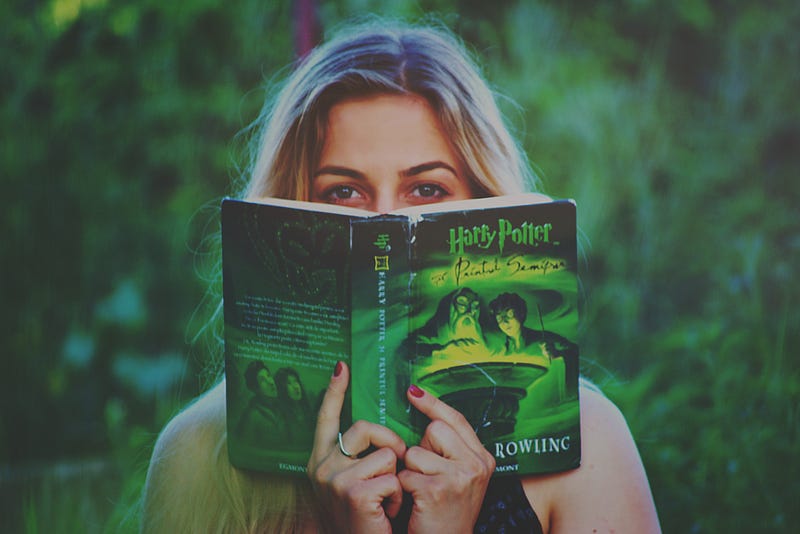
When you suspend your disbelief you see real people operating in a world with its own rules. When those characters engage in those worlds with behaviours we intuitively know to be important we pay attention. That’s why Harry Potter is so compelling to those who choose to read it.
Only when the film, book or TV show ends are you able to return to a normal place.
But books, in particular, do something special — and the shift away from reading towards watching TV and film may be a stupid move. I have concerns about low levels of empathy in future generations of young people. Youtube, which also gives people compelling windows into other lives, lacks much of the moral direction many books imbue in their young readership.
When reading, we play an active part in the story rather than simply passive observers. Empathy only comes from feeling what others feel.
In many books, children see and experience the world from both inside and outside of a character’s mind. You hear about their hopes and dreams, you see their flaws and their entire psychology is laid bare. You get to know them as though they are your friends and you develop a closeness that may not be easily accessible in the real world.
This is a very powerful thing for a child to experience.
What should you do if you’re in love with a fictional character?
Nothing. If you’re approaching sixty and haven’t had a real human relationship because you’re holding out for Eric from the Little Mermaid, you might want to see a therapist. If it doesn’t interfere with your life then crack on with it.
You’re not doing anyone any harm and when he’s finished with Ariel, he may be yours one day. Keep the dream alive.
For those of us who are writers, there’s an argument that we can use this skill too. One of the reasons I know that I’ve written a good script or a good play is that I have strong feelings for the characters. I’m not in love with them. But I do feel for them. I have empathy for them.
When I kill them off, I often have overwhelming feelings of sadness. That would only be possible if they are real. The sadness I feel is then mirrored when the scripts are performed. If I don’t feel it, the audience won’t either.
If you’re generating real feelings about your own characters then chances are that you’re going to generate those feelings in other people too. You have written something real and tangible.
You know it will affect others because it has affected you.
Falling in love with characters is part of a healthy developing psychological model of love. It’s an interesting part of the human condition. It shows that your mirror neurone system is active and in good nick. It also demonstrates, to me at least, that the written word is far more powerful than we ever imagined.
I still struggle to shut books and I’m refusing to read Pratchett’s ‘The Shepherd’s Crown’ because I know it’ll devastate me. Soon. I promise
More Penguin psychology?