
Evaluating Returns, CAGR style
Not that you asked, but the largest gain is not always the best performer
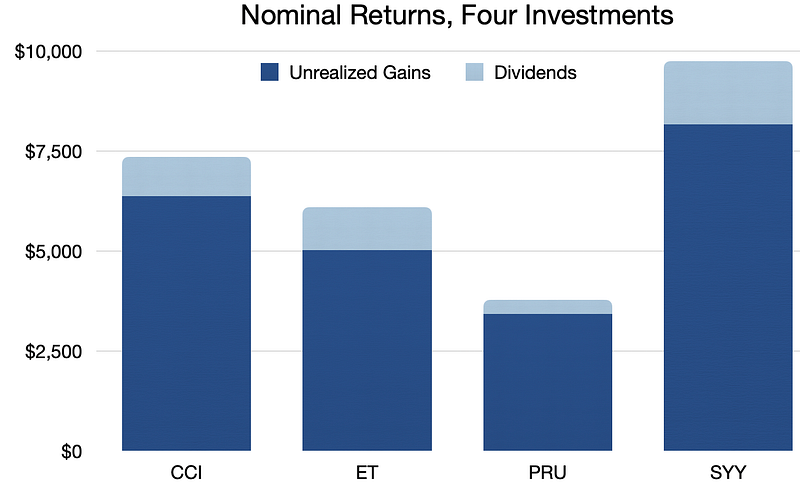
When evaluating financial returns from investments, one burning question is how much did I make? This is typically expressed in nominal terms.
Nominal refers to the face value without regards to any other influences, such as inflation or market. For example, a $1 bill from 1998 has a nominal value of $1, the same as a $1 bill from 2020.
From the chart above, in nominal terms, SYY has the best results to date. No one is mad at a $9 thousand gain. How much did I make is an important question, as those monies are what will be used toward your investment goals.
Which one has the best returns?
SYY was purchased in July 2012, and the latest addition to the group is PRU, purchased in September, 2020. That is eight years of growth that SYY enjoyed before PRU entered the picture.
The cash investment in PRU, though, was 38% higher than SYY, but 50% lower than the investment in CCI.
Knowing that the start dates and the starting values differ, which of these investments had the best returns?
A fair evaluation can be used using Compound Annual Growth Rate (CAGR).
Use the CAGR calculation to determine the annualized rate of return of a single investment, or when comparing investments. There are countless online calculators, or perhaps use a spreadsheet. There is no need to memorize this, the formula is:
((Ending Value ÷ Beginning Value) ^(1/number of periods)) -1
Number of periods could be days, months, years, or whatever is meaningful. The periods below are in years.
ET technically pays a distribution and not a dividend. The word dividend will be used for simplicity.
The annualized return rates without dividends are:

In nominal terms, SYY is the winner. ET leads the small pack in terms of annualized returns, though. The rankings do not change when adding in dividends (which are not re-invested).

As an aside, ET was a risky investment, and riskier investments can pay off bigger or perhaps tank. It was purchased in March, 2020, when most of the market was down in response to COVID-19. ET was not intended as a long term investment.
SYY was purchased with a long horizon planned. It is a stable company which pays a stable dividend. It is a dividend aristocrat, a term for S&P 500 stocks which have increased their dividends annually for a minimum of 25 years.
PRU and CCI fall between those two in terms of assumed risk and assumed holding time.
Comparing Results
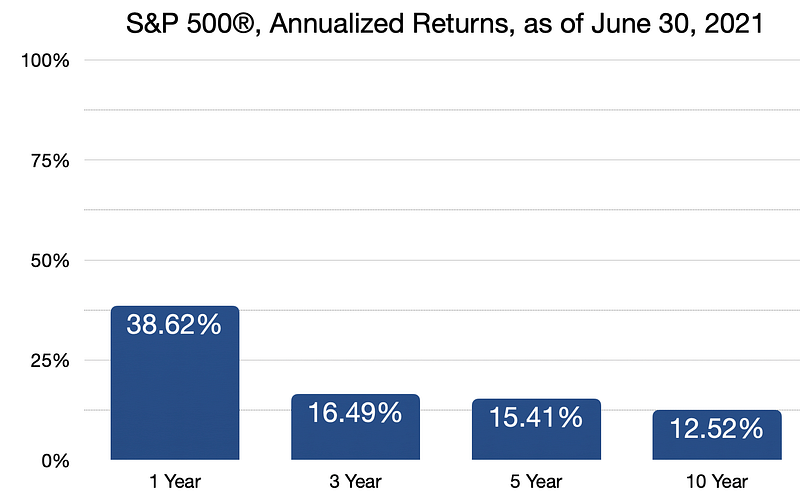
Comparing results to the broader market can give guidance as to whether what you invested in is worthwhile, or perhaps you are better off investing in an indexed fund or ETF. One of the standards to compare against is the S&P500. (This is not stating that the S&P 500 is the metric to beat, but it is a reasonable benchmark.)
The CCI, ET, and PRU investments are comparing favorably against the S&P 500 results for their time frame, 1–3 years.
The SYY investment was bought nine years ago and has a CAGR of 12.85% in that time. That compares to 12.52% for the S&P500 over the last 10 years. They are roughly tracking each other.
Why hold SYY when a broader and more diverse basket of stock has nearly the same returns?
That is outside the scope of this article. Without being sidetracked too much, part of that evaluation is why was this purchased initially? Answer: Dividend growth.
As noted, SYY is a dividend aristocrat, raising its dividend every year for at least 25 years. For the purpose of this investment, that stability is wanted and the dividend growth is wanted.
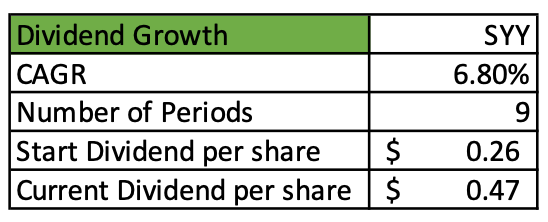
And the dividend growth rate of this stock since buying it is an enticing 6.8%. How is this known? CAGR.
Take aways
- It is easy to calculate the change in nominal dollars an investment has achieved
- To understand how well an investment is doing, using CAGR can provide better insight to its performance over time
- It is also useful for comparing different investments (including market indexes), which might have different start dates or different start values
None of the above are recommendations as investments or as endorsements of the companies. The stock tickers are identified for context. Investing in any asset is a personal decision which you make for yourself.
The Latest Stories From Money. Daily.
- The Linguistic Bait and Switch of Climate Change
- There Is No Labor Shortage
- The Necessity of a Checking Account
- Stop Dreaming About Student Loan Cancellation.
- Dividend Reinvestment in Action
This article is for informational purposes only, it should not be considered Financial or Legal Advice. Not all information will be accurate. Consult a financial professional before making any major financial decisions.