
“Europe’s Conscience”: Fridtjof Nansen, the right to food, and Ukraine
Coverage of Russia’s invasion of Ukraine often underscores how important Ukraine is to feeding people across the world. According to Roman Leshchenko, the country’s Minister of Agrarian Policy, “For centuries, Ukraine has been known as ‘the breadbasket of Europe.’ This title is entirely accurate, given that Ukraine is home to around a quarter of the world’s super-fertile ‘chernozem’ or ‘black soil.’”
Here’s a helpful explanation of chernozem for kids from Kiddle.
The name combines the Russian terms for black and soil, earth, or land (chorny + zemlya). In 1883, a Russian geologist first identified chernozem in the Russian steppe or prairie. Called “mollisol” in the US and abundant in the midwest, chernozem contains rich organic material as well the minerals crops like grains, soybeans, corn, and sunflowers need to flourish.
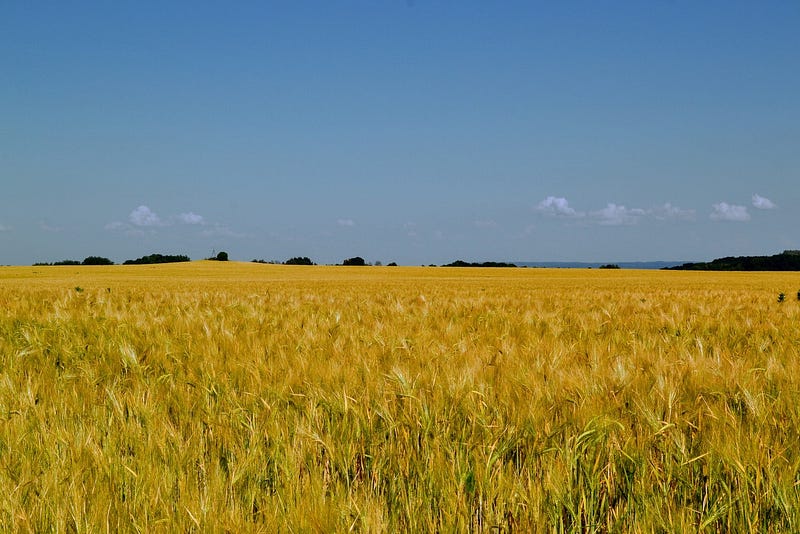
Prior to the Russian invasion, Ukraine was among the world’s top three grain exporters. By 2019, Ukrainian agricultural exports fed people in China, Egypt, India, Turkey, and across the European Union.
No more. Because of the invasion, Ukraine has banned exports of wheat and other key staples. If Ukrainian farmers can’t start sowing soon, the effects could be catastrophic for world markets and humanitarian aid.
Already, rising food prices have sparked demonstrations in places like Sudan. Ngozi Okonjo-Iweala, the head of the World Trade Organization and Nigeria’s former finance minister, recently cautioned food-producing countries against hoarding existing supplies as a result of the invasion. She pointed out that rich countries often hoard what they have (as some did with COVID vaccines), leaving poor countries to face disaster.
Many African countries depend on Ukrainian food. “It is poor countries and poor people within poor countries that will suffer the most,” she noted.
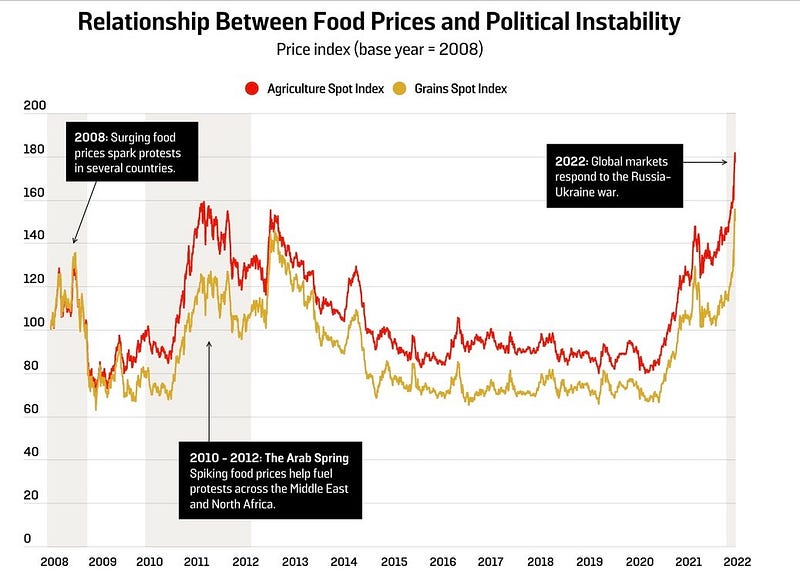
Ukraine also provides half the wheat to the United Nations’ World Food Programme (WFP), which provides emergency supplies to countries in conflict or experiencing natural disasters. Already underfunded, the WFO now faces a terrifying bargain, in the words of executive director David Beasley. “We have no choice but to take food from the hungry to feed the starving and, unless we receive immediate funding, in a few weeks we risk not even being able to feed the starving. This will be hell on earth,” Beasley said during a trip to Yemen, where the WFP provides food assistance to 13 million people every month.
What does war or food hoarding or famine or chernozem have to do with human rights? Simple. Access to food is a human right recognized in the 1948 Universal Declaration of Human Rights as well as the legally-binding 1966 International Covenant on Economic, Social and Cultural Rights. This right is also protected by regional treaties and many national constitutions.
Here’s another thing I learned while researching my new book, Righting Wrongs, which profiles 20 human rights heroes from around the world. Many famines — possibly most of them — do not occur naturally, but are caused by human beings. In fact, one of my heroes, Fridtjof Nansen, helped organize a world response to another famine caused by war.
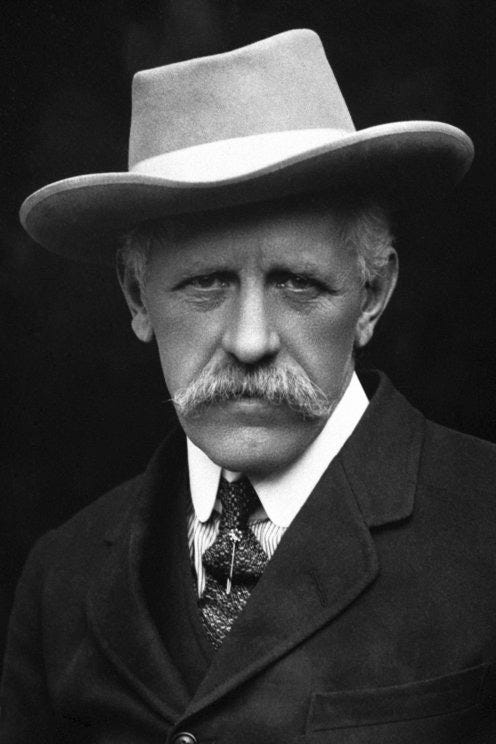
Nansen was an unlikely human rights champion. In his early career, he was a scientist and polar explorer. After making the first recorded crossing of Greenland, in 1893 he set off in a carefully designed ship to reach the North Pole. Nansen not only outfitted the Fram (Norwegian for “forward”) like a five-star hotel, with plentiful food and liquor. He made sure that the shipwrights had reinforced the wooden hull so that it could withstand getting frozen in the ice he hoped would eventually carry them to the North Pole, making the first recorded arrival.
The plan didn’t work. But unlike contemporaries like Sir Ernest Shackleton, who lost his ship, the Endurance, or Robert Falcon Scott, who died along with his companions, Nansen returned alive along with his entire crew.
I think that experience must have helped prepare him years later to become the world’s first High Commissioner for Refugees, named by the League of Nations (the short-lived precursor to the United Nations). Appointed in 1921 in the wake of World War I (1914–1918), Nansen’s first task was to help Russian prisoners of war return home. The League gave him no money, so Nansen and his staff partnered with groups like the International Committee of the Red Cross to send aid.
He’d learned a lot from outfitting the Fram. As a humanitarian, his challenge multiplied across a devastated Europe, with hostile nations still at war. He demanded, cajoled, and pleaded for private and government donations of funds, trains, food, clothing, and medicines. In less than two years, Nansen helped send nearly 500,000 prisoners of war from twenty-six different countries back home, giving the League of Nations one of its first real successes.
But there was always a new challenge. The civil war following the 1917 Russian Revolution meant hundreds of thousands of new refugees. Many couldn’t return since they faced imprisonment or execution by the new Communist regime. Nansen not only had to find a way to house, feed, and clothe families, but also find countries willing to accept them permanently.
Here’s where the past seems eerily like the present. The same year Nansen was appointed, the new leaders of the Soviet Union (formerly Russia) seized the wheat harvest, causing a massive famine. Nansen spent months trying to convince Vladimir Lenin, then the leader of the revolutionary government, to let the international community help. Nansen showed the same stubbornness that brought him to Greenland and the North Pole.
Personally, Nansen traveled to famine areas to conduct interviews and take photographs, hoping to persuade potential donors. “The famine in Russia is worse than words can describe,” he wrote. “Millions of human beings are being tortured slowly to death by hunger and cold.”
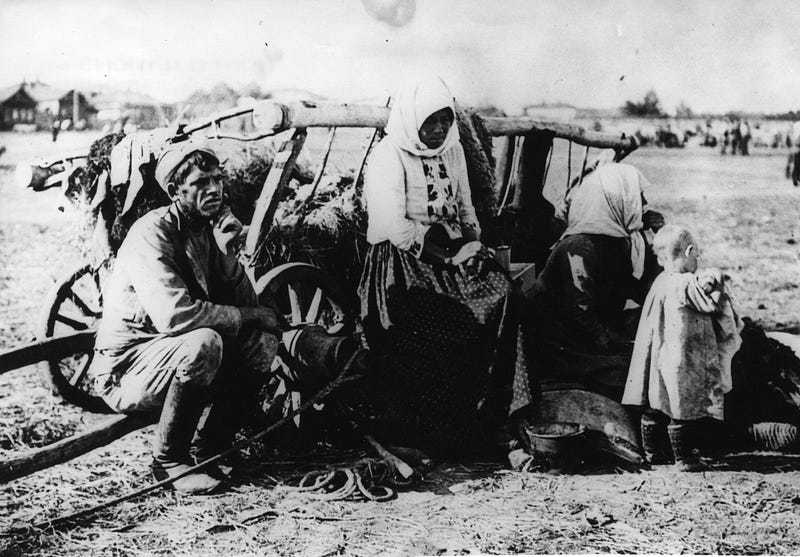
To the League of Nations, Nansen argued that for the cost of a single battleship, they could save hundreds of thousands of lives. “In the name of humanity,” he wrote, “in the name of everything noble and sacred to us, I appeal to you who have wives and children of your own, to consider what it means to see women and children perishing of starvation.”
Nansen was later awarded a Nobel Peace Prize. His work also earned him the informal title of “Europe’s conscience.” After Nansen’s death in 1930, a former colleague summed up his life: “Every good cause had his support. He was a fearless peacemaker, a friend of justice, an advocate always for the weak and suffering.”
Here’s the Righting Wrongs chapter heading for my Nansen profile.
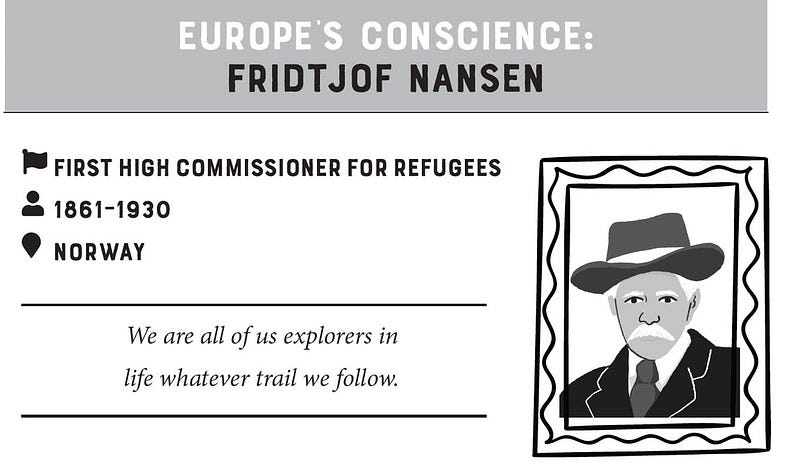
I say a lot more about Nansen in Righting Wrongs: 20 human rights heroes around the world, available starting in June 2022. Until then, please join me in supporting the groups assisting the needy, including all refugees, around the world.
- International Rescue Committee: Founded at the call of Albert Einstein in 1933, the IRC works in over 40 crisis-affected countries as well as communities throughout Europe and the Americas. The IRC delivers lasting impact by providing health care, helping children learn, and empowering individuals and communities to become self-reliant, always seeking to address the inequalities facing women and girls.
- World Central Kitchen: Founded by renowned chef José Andrés, WCK started with a simple idea at home with my wife Patricia: when people are hungry, send in cooks. Not tomorrow, today.
- Nova Ukraine: This Ukraine-based NGO provides humanitarian aid to the people of Ukraine. This includes emergency humanitarian assistance and supporting people outside Ukraine calling for international support for the Ukrainian people.
Finally, this is a great explainer on Ukraine by the wonderfully amazing John Green.