
Europe in the age of geopolitical platformisation
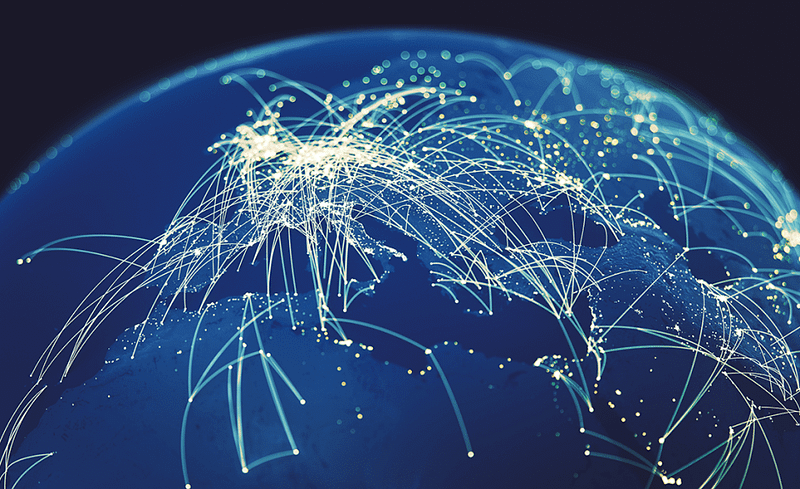
Amazon, Alibaba, Google, Baidu — all of these digital players have become global giants thanks to the platform economy and its network effects. The more users they have, the more data and information they obtain, the more tailored services they can offer and more efficiencies they gain. This in turn brings more users, and the cycle is repeated. Bigger becomes better — size does matter.
You can shut down your Facebook account, but if all your friends are on it, you’ll miss out on what’s happening in their lives. You can stop using Google, but your search results are likely to be, let’s say, sub-par. These platforms hold power.
To some degree, the same holds true in politics. Power comes from numbers. In democracies, it’s about who can attract the most votes and form stable governing coalitions. In dictatorships and authoritarian countries, it’s about who can shape and dominate elite networks. It’s about who can be the magnet, connecting different actors and stakeholders into a platform. Even in chimpanzees, the alpha male wins his position not by mere violence, but by forming social connections and stable alliances.
The liberal world order combined with globalisation saw a lot of players arguably being part of the same platform — the UN, the WTO, the World Bank. Of course, there were still regional and thematic specifications (EU, NATO, SCO), but there wasn’t really a challenge to the overall existing western-led platform.
These days are long gone.
The US-China hegemonic struggle and beyond is in essence a grand conflict of geopolitical and geoeconomic platforms. Because platforms are run by Lenin’s raw dictum kto kovo — who dominates whom. Who is the platform, who is the platformed? Who is the gatekeeper and who the gatekept, forced to take the rules of the platform designer or risk elimination?
Platforms mean power. If you lose access to the largest financial transactions platform — the SWIFT banking system — you ain’t getting paid. If you can’t access certain high tech trade platforms, such as semiconductors, your industry will grind to a halt. If you rely on the Russian energy platform, and Putin turns off the gas pipe, you risk a cold winter.
This is what the issue of decoupling between the United States and China is all about. Neither wants to be on the other’s platform for fear of losing information (data), influence, and independence. China’s dual circulation strategy is a platform rotation strategy. It’s about retreating from foreign platforms and advancing its own platforms. It means increasing trade influence with its Belt and Road platform, promoting Chinese digital infrastructure (think 5G and Huawei), and becoming a leader in industrial standardisation, because whoever owns the standard, sets the platform, and owns the market. All the while decreasing US chokeholds in the tech sphere (especially semiconductors) and reducing exposure to US financial markets.
China’s tech crackdown has many different facets, but one is that Beijing doesn’t want Chinese companies listed on US stock exchanges for fear of their disclosure requirements which could provide the US with important information and data. So, it is discouraging Chinese firms from foreign IPOs while opening the doors to foreign investors to invest in China. Wei Li, chief investment strategist at the BlackRock Investment Institute put it aptly: “If you want to get China, you have to go to China”.
The US in turn is trying to counter China’s platform drive. Washington has asked allies in the world to shun China’s 5G infrastructure offers and Biden is proposing a Build Back Better World (B3W) infrastructure initiative to counter China’s Belt and Road.
Alas, this isn’t the simple two-bloc platform confrontation that we saw during the Cold War. The world is currently full of competing, overlapping, messy different platforms with different actors connected in myriad ways to each other. In the currency world, there is even a state-avoiding neutral blockchain finance platform with Bitcoin. The world is made up of a complex geopolitical cat’s cradle.
And this is where Europe’s endless discussion on “open strategic autonomy” comes in. Under this slogan, Europe aims to become its own autonomous platform. But this is a defensive mindset that is mostly seen from a prism of moving away from the US. And the narrative is strategically faulty in my view. In a world of platforms and connections, autonomy can equal being alone. And being alone in such a world, is a dangerous place to be. Instead of being autonomous, you want to be a platform that attracts, connects, and brings people together.
But if Europe strives to be a platform, will it compete with the US platform? Or can these platforms join in a larger ecosystem? This is the crux of the matter in the transatlantic alliance and the China debate. I don’t believe China’s platforms can be countered with separate individual platforms, but only when like-minded allies come together and join hands.
The question then becomes, however: who controls and manages the alternative platforms to China? Or can separate EU-US-X platforms join in a larger ecosystem? What framework would this need to take and how could such a platform be co-shaped?
The danger is that nobody wants to be relegated to a simple user and decision-swallower in the platform. Two recent examples that show the difficulties in finding a common approach. First, Afghanistan. The Afghanistan debacle speaks volumes. The US retreat done without any organisational-logistical coordination within NATO was a disaster. It demonstrated utter disregard for European allies. Biden has shown that US presidential style has changed, but not substance. The Financial Times was right to argue that “Joe Biden and Europe are going different ways”.
Second, Biden’s B3W. As mentioned in my earlier post, Biden has tried to enlist Europe in joining a counter-initiative against China’s Belt and Road. But instead of pro-actively joining this effort, the EU has sped up its own infrastructure alternative with its connectivity strategy. Particularly the Build Back Better World narrative was seen as too US-centric, and Europe is now desperately searching for an adequate title reflecting Europe’s budding infrastructure platform. But competing in the infrastructure space against each other and the Belt and Road initiative is pointless.
Both, the EU and the US, need to re-evaluate how they can better promote common platforms. I can see two strategies. The first is to increase buy-in in existing platforms. For existing platforms, like NATO, it should be as simple as the European partners manning up. If you want more say in an organisation, put your money where your mouth is and invest appropriately. The EU and its member states talk but don’t walk a big game; it’s all about rhetoric, little about resources. This is one reason why the EU is not a geopolitical player.
The second is creating shared overlapping platform with a common agenda — a kind of Open-Ran interoperable platform. For the connectivity strategy countering China, there is a need to have an overarching framework with an overall common strategic goal while leaving implementation to respective platforms and self-defined narratives (possibly even dedicating certain regions to each platform). This is what the counter to China’s Belt and Road could look like — the EU with its connectivity platform (for example responsible for Africa, Middle East, Eastern Europe, and Central Asia), Japan with its infrastructure initiative (responsible for Southeast Asia), the US with the B3W (responsible for Latin America, Africa, and Southeast Asia), as well as other actors such as Australia, India, South Africa, etc. and all jointly discussed and coordinated with common standards and goals in a larger G7+ framework.
The geopolitical platformisation of the world is messy. It is going to take conceptual thinking and time. Both of which there is too little of. But it is the only way to remain an actor with agency, a ruleshaper, rather than the ruled.