
Tribute For My 89-year-old Dad, Pastor, and Missionary
My model of non-toxic leadership
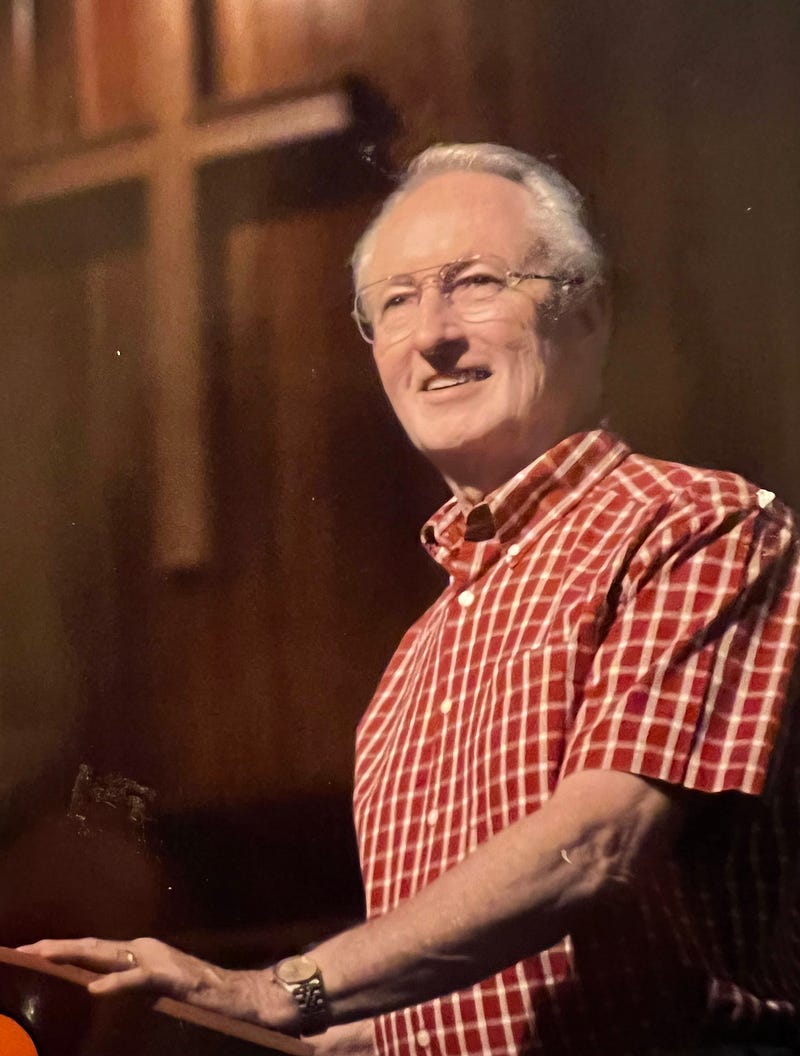
Who knew that a Baptist missionary from the ’60s era could be so counter-cultural? We usually think of those men and women as being antiquated and irrelevant, usually imposing their western ideals on the natives.
I’ve heard plenty of horror stories of missionaries abusing their power — and saw some of it first-hand as well. However, there were some who really cared for the people they ministered to, and one of them was Dad. Sometimes it got him in trouble because, like today, other Christians had very narrow views of how things should be done.
I was raised to think for myself, to question the notion that “things have always been done this way,” and Dad encouraged me to seek a degree in theology. That was rather countercultural for a young woman growing up in the ’60s as a Baptist missionary kid.
But you see, Dad, even though he was raised as a farm kid in Nebraska, he was always thinking outside the box. Sometimes that got him in trouble with colleagues who were threatened by his innovative stances and care for the local pastors.
I guess, as white men in power will do, they feared losing their influence and power. Not Dad, though. He loved seeing others flourish.
In a classic move, Dad encouraged women to take leadership in his church and got flack for it, with some choosing to leave over that issue. He simply said, “I don’t want to stand before the Lord and have him ask me why I ignored half of my congregation.”
Innovative problem-solving
One of the first things he noticed as a young missionary in his 30s was the plight of Brazilian village pastors who could not make a living wage from the support of their poor congregation. But it was against the mission policy to help them because they feared those pastors would become “rice Christians” — those who came to faith for material benefits only.
Those pastors, needing to feed their families, joined the Southern Baptists because they paid them a salary. This miffed the Conservative Baptists, incensed that they were losing pastors to their rival mission. Naturally, this created a division on the field between the two Baptist faiths.
At the time, the Conservative Baptist Mission had as its goal to make the local churches independent of missionary support. In other words, Dad was supposed to work himself out of a job and hand the church over to a Brazilian pastor. Yet oddly, there was no plan in place to make that happen.
Taking those two objectives— the financial need for poor village pastors and helping missionary-run churches become independent, Dad came up with an ingenious plan. He asked missionaries who took no salary from their Brazilian churches to begin doing so —and then send it on to the Brazilian Baptist convention for them to distribute those funds to the poor pastors.
It solved two problems at once —churches learned to fund a pastor, and become independent of foreign aid, while also sending money to struggling pastors.
Walking away
In Portugal, Dad did what he always did — built consensus, showed love and consideration for the local pastoral leadership, and encouraged them to take leadership. Consequently, he was invited to teach at the Seminary, be the keynote speaker at a Baptist convention, and be the pastoral representative to the Portuguese youth.
In a very short time, Dad became known as the “Pastor of Love.”
However, when Sam, the former missionary, got wind of this, he came out of retirement and returned to Portugal, hell-bent on “setting things right” as he saw it. He was quite miffed that he had never — in over 20 years of service — been invited to take any kind of leadership apart from the church he ran.
He was jealous of dad, who accomplished in just a year or two what he had never been able to do. Instead of applauding Dad’s work, in a typical toxic move, Sam wanted to shut it all down, claiming that the mission should not collaborate with the local Baptists.
The conflict between dad and Sam escalated to the point that Arno, the mission representative, came over to mediate. Unfortunately, he took Sam’s side, and collaboration between the mission and the local Baptists came to a halt.
It all came to a head when Sam shouted, “My enemies are your enemies!” Like a true narcissist, Sam had created enemies where there were none and demanded full loyalty to himself, even if it meant the destruction of the very thing he claimed to support. With no backing from the mission, it was the final straw. After 25 years of dedicated service, Dad threw up his hands in defeat and left the mission field — for good.

Finding Common Ground
When Dad took up a pastorate in Utah, he was glad to be finally free to implement his ideas without interference. It was considered the back of beyond “Mormon country” where no one wanted to go. All Baptist churches in the area were small, and the one dad took on had only about 130 in attendance.
The first thing Dad encountered was a militant Christian group called “Saints Alive.” Their goal was to warn Christians that the Mormon faith was a cult and wanted Dad to support their cause and spread their message. Most Evangelical churches in the area, after all, were known to be anti-Mormon. They thought they had a shoo-in with Dad.
After a brief look at their videos and listening to their diatribe and hateful speech, it became clear that they thought that spreading hateful messages about Mormons would win them over to their side. Some things never change…
Dad declined to participate, which irritated Saints Alive. He just shrugged his shoulders and moved on. He wanted no part of a toxic approach to creating a fortress mentality among Christians.
Instead, Dad took his missional thinking to those in his congregation who had been Mormons and asked what kind of things would appeal to them.
Magee: Because of our setting in Utah, we’ve structured ourselves to be accessible to Mormons. For instance, we use hymns that Mormons use, such as “How Great Thou Art.” We also call our midweek activities “family night.” When we built our new building, we included a gym, because many of the Mormon wards have a gym where they focus their activities.
Our biggest difficulty is getting people to reach out. Non-Mormons can feel ostracized, and it’s easy for a church like ours to become a safe fortress. We have to guard against the siege mentality. Recently we’ve offered an adult elective titled “Cross-cultural Living in Utah” to help people avoid the tendency to either fear the isolation or lash out in resentment and ridicule. We want to understand and reach out to these people by seeing them through Christ’s eyes.
Wednesday nights skyrocketed from the staunch twelve to over 700 and became a favorite among the members. They came to be nourished — found community, growing in their faith, and learned how to reach out to their neighbors in a non-toxic way.
On Sunday mornings, Dad forbade any guests in the pulpit to preach against Mormons or anyone to teach anti-Mormon sentiments in their Sunday School classes. He did not want to be known as being an anti-Mormon church.
The only reference Dad made to Mormon teaching was to obliquely say, “Some say this” or “Some say that” and include a Mormon teaching in one of those sayings — but not singling them out. Then he would say, what does Scripture say — and teach from that.
When he retired at 70, the church had grown to nearly 1300 on a Sunday morning, unheard of for a Baptist church in a predominantly Mormon state — about a third of which were Mormon converts. Over 700 attended his retirement service, and he was honored in the Mormon community for his acts of service and positive influence — all the while maintaining his integrity as a Christian pastor.
Continuing Dad’s legacy
I’ve taken the lessons I learned from dad — how to think outside the box, listen to people, and care for those less fortunate than me. I hate injustice and take issue with people in power abusing their positions.
I especially hate it when pastors and leaders say, “God said it in the Bible, so don’t blame me,” shielding themselves from their own bias — and any accountability for their bad theology.
Dad and I both grieve over the state the Evangelical church finds itself in today. We’ve had some really good conversations about our changes in theology over the years. I am fortunate that he and Mom have been supportive of my deconstruction from the faith of my youth.
The Backyard Church is not just a blog. It’s a real online community for people who have faith but can’t, don’t, or won’t go to church. Join today.
For more articles on faith, religion, and spirituality, sign up for my newsletter.
New to Medium? Click here to become a Medium member for a mere $5 a month, and get access to all my articles and thousands of others.