
Ethereum is Dead: Everything You Need to Know About ETH 2.0
The bear and bull case for Ethereum
Ethereum is dead.
Somehow that omen doesn’t have the same ring as Bitcoin is dead.
While “Bitcoin is dead” has been championed more than 400 times by mainstream media, that statement is seldom applied to Ethereum, the second-largest cryptocurrency by market cap.
Usually when Bitcoin is pronounced dead we celebrate. It almost always means the price will go up again soon and the media will eat crow. When Ethereum is pronounced dead, I for one panic. There must be an issue, a serious one, and now we’re all fucked.
And this year Ethereum has had a lot to worry about:
- High gas fees (AKA transaction costs for sending ETH) which have led alt-coins like Cardano, Binance Coin, and Polkadot to rise to superstardom.
- Delayed Ethereum upgrades. Which also need to go off flawlessly or else risk loss of more support.
- Unhappy Ethereum miners who don’t want mining to change from a proof of work to a proof of stake.
With Ethereum currently crashing into oblivion, I think it’s a good time to detail out its plans for the next year, and if there is serious cause for alarm.
EIP-1559 And Complications With Proof of Stake
Ethereum improvement protocol-1559 is an upgrade slated for integration in July that is expected to transform Ethereum into a proof-of-stake blockchain, instead of proof of work.
Proof-of-stake will make transactions much more efficient by not rewarding miners with a block reward but with the actual transaction fee.
No more huge wasteful mining farms. No more scalping people for graphic cards. No more getting scammed (like me)
POS mining means you place your Ethereum tokens in a specific wallet which then freezes them. Doing this enables you to win any transaction fee while verifying any new transaction on the blockchain. The more you “stake” the higher the chances of you winning this fee.
Even Coinbase is allowing its users to stake Ethereum [Shoots confetti]
You aren’t called a miner in a Proof of Stake system, but a forger; and it's much easier to become one making support for Ethereum stronger.
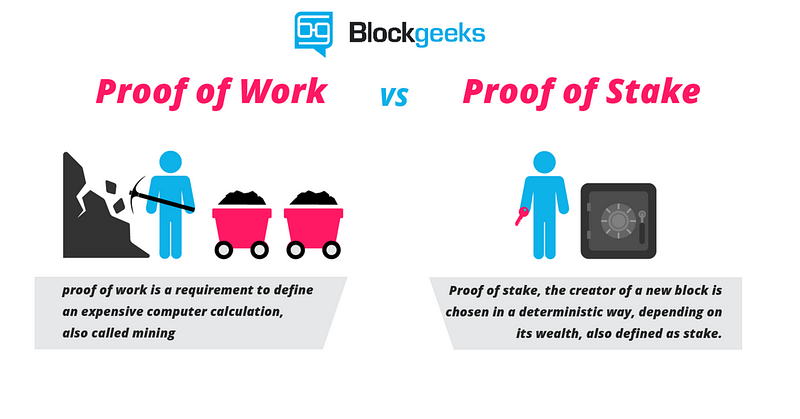
While POS will make Ethereum faster, more efficient, and greener, not everyone is happy.
The transaction reward isn’t as valuable as receiving an actual Ethereum token when mining; and since miners hold the power on the blockchain, many were uncertain where this would leave Ethereum if enough split.
The Ethereum developers proposed a solution to this problem, however.
EIP-3368 is a compromise between miners and ETH devs. The proposal was shared by ETH developer Tim Beiko on Twitter who suggested that miner’s block rewards be increased from 2 ETH to 3 ETH.
This will gradually decrease over the next two years until it reaches 1 ETH per block and eventually a full POS system. I’m curious to see if miners are fully satisfied with this update by then.
Amazon’s Partnership With Ethereum
Amazon Web Services now supports the Ethereum blockchain.
Amazon Managed Blockchain originally went live in 2019, and while many would see Amazon Web Services as a competitor to Ethereum — which aims to be the plumbing of the internet; much in the way that AWS is now — Amazon decided a partnership was in their best interest.
One thing that is worrisome about Amazon’s announcement is if they implement enough power on Ethereum, they could have a great deal of sway on the blockchain. The opposite of decentralization.
Anyway, here’s an excerpt from the announcement —
“Amazon Web Services (AWS) announces general availability of Ethereum on Amazon Managed Blockchain… With this launch, AWS customers can easily provision Ethereum nodes in minutes and connect to the public Ethereum main network and test networks such as Rinkeby and Ropsten. With Amazon Managed Blockchain, customers get secure networking, encryption at rest and transport, secure access to the network via standard open-source Ethereum APIs, fast and reliable syncs to the Ethereum blockchain, and durable elastic storage for ledger data.”
In other words you can set up Ethereum nodes now on the Amazon blockchain.
[Shoots confetti]
Nodes help Ethereum run faster, check transactions, and keep consensus on the blockchain. You do not earn Ethereum by running a node, but a detailed explanation by “Anthony” on the Ethereum Classic forum elaborates why you would want to run one:
“You have a few reasons why you’d run a node, including:
- You’re solo mining or running a mining pool, if this is the case then you need a node in order to talk to the network.
- You want to make sure your transactions to the network yourself. Remote nodes are generally reliable but are controlled by 3rd parties and typically throttle heavy usage.
- You want to help secure the network; the more independent nodes running the more copies there are of the blockchain and the more resilient it is.
- You want to make the network faster and secure; the more nodes the lower the latency in sharing blocks and the more copies of the blockchain that exist.”
Institutional Investor Buys More Ethereum Than Bitcoin

Just like Tesla and Square’s interest in Bitcoin, institutional investors are also investing in Ethereum.
Meitu, a Chinese company that makes a photo editing app, became the first major company to buy Ether.
In fact, the Hong Kong-listed company bought more Ethereum than Bitcoin, accumulating $22.1 million worth of Ether and $17.9 million worth of Bitcoin on March 5.
Will more companies follow suit and invest more into Ethereum than Bitcoin? I believe so.
100X Scalability with Ethereum
In a recent and iconic appearance on the Tim Ferris Show podcast — maybe one of my favorites episodes ever — Ethereum creator Vitalik Buterin highlighted a “really powerful” scaling solution that will fix scalability issues until ETH 2.0 is fully implemented.
These two solutions are sharding and rollups.
Sharding ostensibly is the most promising of Ethereum’s scalability problems. It spreads out the computational workload across the blockchain by breaking large amounts of data into smaller pieces. It's slated for release with ETH 2.0
However, both sharding and Ethereum 2.0 are still some years away. The solution in the interim is “Rollups.”
Rollups scale Ethereum off the blockchain and reduce fees, congestion, and in theory, increase transaction speed from its current 15 transactions-per-second to 1,000 TPS.
Optimistic Rollups are the leading scalability solution for Ethereum right now.
Vitalik even noted on Ferriss’s podcast that the Optimism team will introduce the release of Rollups “very soon” and that it will help Ethereum scale 100X.
“If you have rollups, but you do not have sharding, you still have 100X factor scaling,” Buterin said. “You still have the ability for the blockchain to go up to somewhere between 1,000 and 4,000 transactions a second, depending on how complex these transactions are.”
Two More Upgrades to Note:
The Berlin hard fork is scheduled for April.
The upgrade will introduce several important improvements to Ethereum’s protocol including facilitating changes for ETH 2.0.
Additionally, EIP-1559 will burn Ethereum tokens after every transaction making Ether a deflationary currency. This move should guarantee its price to skyrocket.
Where Does Ethereum Go From Here?
Ethereum can talk the talk, but the real question is can it execute? [walk the walk].
There are many problems facing Ethereum right now, and while the solutions look promising, it’s a steep mountain to climb.
However, the goal Ethereum looks to accomplish — as the technology backbone that powers the world — warrants many complex obstacles.
If it fails, it will do so spectacularly.
If it succeeds, I don’t think anyone truly understands what it means for the world.
This is not financial advice. All investment strategies and investments involve risk of loss. Nothing contained in this publication should be construed as investment advice.
Join 1500+ people on my newsletter for a free copy of my eBook “Mind and Muscle.”


