
Essay 21: Too Early For Optimism
It may be naive to look for positivity; as services creak, businesses stall and deaths mount. But there’s also a risk we’ll regret we didn’t dare to dream early enough. That we didn’t ask what the opportunity part of the paradox is with time left to make it happen, while the moment lasts.
What part in all this are we going to to play? Easy to ask, less easy to answer. What part have I played since the new normal became a low-rent BBC disaster movie with furloughed EastEnders extras playing politicians?
<<
In truth, a week ago, the role I’d played was inadvertently scare my children by being stressed and listening to the news too often. What I’d done was panic as I watched nearly all of my hard-fought-for contracts for the entire year evaporate in a few days. What I’d done was make things considerably worse.
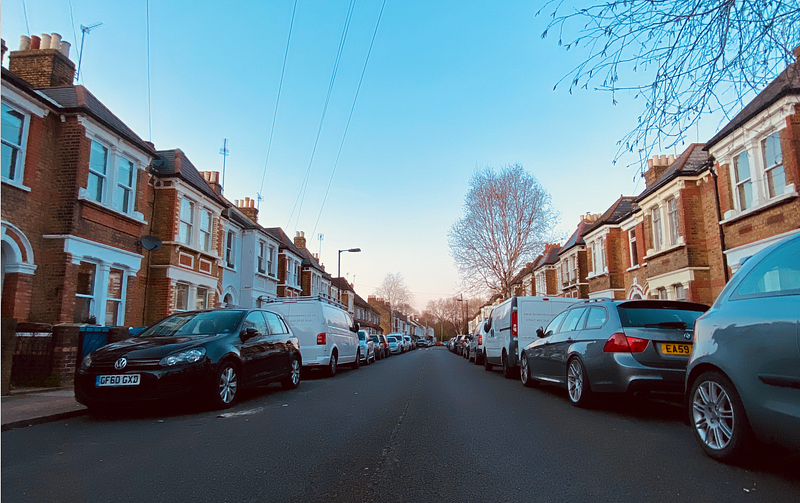
Fear does that, it infects things, until you apply the one antidote that always works, a little hope. In that weird moment we’ve all now had, the first time the grim reality of all this really caught up with us, I was at home, two hours from school pick up, more alone than ever, as the echo of my anxiety bounced off the walls of the little houses in my eerily quiet pocket of densely populated and infection-prone south London, I decided to do something.
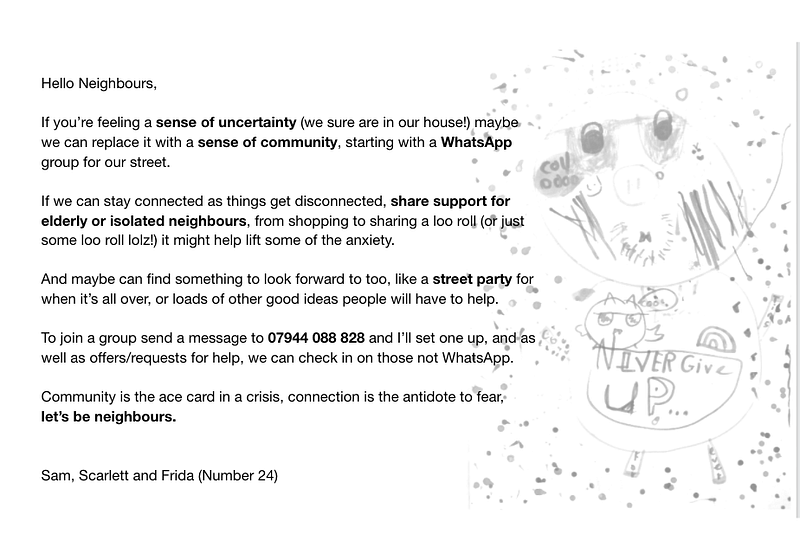
I took a drawing by my daughter, a hero pig, emblazoned with ‘Never Give Up’, and I wrote a note to my hundred or so neighbours, with my self doubt in overdrive. ‘Who made you Papa Smurf?’ Bastard, I delivered them anyway.
By the time I’d got my girls home, homeworked, fed, read and off to bed, there was a WhatsApp group of fifty neighbours acting like humans, sharing their concerns and offering support to their nearest and not so dearest. Most of them said they’d rarely spoken to anyone on the street and yet here we all were, representing the apex of community by, y’know, sharing a few gifs.
A week on, I’ve handed over the Admin to someone who likes WhatsApp and has their notifications turned on, and we’ve seen vegetable and loo-roll sharing, online classes for kids, collective food ordering, a book and movie club, elderly and isolated neighbours brought into the conversation, kids decorating windows, a shared sense of experience, an increase in confidence, a decrease in anxiety and my personal favourite: a 6pm Cheers, with a G&T or cup of tea from our front doors every night since we all felt like shit got real. The street even sang Happy Birthday to an eight-year-old in isolation.
Nothing much and everything, all at once. One of the simplest things you could do in a complex crisis, possibly one of the most profound. A short-term response to a daunting threat. A silver bullet of banter amidst a growing unease. An answer, when we don’t even know the full extent of the question.
Sometimes, simple answers to complex problems do help, and just possibly, almost inconceivably, our full potential as tiny weeny individuals caught up in a global clusterfuck is way bigger than we usually allow ourselves to believe.
I know there’s a lot of basic surviving to be done at the moment. We’ve all got costs, families and challenges relative to our own situations, I had such a turbulent last year it obliterated all my savings, doubled my costs and left me without any assets, and as of last week, now have next to clients left to dig my way back with.
Part of me craves a return to normality. But if the Country at War comparison is accurate, then let’s not forget that at the same time the Allies were fighting Fascism and thousands were dying every day, they also had to conceive the post-war world and lay the foundations of systems new, from which grew everything from the NHS to fifty years of financial stability and world peace.
Even in times like these, we can think big and deal with the detail, we can bring together our streets whilst thinking about our countries, we can find it difficult to believe anything will really change whilst taking small steps to try. Because something subtle but crucial has shifted: our sense of the possible.
We were always told that change is impossible. ‘Too many sunk costs,’ . ‘The people would never accept that kind of sacrifice. It’s impossible.’ Except, oh look, shit just got possible. And the longer this goes on, the more achievable the once inconceivable will seem, that continuity/possibility dynamic will come to count for everything.
Millionaire right-wing chancellors adopting economic policies that previously would have seemed socialist. Armies of executives are finding out that online are more efficient and far less expensive or toxic than endless air travel. Millions of exams based on a hundred years of inflicting averages on young minds replaced by human judgement. Layers of leaders are discovering that humanity, vulnerability and empathy are not just words in leadership books.
What if this sorts of ambition is what remains? Not just the trauma but the discovery that, amongst temporary techniques and coping strategies lie not just tweaks for outdated systems, but the chance to write entirely new rules.
What I’m grasping for is evolution, which typically happens so slowly you can’t see it but today is happening so fast we can’t keep up. And maybe this isn’t the time to keep up. As a wise woman once said to me, ‘Never run in the fog.’ Maybe this is the time for reflection and imagination.
CV19 was inflicted upon us, but whilst sufferers is how we’re currently cast, we will get to choose how it ends. We weren’t the architects of this crisis (for a change) but we damn well ought to try to be the authors of the next chapter.
I know that many will think such views are idealistic, unrealistic and that soon this crisis will be nothing but a memory. That things will carry on as they were and that, that’s a good thing. Perhaps. Many have an enormous stake in society swinging right back where it was. Others will think this is too positive in light of the many deaths we haven’t seen yet, that will affect the less advantaged worst. Correct, but in fear more than ever, we also need hope.
At the same time, groups that are actively working for systemic change are urging caution about an overdose of idealism. Getting over-excited about pictures of the newly transparent canals of Venice will not be sufficient to ensure they stay that way. Extinction Rebellion, an organisation I have huge respect and reservations about, are warning of lazily misunderstanding the upside of the crisis. Brief emissions reductions won’t undo a monolithic machine that eats carbon (and your children’s future) for breakfast. And they’re right. This might just be a crack, and nothing more.
But could it be the crack through which light could shine, levers could be rammed, bricks could be heaved and from which we could pull the whole fucking wall down? Even if it’s a maybe, it’s a definite maybe that won’t be tested by debating it on social media. It will only be proved or disproved by getting your hand on a brick and pulling until you bleed.
The system we were told we could never change is fallible as well as flawed, and it won’t be long before engines grind to a halt. We need to ensure that our response is not stealing the neighbours’ hand sanitizers but massive outbreaks of solidarity, society and singing together badly. And let’s be honest: this hasn’t got as bad as it’s going to yet, so optimism will likely get harder, too, if we don’t try a little imagination now, then when, and who.
Already I can only see extreme positions on offer. And as we know from recent experience with the now near as well forgotten Brexit saga, if you can only discuss a deeply nuanced subject via two contrasting over-simplifications… good or bad, well, look at how that worked out.
I’ve heard dozens of times over the last week that the ideas I’ve been working on are needed ‘now more than ever’. So this essay is in response to the ‘pirates’ who are stepping up and being the change. For all those who’ve been in touch, where the fear is great, the answers elusive and the risk high, all facing the defining question of the hour. How do we emerge from this, not just stronger but better? And when I say we, I mean all of us. How do we come out of this as better humans, a more cohesive society, a fairer economy?
This week, something happened that made me finally decide to press ahead and publish this. I was in a Zoom meeting watching the CEO of a FTSE 250 business who’s responsible for 4,000 people, he was leading over 100 senior execs with exactly the balance of emotional intelligence and calm confidence that the hour demands. Even under the immense pressure of keeping plants open, food supplies moving and people protected, he closed his talk by saying, ‘If good can come of this, it’s that the world becomes less divided and more compassionate, and that this is the beginning.’ Far from rhetoric, it’s the absolute underpinning of successful leadership in these unprecedented times, proving that under this extreme stress, with no rule book to hand, a new narrative in business can arise.
So truly, I see slivers of light shining through and I want to find more of them. I want to try and find patterns so I can pull them together into understandable examples of what and how we can adopt and adapt, so that statements made in powerful forums like the one above, are the beginning of belonging, in a human-centred upgrade to the world’s operating system.
I start from a place of optimism but also anxiety, and I’m going to try to use both to write my way though this. I heard last week from a behavioural specialist in social movement theory, that people with strongly held beliefs need 21 touch-points of a counter-argument to be able to find middle ground. Given that everyone, including me, currently holds a pretty justified belief that this is a shit situation, about to get shitter, I figure we all need 21 touch-points to build the perspective that it doesn’t have to be shit and nothing more. So I’m going to try and do it, over 21 pieces of writing.
Before this crisis we were in another. Countries divided, and in the vacuum of division we saw hate crime, prejudice, extremism and all the forerunners of truly dark times. Contrast this with a vision of countries on the other side of this, where streets have become communities. Where resistance, collaboration and shared experience deliver us (albeit counter-intuitively) the identity, cohesion and belonging that nobody had a plan for.
As one of the smartest minds I know likes to say, ‘All we have is now’ and I don’t think that’s ever been truer. But I’d like to add, ‘And each other.’
Let’s be the best neighbours we can be, and dare to dream about what’s next.
— -
Link to my mailing list for the rest of this series and other Be More Pirate / Professional Rule Breaking updates is here:
— -
Update: Since publishing this, far from the backlash I feared for being too early with Optimism, the response has been the opposite and I’ve been met with hundreds of messages hungry for HOW we translate optimism into action, so I’ve created short (6 questions ) Typeform, hoping for 1 or 2 line answers, and I’ll collate the consensus int one of the next essays , thank you very much for joining the conversation: https://sam774431.typeform.com/to/Ulm0uS
— -
— — — — — — — — — —
I’m a writer, social entrepreneur and consultant, mostly working on sustainability, social innovation and what I call Professional Rule-Breaking, you can sign up to an irregular newsletter of inspiration & insubordination at www.samconniff.com and my first book is out now: www.bemorepirate.com