
Escaping The Corridor With MD5 Hashes-TryHackMe Corridor
This challenge is a classic representation of using MD5 hashes in a real-life cybersecurity scenario, demonstrating their application and limitations

In the intricate world of cybersecurity, understanding the role of cryptographic hashes, particularly MD5, is crucial.
Let’s delve into the captivating scenario presented in the TryHackMe Corridor challenge.
This challenge is a classic representation of using MD5 hashes in a real-life cybersecurity scenario, demonstrating their application and limitations.
What Are MD5 Hashes?
MD5, or Message Digest Algorithm 5, is a widely-used cryptographic hash function that produces a 128-bit (16-byte) hash value.
It’s commonly used to verify data integrity.
MD5 has been utilized in a vast array of security applications and is also commonly used to check the integrity of files.
However, it’s important to note that MD5 is no longer considered cryptographically secure for preventing intentional data corruption by malicious entities.
The Scenario: Escaping the Corridor
Imagine a digital corridor, a sequence of locked doors, each requiring a unique key.
In the TryHackMe Corridor challenge, these keys are MD5 hashes.
Your task is to navigate through this corridor by generating the correct hash for each door.
How To Start
To begin the ‘Escape the Corridor’ challenge, you’ll interact with a virtual environment that simulates a series of locked doors, each requiring an MD5 hash as the key.
Initialize Your Environment
Upon entering the TryHackMe platform, you’ll be prompted to start your machine.
This process will set up a virtual environment where the challenge will take place.
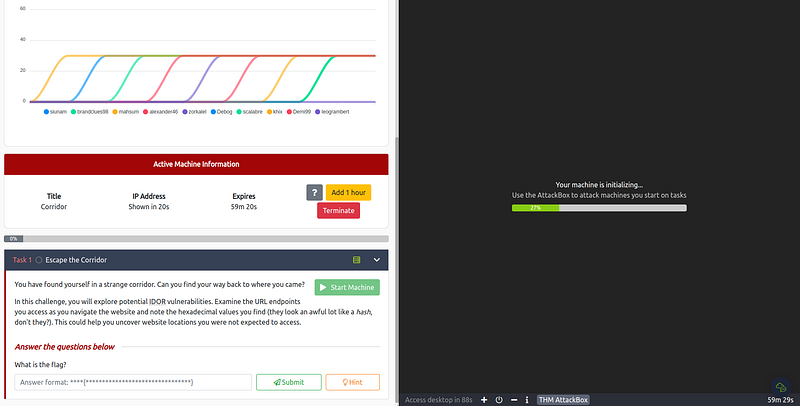
As shown in the screenshots, you’ll see a progression bar indicating the initialization of your machine.
When your virtual environment is ready, you’ll see something like this:
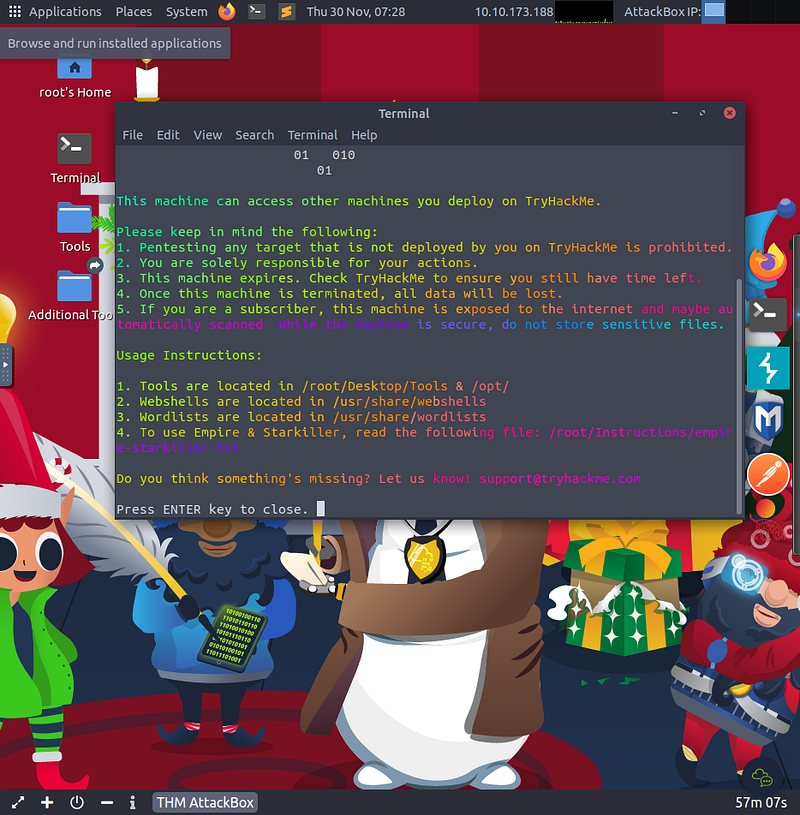
Simply open a browser and navigate to the provided IP address to view the corridor:
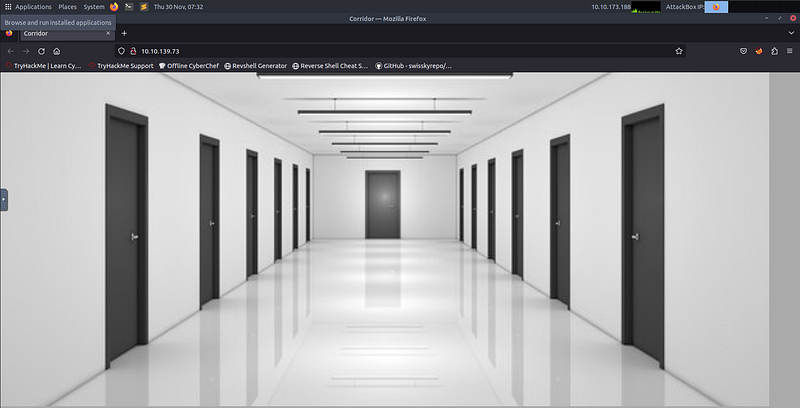
How It Works
Each door in the corridor represents an endpoint or a piece of the system that you need to access.
The trick is to analyze the hexadecimal strings found in the URL or provided by the system, as these are likely to be MD5 hashes or related to them.
Practical Steps:
- Identify the Pattern: Look for hexadecimal patterns that could represent MD5 hashes in the URL or provided clues.
- Calculate the Hash: Use the clues to calculate the MD5 hash that matches the pattern required by the door.
- Automate the Process: To efficiently solve the challenge, you might want to write a script that automates the hash generation process.
The Limitations of MD5
While MD5 is useful in this controlled environment, it’s crucial to understand its limitations in real-world applications.
MD5 is vulnerable to hash collisions, meaning different inputs can produce the same hash value.
This vulnerability makes it unsuitable for cryptographic security purposes.
Concluding Thoughts
The TryHackMe Corridor challenge is a fantastic playground for understanding MD5 hashes.
It offers a hands-on experience in generating and manipulating hashes, providing insights into their functionality and limitations.
However, remember that in the real world of cybersecurity, MD5’s vulnerabilities necessitate more secure alternatives for cryptographic needs.
For further reading and resources, you can explore the following:
Remember, challenges like these are more than just puzzles; they’re gateways to understanding the deeper principles of cybersecurity.
Keep exploring, keep learning, and most importantly, stay curious!
Enjoyed the read? For more on Web Development, JavaScript, Next.js, Cybersecurity, and Blockchain, check out my other articles here:
If you have questions or feedback, don’t hesitate to reach out at [email protected] or in the comments section.
[Disclosure: Every article I pen is a fusion of my ideas and the supportive capabilities of artificial intelligence. While AI assists in refining and elaborating, the core thoughts and concepts stem from my perspective and knowledge. To know more about my creative process, read this article.]