
Life
Escaping America by Vanishing Into Yesterday
My best weapon against boredom, ignorance, and alienation.
It seems every terrible deed and wonderful thing has already been done at least once, and perhaps twice. At least it feels that way at times, as I fall under the hypnotic spell generated by reading of distant events driven by men and women obscured by time. In this restless era of endless disease, social turmoil, and political uncertainty, I find reading history far more appealing and infinitely more enlightening than the average nightmarish news cycle.
I’m escaping our grim present by slipping into our past. I recommend it.
I’ve always been captivated by history. It seems to be one of the very few ways humans can try, vainly, to pursue what it is to be a human being. Why do we fight our endless wars? How is it that a vibrant democracy succumbs to fascism? What in God’s name is happening to us?
Perhaps we’re not meant to know.
The answers we do find are elliptical riddles, requiring still more inquiry. These excavated tales of our collective time on earth are also seductive, especially when deeply researched and beautifully written, as history ought to be.
History is also that rare stimulant for the hungry intellect in these times of social media superficiality and reality TV frivolity. In times that seem to celebrate stupidity and ignorance, history is a potent antidote.
The German philosopher Georg Hegel famously wrote, “The only thing that we learn from history is that we learn nothing from history.”
This seems sadly true.
Nevertheless, humanity always finds new and original ways to make its oldest mistakes.
History lights a navigable path into the reasons and rationales of our blunders, and into our strange and unknowable existence on earth. It would be impossible to at all grasp where we are or where we’re going without first comprehending our origins. That notion, at least, seems uncontroversial to me.
Indeed, modern history is a living breathing thing, evolving as we learn more about ourselves, becoming by turns more sophisticated and challenging along the way. History evolves, and not just because old and dusty archives are discovered and pried open.
History grows alongside humanity. It’s a process of continual reconciliation with ourselves and our past. The New York Times 1619 Project, which attempts to show American history as inseparable from the slave trade, and the continuing controversy around statues celebrating confederate generals show America is deeply engaged in this process of discovery and rediscovery.
Ultimately, history is our reflection back at something that can never truly be captured. One brief vision in a hall of trembling mirrors.
In that way, our understanding of history is fleeting and quite priceless. Self-knowledge is that rarest of human achievements, and history seems to offer a kind of key into the locked rooms of our past, at least for those willing to risk a glance.
Lately, I’ve been scouring the recently unlocked vaults of Russian history, with the help of historian Simon Sebag Montefiore’s brilliant works about young and old Stalin, along with his epic 300-year history of the Romanov dynasty. He observes the madness and beauty and lurid violence of the times, expertly capturing the pathology and genius of his fascinating subjects.
He draws meticulous texture and breathes humming life into distant political events by casting a light into the darkest souls, with a brutal wit and humor to spare. Of all the many historical accounts I’ve read of Stalin, born Ioseb Jughashvili, Montefiore’s is the most vivid.
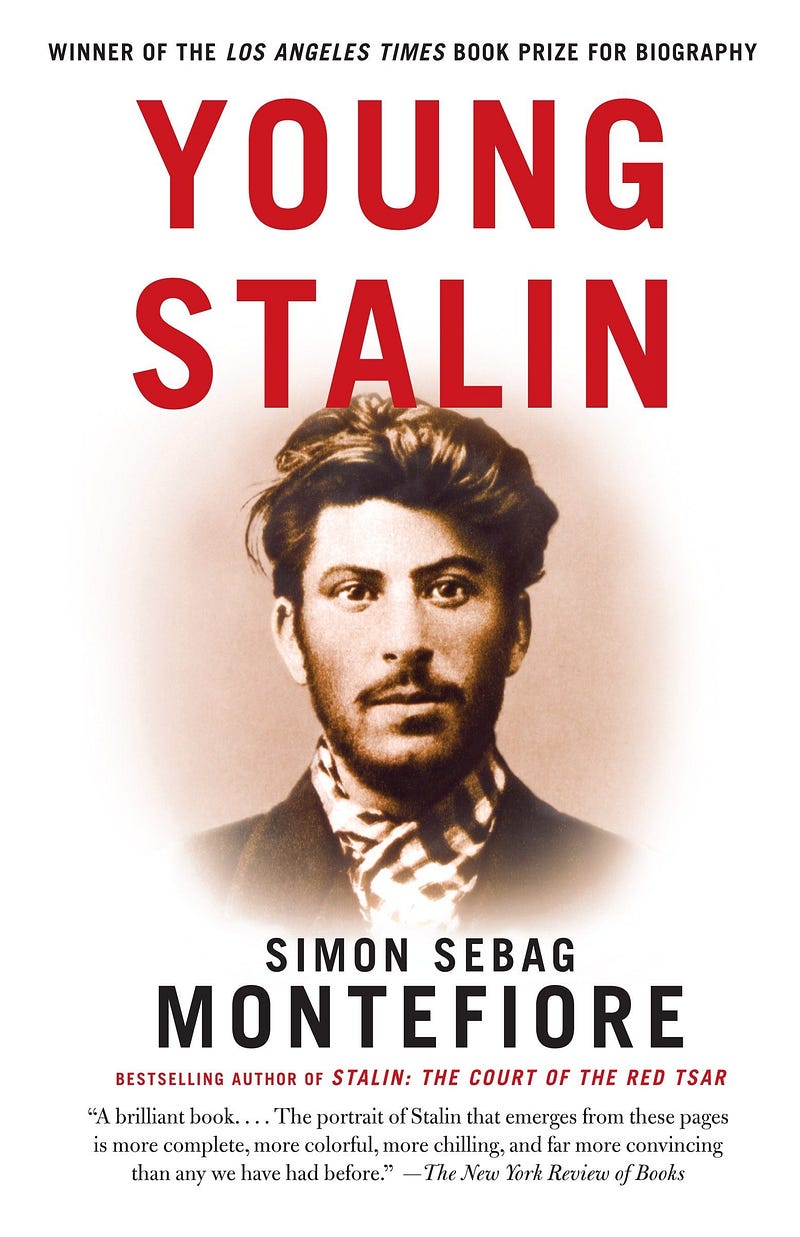
Young Stalin, published in 2007, is a window into the life of a cunning terrorist godfather and cold-blooded kingpin, one with a skill for nurturing small radical revolutionary sects into becoming effective and bloodthirsty political machines. The book uncovers his formative years and his family life in Georgia, and his schooling at seminary in Tiflis, where the young Stalin engaged in a running campaign of defiance against his strict religious instructors, reading banned books and organizing the students in his midst.
It progresses into his young adulthood, as Stalin cycles through violent revolutionary terror, countless women and allies, and deadly political conspiracies, showing his feline climb up into the top echelon’s of the political underground in Russia.
Montefiore details Stalin’s first meeting with Vladimir Lenin in Finland (he was initially unimpressed by Lenin, expecting a more physically imposing man) amid his many rounds of imprisonment and Tsarist exile in the Siberian wasteland, all the way up to the 1918 October revolution.
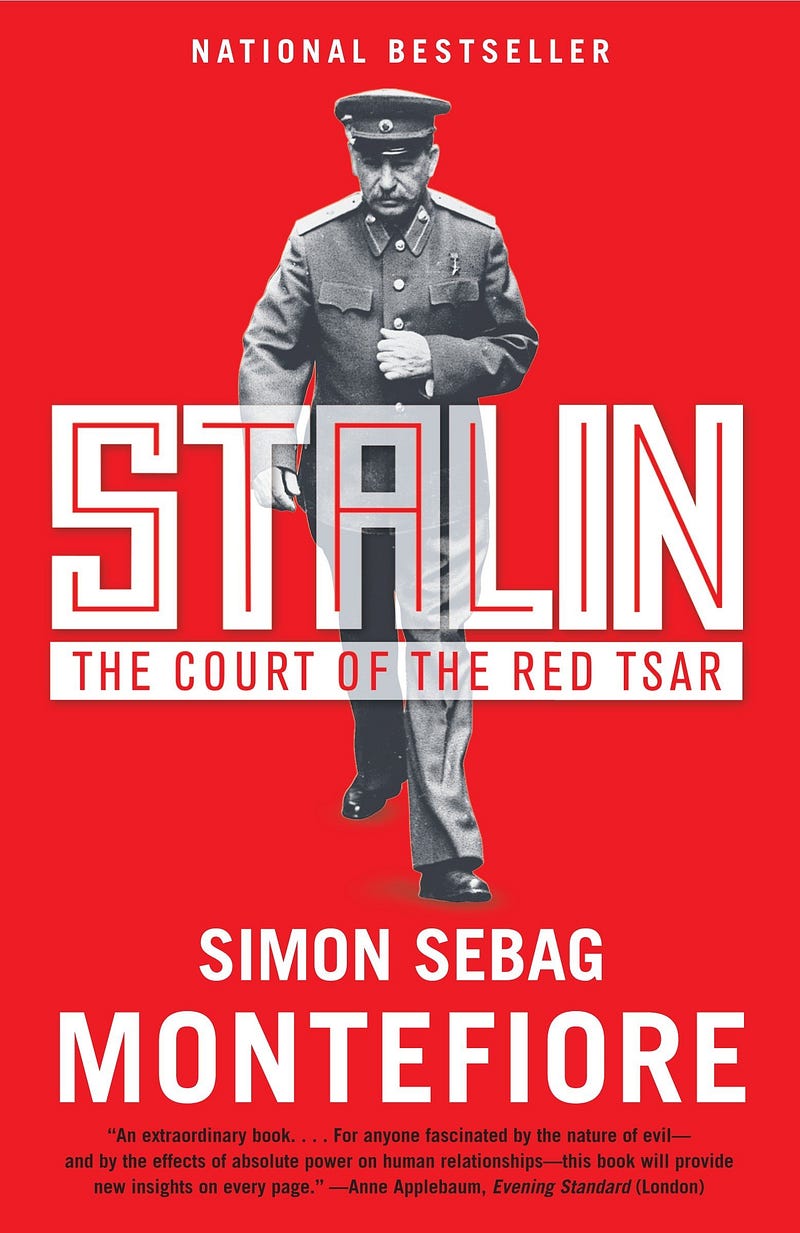
Stalin: The Court of the Red Tsar examines the dictator’s later years, and gives us an intimate recounting of his life reveling in absolute power among his top Bolshevik courtiers while he was in the last stages of his long and improbable reign. Montefiore captures the atmosphere of seething paranoia and constant and vicious betrayal and political backstabbing Stalin himself instigated among his communist chieftains. You can smell the sulfur in the air as you read.
Above all, Montefiore’s books are endlessly entertaining and written extraordinarily well.
The Romanov empire seemed a fitting addition to my reading list after I devoured both of Montefiore’s biographies of Stalin. That bestselling book catalogs 300 years of Romanov autocracy in Russia, and it paints a vivid portrait of the ruling clan’s idiosyncratic and frequently insane dynasty. It also does much to explain the later authoritarian impulses of Soviet Russia, and Vladimir Putin’s iron grip on political power today.
As American politics deteriorate and our own democracy falters, I find it immensely instructive to read up on my history of Western Europe. Specifically, Weimar Germany in the 1920s and 1930s as Adolf Hitler built his political career on fear and hatred.
My head is always buried in one or another book about the past. I read to escape our depressing current circumstances, as we find ourselves isolated from others by a deadly airborne plague, and divided from our neighbors by the fascistic politics of Donald Trump’s crazed Republican Party.
History is my way to comprehend the dark forces at work on our own democracy and liberate myself from them.
I frequently wonder if the American people possessed a better sense of history might they make different political decisions? Perhaps.
Subscribe here for free to see my latest work
Want to read more of my writing? Sign up for a Medium membership for $5/month to receive unlimited access to all my new writing along with all the other talented writers publishing on Medium. I’ll receive a small referral fee with no increase to your cost if you sign up using the above link.


