
ERISA: the Dramatic Rescue of American Retirements
Employee Retirement Income Security Act (ERISA) on protecting your golden years.
The Employee Retirement Income Security Act (ERISA) is a critical piece of legislation in the United States designed to protect the retirement savings of Americans. This law sets minimum standards for most voluntary pension and health plans in the private sector in order to protect individuals in these plans.
Prior to the enactment of ERISA, there were limited regulations in place to protect employee retirement benefits. This lack of regulation meant that employers could mismanage or misuse pension funds without significant consequences. This led to several high-profile cases in which employees lost their retirement savings due to their employer’s bankruptcy or fraudulent management of pension funds.
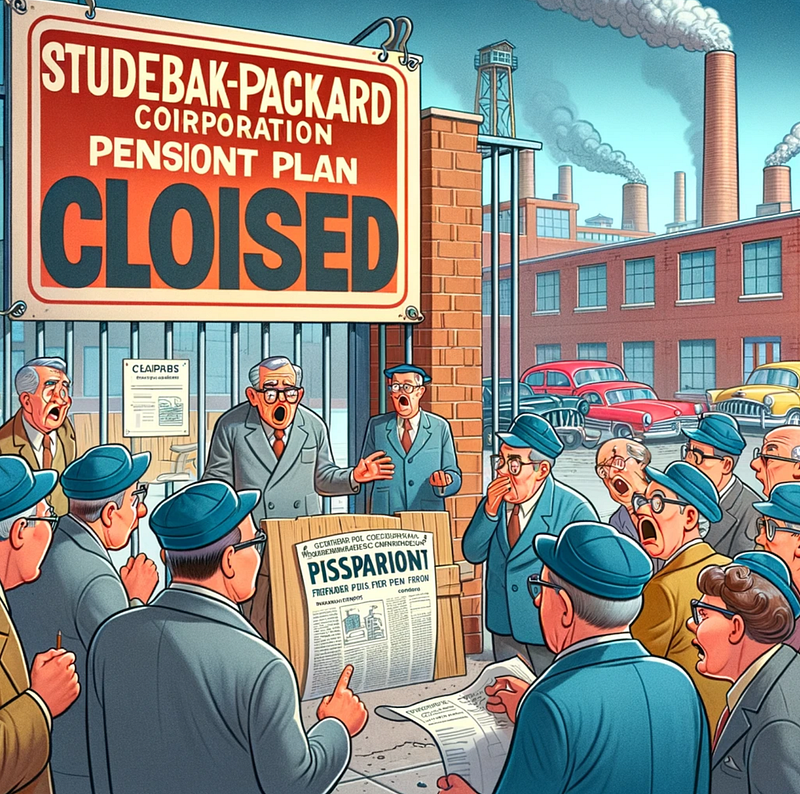
One of the key cases that highlighted the need for ERISA was the failure of the Studebaker-Packard Corporation pension plan in the early 1960s. When the company closed its plant, many employees discovered that their pension benefits were significantly lower than they had been led to believe, and some received no benefits at all. This incident, among others, raised public awareness of the need for comprehensive pension reform.
In response to growing concerns about retirement security, Congress passed the Employee Retirement Income Security Act of 1974. President Gerald Ford signed ERISA into law, bringing a new era of pension and employee benefit regulation.
ERISA fundamentally changed the way employee benefit plans are administered and protected in the United States. It has been amended several times to address new challenges and expand its protections. In particular, the Consolidated Omnibus Budget Reconciliation Act (COBRA) of 1985 and the Health Insurance Portability and Accountability Act (HIPAA) of 1996 are amendments to ERISA that provide protections for health insurance coverage.
What is a Pension Benefit Plan?
Think of a pension benefit plan like a promise from your employer to help you save for the future — specifically, for the time when you’re no longer working (retirement). It’s a way to ensure that you’ll continue to receive income in retirement, just as you did when you were working. For example, an ERISA pension plan might promise to pay you $500 each month after you retire.
Types of Pension Plans
There are two main types of pension plans:
- Defined Benefit Plans. This is the traditional type of pension. In this plan, the amount you’ll get after retirement is set in advance. You know exactly what to expect — it could be a specific dollar amount like $500 a month or calculated through a formula based on how long you’ve worked and how much you earned. Your employer puts the money aside for this type of plan. You don’t have to contribute, but your employer does on your behalf.
- Defined Contribution Plans. This type is more like a personal savings account for retirement, but with some help from your employer. Both you and your employer can put money into your account, which is then invested in stocks, bonds, or other assets. How much money you end up with when you retire depends on how much was contributed and how well the investments did. How does it work? A common example is a 401(k) plan. You decide how much of your paycheck you want to save in your 401(k), and your employer might match a part of your contributions. The total amount you have at retirement depends on these contributions and the performance of your investments.
So, the key difference is that Defined Benefit Plans promise you a specific amount after retirement, giving you a clear expectation of your retirement income. Defined Contribution Plans, on the other hand, don’t promise a specific amount; your retirement income depends on contributions and investment success.

What is a Welfare Benefit Plan?
Imagine having a safety net that catches you when life throws you a challenge. It’s not about saving for retirement but rather on helping you now, when you need it. This plan is part of the perks or benefits your employer may offer to help you meet the various needs that can arise at any time in life.
Types of Support Offered by Welfare Plans
- Health Insurance. This is probably the most well-known welfare benefit. It helps cover your medical expenses, like doctor visits, hospital stays, or prescription drugs. Whether you catch a cold or need surgery, health insurance is there to help reduce the amount you have to pay out of your pocket.
- Disability Insurance. Imagine if you got injured or became seriously ill and couldn’t work for a while. Disability insurance provides you with a portion of your income during the time you’re unable to work, helping you keep up with your bills and financial commitments.
- Employee Wellness Programs. These programs are designed to keep you healthy and happy. They might include gym memberships, stress management workshops, or nutrition counseling. The idea is to prevent health issues before they start, supporting your overall well-being.
How Do Welfare Benefit Plans Work?
Unlike pension plans, which are about the future, welfare benefit plans are about meeting your needs today. They’re not deferred until you retire; you can use these benefits whenever you need them. For example, if you have health insurance through your employer, you can use it for medical appointments now, rather than waiting until you retire.

How ERISA Works?
Under ERISA, each pension plan is subject to certain requirements and conditions.
Legal Documentation
ERISA says that every employee benefit plan has to be written down. Plans have to report regularly to the U.S. Department of Labor, showing they’re on the up and up.
Everyone involved gets a summary in plain language about what the plan offers, how it works, and how to make a claim if you need to.
Plans must clearly outline: (i) how they’re funded; (ii) who’s responsible for managing them; (iii) how they can be changed, and (iv) how payments are made to and from the plan.
Guardians of Retirement Plans
Who are fiduciaries? These are the people or companies who make decisions about how the plan is managed or who provide investment advice for the plan. Employers can manage their own plans, but they often hire professionals.
What do fiduciaries do? Their primary responsibility is to put the interests of plan participants and beneficiaries first. They must be as careful and prudent as if they were managing their own affairs.
Fiduciaries can’t engage in self-dealing or make deals that aren’t in the best interest of plan participants. They’re also held accountable if they don’t follow these rules.
Varity Corp. v. Howe (1996) is a prominent case where the Supreme Court ruled against Varity Corp. for misleading its employees. To cut costs, Varity transferred employees to a new, intentionally underfunded subsidiary, falsely promising that their benefits would remain secure. When this subsidiary failed, employees lost their promised benefits. The Court found Varity breached its fiduciary duty under ERISA by deceiving employees, highlighting the strict legal standards employers must follow in managing employee benefits.
Vesting
Vesting is like earning your benefits over time. The longer you stay with your employer, the more of your retirement benefits you “own” and can’t lose, even if you leave your job.
How it works? Imagine you’ve just started working at a tech startup, and part of your compensation package includes a pension plan and a 401(k) plan.
- Initial Setup. On day one, you decide to contribute $200 monthly to your 401(k). Simultaneously, your employer promises to add an equivalent of 5% of your annual salary to a pension plan on your behalf.
- The 401(k) Plan. Every dollar you put into your 401(k) is 100% yours immediately. So, if you decide to leave the company at any point, whatever you’ve contributed to your 401(k), plus any earnings from investments, goes with you.
- The Pension Plan (a new timeline). (i) Year 2 Milestone. If you decide to move on after two years, you’re entitled to take 30% of the total amount your employer has contributed to the pension plan. Let’s say your employer has contributed $5,000 over two years. You would be entitled to $1,500 of that amount; (ii) Year 5 Goal. If you stay with the company for five years, the rules change in your favor. You become entitled to keep 80% of your employer’s contributions. If the total contribution by then is $12,500, you’re entitled to $10,000 of it; (iii) Year 6 Ultimate Reward. ERISA mandates that by the sixth year, you should be fully vested (see page 4). This means if you’ve stayed with the company for six years, you get to keep 100% of what the employer has contributed to the 401(k) pension plan. So, if the total employer contribution is $15,000 by year six, all of that is yours, should you decide to leave.
If the plan is terminated, you’re immediately vested in all benefits, which means you get everything you’ve been promised, regardless of the timing.

Amendments & Cancelations
What it means? Employers have the ability to change their employee benefit plans. However, they must follow specific steps outlined in the plan’s own rules when making these changes.
The Anti-Cutback Rule
There’s a crucial protection here for employees. Even though employers can amend plans, there’s a rule called the “anti-cutback rule.” This rule prevents any amendments that would reduce or take away benefits that employees have already earned or are entitled to. In simple terms, if you’ve earned certain benefits, an amendment can’t just take them away.
Plan Cancelation
Employers may decide to terminate a benefit plan. This action, in and of itself, is not considered a breach of their duties (such as a breach of fiduciary duty) to participants.
If an employer decides to terminate a defined benefit plan, it must notify everyone involved — including the employees who are part of the plan and a government agency called the Pension Benefit Guaranty Corporation (PBGC).
Role of PBGC
The PBGC is like another safety net. It’s a federal agency that makes sure workers still get their pension benefits even if a plan is terminated without enough money to cover all promised benefits. When a plan is terminated with insufficient funds the PBGC steps in to manage the plan. They guarantee to cover the shortfall, up to certain limits, ensuring that employees still receive some level of benefits.
How Assets Are Handled?
If a terminated plan has enough money to cover all promised benefits, the plan’s assets are distributed according to ERISA guidelines. Everyone gets what’s owed to them.
If there is not enough money in the plan to cover all benefits, the PBGC takes over and provides insured benefits to participants, providing a safety net to ensure that employees don’t lose all of their promised retirement benefits.
Disclaimer
The information provided in this article is for informational and educational purposes only and is not intended to serve as legal advice or as a substitute for legal counsel. While efforts have been made to ensure the accuracy and completeness of the content herein, it is important to note that legal principles and regulations can vary significantly based on jurisdiction and specific circumstances. Therefore, this article should not be used as a definitive legal resource or as a basis for making legal decisions. Readers are strongly advised to consult with a qualified attorney for advice on legal issues or matters, as each individual case may require detailed and personalized legal analysis.
Reliance solely on the information provided in this article without seeking professional advice from an attorney may lead to unintended legal consequences or misinterpretation. The author or publisher of this article do not accept responsibility for any potential errors or omissions, nor will they be responsible for any losses, injuries, or damages arising from its display or use. The information provided here does not create an attorney-client relationship between the reader and the author or publisher.