
Equality of Caste Creed and Gender
Guru Nanak and his philosophy of unity and equity
As a young kid, I loved the bedtime stories my mother told me. She was a great storyteller and I used to enjoy them.
She would tell me fairy tales and take me to a make-believe world. I used to get mesmerized. She would tell me true stories of her experiences in life and it gave me a lot of food for thought.
Being from a Sikh background, she also told me beautiful stories of the Gurus. When we talk of philosophers and Gods, they have some superior energies and thoughts for people to mull over.
Guru Nanak was a Guru which I was always floored with. The stories about him were interesting because he did small things to make people understand the value and meaning of life.
Guru Nanak was born in 1469 on a full moonlit night in Talwandi near Lahore and it is now called Nankana Sahib after his name. This year his birthday falls on the 30th of November according to the Indian calendar.
Many stories of Guru Nanak have been cited but today I would like to talk about Equality. This topic on equality of caste, creed, and gender has been of great interest to me and I would listen to these stories many times. I often asked my mother to repeat them.
Equality of caste: Guru Nanak’s famous story about equality of caste was when he traveled to Saidpur which is now called Eminabad in Pakistan. He visited Lalo a carpenter from a lower caste and did not go to the feast arranged for him by Malik Bhago who was an official of the local Pathan administration. Malik reprimanded him for going to Lalo’s house and not coming to the feast.
Guru Nanak took a piece of bread in one hand from Malik’s feast and on the other hand from Lalo’s house. Milk poured out from Lalo’s bread and blood from Malik’s bread. Guru Nanak told him the difference between the purity of milk and dishonest dealings through oozing of blood, which was the bread from torturing people.
Guru Nanak did not recognize caste because all human beings were equal before God. It is said that from this simple lesson, Malik learned his lesson and went on the path of being a virtuous person after that.
Equality of Creed: In India, the Hindus and Muslims had differences in their living method and in their system of prayers. Due to this, they did not want to mix with each other socially or culturally.
Guru Nanak wanted peace and equality between different religions. He did not want any kind of differences between them. He wanted to travel far and wide to give this message of equality between people of different faiths.
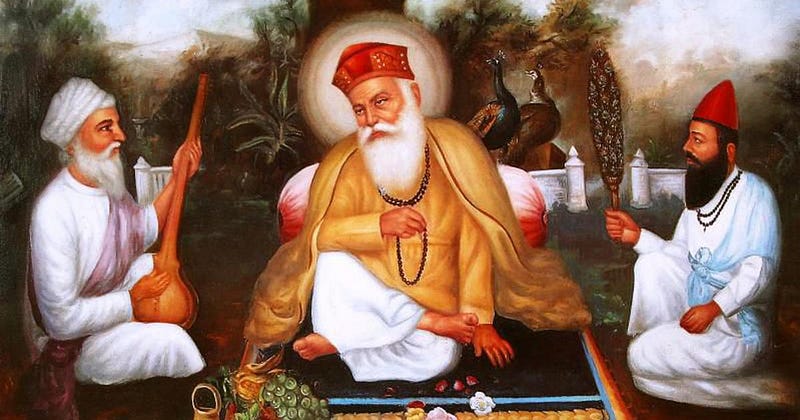
Guru Nanak chose two people to accompany him on his travels. He selected a Hindu by the name of Bala and a Muslim by the name of Mardana who played the Rabab a musical instrument for singing songs in praise of God.
Thus, the selection was fair as he did not make any distinctions between the two faiths. He practiced what he preached.
He declared that there is only one God and there are different ways to pray and ultimately to reach the same destination.
Equality of gender: Guru Nanak preached that there should be no discrimination in caste creed and gender. He brought the concept of Langar which means a community kitchen. Men and women were to collectively cook and then sit together and eat.
There would be no discrimination between young and old, male and female, caste and creed and each one was to share and eat the food.
He advocated Sangat and Pangat. Sangat means to be in the company of people who have a good heart and Pangat means to sit together in a row for food without any discrimination.
During his time, women were discriminated against. They were supposed to be living in the position of a shoe of a man and not as a friend. They were not treated properly so Guru Nanak gave them the position of friend.
He also gave the message of gender equality by stating in Punjabi that “so Kyun Manda aakhiye jit janmain Rajan” This means that how can you discriminate against women who give birth to kings.
The major takeaways from Guru Nanak’s philosophy that are relevant even today are the following:
#1. Spread the word of love and peace. Peaceful existence will bring progress and development.
#2. There is no difference between the different religions and the faith that people follow. Faith brings comfort to a person and it is through birth that he carries on in his life. Do not blame or offend anyone for the faith that he follows.
#3. The path to salvation is through love for everyone and not through cheating. It must be through honest and pure living and through sharing resources with each other.
#4. God is only one, so pray and take his name. In other words, Nam Japo.
#5. Women must be given a special place as they give birth to a child and they bear equal responsibility with men. A spouse should look after his wife and treat her as an equal partner and give her a lot of respect.
#6. Serve the needy selflessly. Always help people when required. This is humanity. This has compassion and love.
Conclusion He believed in Equality for all, caste, creed, and gender. Even as a young kid this impressed me a lot.
He believed in the philosophy of Vand Chako share and eat. Kirat Karo Earn an honest and pure living. Take the name of God naam japo. This is so relevant in the modern world
He often spoke about the unity of God. He said that there is one God but different ways to attain the path. Tolerance is very important to allow each one to take his own desired path.
The teachings of Guru Nanak have been most relevant during the coronavirus pandemic. The pandemic knew no caste creed or religion, the Sikhs all over the world selflessly, adhered to the teachings of Guru Nanak, and served the human beings with food, warmth, medicines, attending to the sick patients from whichever part of the world they came. They believed that everyone should be loved and cared for without discrimination.


