
Epistemology for modern Skeptics: II, Fallibilism as an approach to knowledge
These days we are too darn certain of way too many things we have no business being certain about. Or so I believe. Welcome to modern Skepticism! I am currently in the middle of elaborating a more or less coherent philosophy of life inspired by both ancient and modern Skepticism, and since Skepticism is largely an epistemological stance (i.e., it is about knowledge), this three-part series is looking at what a contemporary Skeptic might have to say about the nature of knowledge. This is important, of course, because everything else in our lives follows from what we claim is or is not true and on what grounds.
Last time we took a quick look at the first of what I think are three pillars of Skeptic epistemology: knowledge understood as a set of coherent beliefs about the world. Today we’ll examine the second pillar, the notion of fallibilism, the proposition that no belief can ever be justified in a way that does not admit the possibility that said belief may, in fact, be false.
If you find fallibilism attractive you are not alone, since the sense in the business is that most epistemologists are, in fact, fallibilists of one stripe or another. Fallibilism in its modern guise began with the work of the American Pragmatist philosopher Charles Sanders Pierce, though it actually goes back to the New Academy of Carneades and Cicero, during the Hellenistic period of Greco-Roman history.
The first distinction we need to make is between general fallibilism and more restricted varieties. One can be a fallibilist about all knowledge claims, as I’m inclined to be, or a fallibilist about empirical but not logical-mathematical truths. If you think there is no way that 2+2=4 may possibly be false, fine, you can still be a fallibilist about everyday as well as scientific notions. Or, you could strike a middle ground and say that while you are absolutely positive that 2+2=4 you are a fallibilist about your justification for why this is so. (That would be prudent, since it turns out that it is really difficult to actually prove that 2+2=4.)
Let us also briefly consider what fallibilism is not about. Among other things, it is not the notion that all beliefs we currently hold, or will hold in the future, are false. Some, even perhaps most such beliefs may be true. But we can’t know for certain.
Fallibilism, according to Stephen Hetherington’s comprehensive article in the Internet Encyclopedia of Philosophy, can be expressed as the thesis that all beliefs are only, at best, fallibly justified. Which is the same as to say that there is never conclusive justification for the truth of a given belief. All beliefs that are considered justified, therefore, should be held as provisionally true, nothing more. According to Hetherington:
“In effect, Fallibilism is saying that no matter what evidence you have, no matter how carefully you have accumulated it, and no matter how rationally you use and evaluate it, you can never thereby have conclusive justification for a belief which you wish to support via all that evidence. … Any possible addition or alteration that you might make will continue leaving open at least a possibility — one to which a careful and rational thinker would in principle respond respectfully if she were to notice it — of your belief’s being false.”
Fallibilist epistemologists have, sensibly, being paying attention to the empirical evidence about human fallibility coming from the sciences. And they have found plenty of confirmation for their stance. Some reasons to believe that human beings are fallible when they make knowledge claims include: biases and prejudices, fallacious reasoning, limited cognitive abilities, misusing evidence, unreliable memory, and unreliable sensorial experiences. If you take a minute to absorb this list, you will likely wonder how anyone can take seriously the possibility of certain knowledge, as far as human beings are concerned.
The sources of fallibility just listed do not apply only to everyday knowledge claims, but to science as well. While science is by far the best guide to understanding the world we have come up with, the history of science is, in fact, a history of rejected theories replaced by newer and usually better ones, i.e., it’s a history of fallibility. Philosophers of science contemplate this history and use basic inductive reasoning to conclude that chances are that all currently accepted scientific theories will also, eventually, be superseded because shown to be false. (This is sometimes referred to as the “pessimistic meta-induction.”)
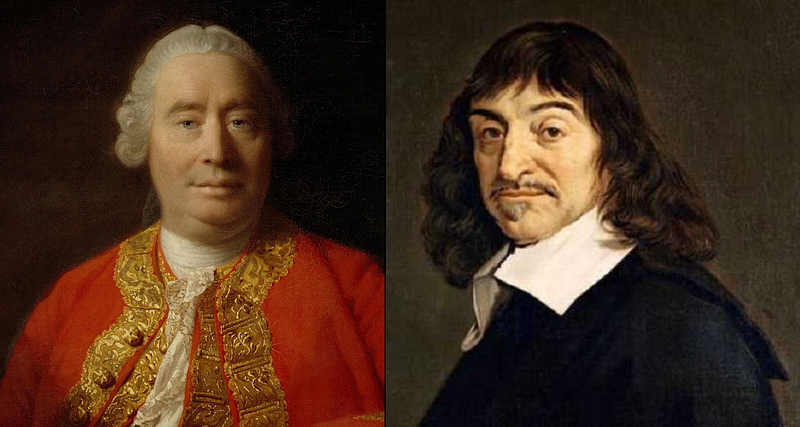
In modern philosophy, there are two fundamental roots of fallibilism: René Descartes and David Hume.
Descartes famously mounted a radical skeptical challenge in his Meditations on First Philosophy, published in 1641. This is the book in which he imagines the existence of an evil demon who misleads him when it comes to all sorts of knowledge claims, from those based on his senses — like am I really in this room writing, or am I dreaming that I’m doing it? — to even those arrived at by reason alone, such as mathematical statements.
Modern equivalents of the evil genius include the possibility that we are really a brain in a vat, as well as the famous scenario presented in the movie The Matrix. The point, of course, is not that anyone, beginning with Descartes, actually thinks that we find ourselves in one of these situations. The point, rather, is that if we did we would have no way to make any reliable or non-fallible knowledge claim.
Despite what Descartes himself concluded, most modern epistemologists think that radical skeptical challenges are, in fact, unanswerable. Which in itself lends crucial support to the fallibilist position about both empirical and a priori (i.e., mathematical and logical) truths.
But one doesn’t need to be a radical skeptic to be a fallibilist. Even if we go with the sort of genteel skepticism associated with David Hume, the notion of certain knowledge is still in deep trouble. Hume articulated what is nowadays known as the problem of induction in his An Enquiry Concerning Human Understanding, published in 1748.
Hume observed that our ideas about how the world works are based on inductive reasoning, that is, on generalizing from previous experience to new cases. Induction is, indeed, the foundation of both everyday and scientific knowledge. But when we ask why we think induction is a reliable means to obtain knowledge, the only available answer is something along the lines of “because it worked before.” Which is, itself, an instance of induction. Now, justifying induction via induction is circular reasoning, a fairly capital offense in logic. The conclusion is that we have no really solid reason to believe that our inductive inferences about the world are any good.
How worried, epistemologically speaking, should we be about fallibilism? A fallibilist attitude about knowledge could be interpreted in two quite distinct ways, again one more akin to Descartes’ radical skepticism, the other closer to Hume’s mild skepticism.
In the Cartesian model, let’s call it, the fact that our cognitive efforts are fallible is, as Hetherington puts it, “like a debilitating illness which ‘feeds upon’ itself. It would become ever more dangerous, as its impact is compounded by repeated use. This would badly lower the quality of one’s thinking.”
In the Humean model, Hetherington tells us, “the inescapable fallibility of one’s cognitive efforts would be like the inescapable limits — whatever, precisely, these are — upon one’s bodily muscles. These limit what one’s body is capable of — while nonetheless being part of how it achieves whatever it does achieve.”
The Cartesian approach leads to epistemic nihilism: we can’t know anything, end of story. It is not useful. The Humean approach is far more sensible, and is in line with the Academic Skepticism of Carneades and Cicero. Skepticism becomes a way to acknowledge the limits of human cognition and to remind ourselves to adopt an attitude of epistemic humility.
Should we ever find ourselves attracted by the dark (Cartesian) side of Skepticism, we may profitably go back directly to the wise words of Hume himself:
“For here is the chief and most confounding objection to excessive skepticism, that no durable good can ever result from it; while it remains in its full force and vigor. We need only ask such a skeptic, What his meaning is? And what he proposes by all these curious researches? He is immediately at a loss, and knows not what to answer. … a Pyrrhonian cannot expect, that his philosophy will have any constant influence on the mind: or if it had, that its influence would be beneficial to society. On the contrary, he must acknowledge, if he will acknowledge anything, that all human life must perish, were his principles universally and steadily to prevail.” (An Enquiry Concerning Human Understanding, 426)
Next time we’ll tackle the third and last pillar of modern Skeptic epistemology: probabilism.