
Enterprise-Level Data Storage: The Data Warehouse

It’s estimated that a total of 2.5 quintillion bytes of data (2.5 millions of Terabytes) is produced on a daily basis. With the constant growth of IoT ( Internet of Things) and this data production rate, it’s becoming more and more vital for any company to have a structured and well thought way to store, read, access and manipulate data.
Moreover, as a Data Scientist, it can be very valuable knowing fundamental data warehouse concepts.
Here, we’re going to discuss one of the most popular data storage and management solution: the data warehouse.
What is a Data Warehouse
At surface, a data warehouse is a central data repository, a data storage. It is used to store cleaned and processed data from multiple sources, and to store current and historical data in a single place.
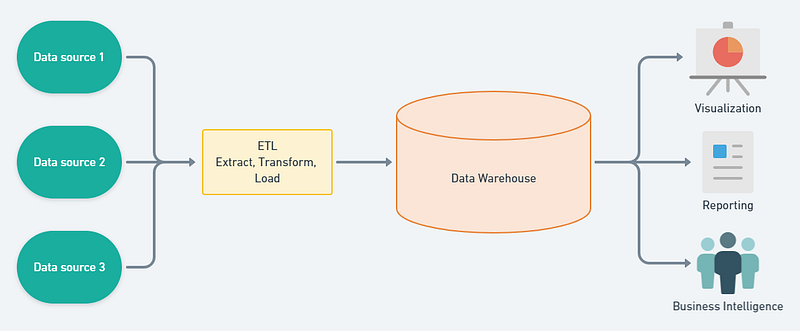
A multitude of figures usually works on or with the data warehouse: Data Scientists and Engineers, Business Analysts, etc. Access to the data is performed through various mechanisms including (but not limited to) SQL clients, Analytics, and Business Intelligence (BI) tools.
Still at surface, a data warehouse basic architecture might look something like this:
- Bottom layer: the warehouse’s core server. It’s usually a relational database (or databases) where the data is loaded, stored, processed and extracted.
- Middle layer: the engine. It acts as middle man between the databases and the user, and it’s used to access and process the data.
- Top layer: the frontend: it consists of APIs, dashboards or other tools to actually help the user access the data warehouse.
Basic warehousing pipeline
To make proper data warehousing, those 4 steps are usually followed:
- Extraction of data: as said before, multiple sources can be at play in this stage. This step requires the extraction and gathering of large quantities of data.
- Data cleaning and processing: the key of data warehousing, having a structured and cleaned storage solution. Here, the data is cleaned and then scanned for any error.
- Data formatting: the beauty of data warehousing is having a huge amount of data in a pre-determined format.
- Warehousing and storing: once the data is converted to the warehouse format, it goes over processes like consolidation and summarization. Moreover, once the data sources are updated, the data warehouse is updated as well.
Advantages of data warehousing
Data warehouses are a very popular solution for data storage in companies, here’s a list of benefits:
- Data quality and consistency: this ensures having access to precise and well-structured information, due to having a fixed structure and format based on which the data is converted and transformed.
- Historical data: having a way to access historical data is crucial to do analytics, and discover and analyze trends.
- Cost-effective decision making: having all the data in a single place enables fast and efficient accesses, and it enables high-performant decision making.
That’s what a data warehouse is: a structured and nonvolatile, ‘ single source of truth for a company.
If you liked the post, consider following me on Medium and my website: alessandroai.com.
You can join Artificialis newsletter, here.
You can also support my work directly and get unlimited access by becoming a Medium member through my referral link here!
Originally published at https://www.alessandroai.com on February 22, 2022.