
Enron’s Former CEO Leaves Prison… And Corporate Fraud Just Kept Happening
Jeffrey Skilling was back in the news to wrap up August’s headlines in the US. Before we get too deep into September, let’s remember some other #mustknow fraud cases that you, my journalist friend, would have not easily dear to uncover.
This post is inspired by my first-ever accounting lecture in English. I’ve taken some accounting courses before in Spanish, but this was different: no class I’ve taken before ever mentioned so many real-life cases that made you think, hey, accounting is not as boring as you think: some very smart people have actually used it to change the world in ways most people don’t fully understand. How? Mainly by sophisticating financial fraud techniques.
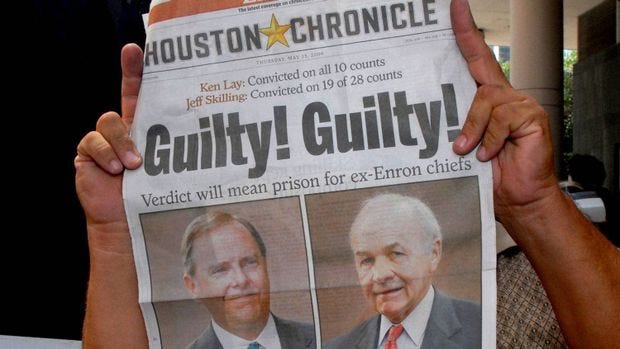
My class coincided with a news I haven’t seen much in my feeds — mainly because THE NEWS of the week was the NYT’s op-ed about la résistance inside president Trump’s administration — : On August 31st, Houston Chronicle reported Enron’s former CEO, Jeffrey Skilling, was released from prison after 12 years of incarceration. But, wait, he’s not just out there having a blast. He was sent to a halfway house — a house at an undisclosed location — where he will complete his 14-year sentence due on February 2019.
To all my journalist friends here, you should know uncovering financial fraud IS objectively complicated, and lots of people usually work behind the scenes to cover up a fraudulent scheme. Thus, it takes a very, very long time before the scheme is understood and its leader is caught red-handed. Retrospectively, when it’s all figured out, you might even say: “Come on, how come not anyone noticed?” Well, you didn’t, until it was news, right?
Let’s look at Enron’s fall. It all began with journalist Bethany McLean asking “very, very specific questions about accounting,” as Skilling said in his deposition before Congress years ago. McLean got a tip from a source who suspected something was wrong. How does a company grow more than 100% in the dot.com bubble years, as reported from Enron’s financial statements in 2000? How do you specifically achieve that?
“Numbers are always going to be good until they’re not.”
This is a keeper from Jim Chanos, the investor who suggested McLean take a closer look at Enron’s numbers. You can listen to him in the video below. Journalists out there, be honest: would you have taken a look?
I won’t describe here the specifics of Enron’s case since more experienced people have written plenty about it. Long story short can be found in the always-reliable Investopedia: Skilling reported the most convenient asset values for the company’s bottom line and kept the losses out of the balance sheet by transferring them to Enron’s off-the-books corporations.
The United States has a prominent list of other Enron-like stories: Tyco, Tesco, Worldcom, Bernie Madoff, Lehman Brothers… But the idea here is to take a quick look at some other scandals outside the US that followed Enron, for there’s always more to see — and new ways to scam people — out there. You won’t get all the specifics, but rather a long-story-short format, videos, and links to tease your curiosity.
UNO. La Polar (Chile): When your bill is almost $1,500 for an iron
Long story short: La Polar is a Chilean retail company — it still exists — that created a fraudulent scheme to increase its assets by refinancing costumers’ debts without their consent. The red flag came from costumers themselves, represented by consumer-rights Chilean regulator (SERNAC) in June of 2011. One of those customers actually saw their bill increased from 30,000 pesos to 1,000,000 ($43 to $1,500 with up-to-date currency exchange rate) after buying ONE iron. Well, imagine more than 400,000 customers like that.
How did La Polar cover it up? Chilean economist and former presidential candidate Franco Parisi explained it quite well in this video (Spanish):
If you really want to go deep into the case, I recommend an article from CIPER (in Spanish):
If you don’t understand Spanish at all, here some other good sources in English: one from Knowledge at Warthon and another one from FT’s columnist Jude Webber about how the company re-surged in the stock market.
DOS. Satyam Computer (India): Your boss confesses he screwed up big time
Long story short: The fourth-largest software provider in India 10 years ago turned out to have pretty much all of its $2 billion revenues fudged. B Ramalinga Raju, former founder and chairman, resigned in January of 2009 after admitting he had inflated revenues, income and cash flows for years. Satyam’s employees received Raju’s resignation letter some days after shares plunged due to a failed acquisition of a company own by Raju’s brother (Maytas Infra) and a World Bank’s sanction for allegedly committing data theft and bribery.
I always find it impressive when revenues are inflated. I mean, that’s the very heart of it all, when everything happens before subtracting costs. But what do I know? This video explains it better:
B Ramalinga is still in jail and will be until approximately 2022. It took Indian authorities six years to close the case. Satyam did not just go bankrupt. Another Indian-British tech company, Mahindra, bought it in April of 2009 for roughly $580 million. Now called Tech Mahindra, it trades both in Bombay and the US.
TRES. Gowex (Spain): Nothing is free, not even Wi-Fi
Long story short: Gowex, founded in 1999, was an award-winning company in Spain for his supposedly innovating model to provide free Wi-Fi in public areas. His founder, Jenaro García, had forged contracts, gone overhead with debt, and inflated revenues from 2010 to 2014, the entire time the company was public in the Mercado Alternativo de Valores — a self-regulated stock exchange — in Spain. The news broke when short-selling company Gotham City Reasearch released a 90-page report stating, basically, Gowex was a scam.
Our friends from EFE in Spain explained the astonishing figures Jenaro García praise himself on having achieved. Not suspicious AT ALL:
Gotham City Research bet against Gowex, meaning they would profit from its fall, which doesn’t undermine the fact their research was detailed… And eventually right. This draw-my-life video makes a smart reflection about that dynamic [Spanish]. The short-seller report was released on July 1st, 2014. Gowex denied it first… But five days later:
This is definitely the most interesting scam I’ve ever heard of in the modern tech world, especially because Jorge García — get ready for this — is launching another Internet-related company. Yes… And this time there’s even blockchain involved. Is this for real? What do investors think about it? Will it succeed? This very thorough article on El Confidencial, published in July of 2018, answers those questions and more:
BONUS TRACK. CLAE (Peru): A bank that was not really a bank
I’ve left the best part for the end because I’m sure you’ve never heard about this case (or at least it was not mentioned in my class). If you have and you’re not Peruvian, I’d like to know who you are, really 😐. CLAE is actually a predecessor of Enron. Long story short:
It was 1978 when Carlos Manrique funded the Centro Latinoamericano de Asesoramiento Empresarial (CLAE). At first it was some sort of consultancy firm, but in the 80s it became a bank without a permit for it: it received deposits with the promise of doubling people’s money, which was achievable by capturing new clients. Yes, it was a Ponzi scheme. In 1992, CLAE sought to register itself as a formal bank, but it was unable to state its financial performance to authorities. Fifteen years later, in 1993, it was seized and closed by the government.
In 2013, 20 years after CLAE’s government intervention, there are still people claiming for their money to the authorities:
It’s not so surprising. Some news has reported CLAE grew so much it represented 40% of Peru’s liquidity in the financial system at some point between 1989 and 1992, around $640 million at that time dollar’s price.
Carlos Manrique is quite a character. He’s actually still alive and giving interviews from time to time after he served his two jail sentences and was released in 2013. When the news broke in 1993, he fled to Miami and stayed there for some time until it was extradited to Lima. Every time a news channel can interview him, they make a big a fuzz about it, but he always says the same: “It was the government that caused CLAE’s bankruptcy. People love me.”
There you go. Whether you’re in a small country like Peru or Chile, or a big one like the US or India… Here’s one thing we all share: corporate fraud, in all colors and shapes. I guess accountants on the light side of the Force are still outnumbered by the dark side.


