
Enough Space to Be Okay
They say infants don’t realize they’re out of the womb until about six months post-birth. But what about the owners of those wombs? When do we feel our premises have been wholly vacated?
My son is seven years old and while he is steadily establishing his independence, I can still feel him squirming — after he’s climbed into my bed at 4 a.m. and spreads his long pinwheel limbs over and onto me; when we’re curled up under blankets on the living room couch, watching movies he loves that no one else remotely even likes (looking at you, Evan Almighty) and his big toe challenges my big toe to an impromptu wrestling match; while he’s up to bat, swinging at balls thrown by droopy-eyed Little League coaches and missing nearly every one of them in actual slow-motion.
That last one is a phantom squirm I feel in my throat.
We are not always together, physically speaking — this summer he’s been attending day camp Monday through Friday while I work a busy 9 to 6 job — yet, really, we are always together. I am both beautifully and painfully tethered to him.
Every August we travel to Gloucester, MA, from our home in New Jersey to spend a week with my parents in a rental house that’s situated on picturesque Good Harbor beach. The house is sought after by renters for its location — mere steps away from the sand — but its insides fall short of its outsides. Various paint-by-number watercolors of flimsy sailboats and unidentifiable animals (exotic bird or long-necked vase? It’s unclear) adorn the wood-paneled walls, the bedroom mattresses beckon guests like stacks of bricks, and there’s a constant creak and whirl of old fans in every room because the owner does not believe in the merits of air conditioning. On 75-degree weather days, with every window and door pied-pipering in the ocean breeze, all is forgiven. On 90-degree weather days, my parents and I swear off this overpriced petri dish and promise never to return.
Today, which is day three out of eight, the temperature reads 92 degrees. The backs of my knees stick to stiff, wicker, outdoor-turned-indoor furniture that was painted toothpaste green at least 40 years ago. I am listening to a podcast — a conversation between a child celebrity who recently made a comeback and LinkedIn connection whose career I respect but also envy — and my son interrupts no fewer than every 10 minutes to tell me he’s bored, even though we’ve already spent a full morning in town that included a pancake breakfast, palm readings for each of us, and the purchase of a new baseball cap that says “Wicked Smaht.”
My son’s expectation is to always be entertained. This is one difficulty of being a single mother to an only child at age 46 — you are both parent and playmate without any respite for either role. But complaining about being someone’s everything strikes me as something a very annoying person would do, so I’m often split on whether to roll my eyes at myself or seek out sympathy.
He tells me again that he’s bored and I decide the repetition has finally run its course through my nerves. I tell him to put on his swimsuit; it’s time to switch gears. After all, listening to a person whose career path once paralleled your own, until hers suddenly sky-rocketed and yours continued to merely coast, wax on about her latest projects is not exactly chicken soup for the soul. Nor, quite frankly, is paying attention to any media these days. Lately I find the best medicine is being uninformed — though I would never say that out loud.
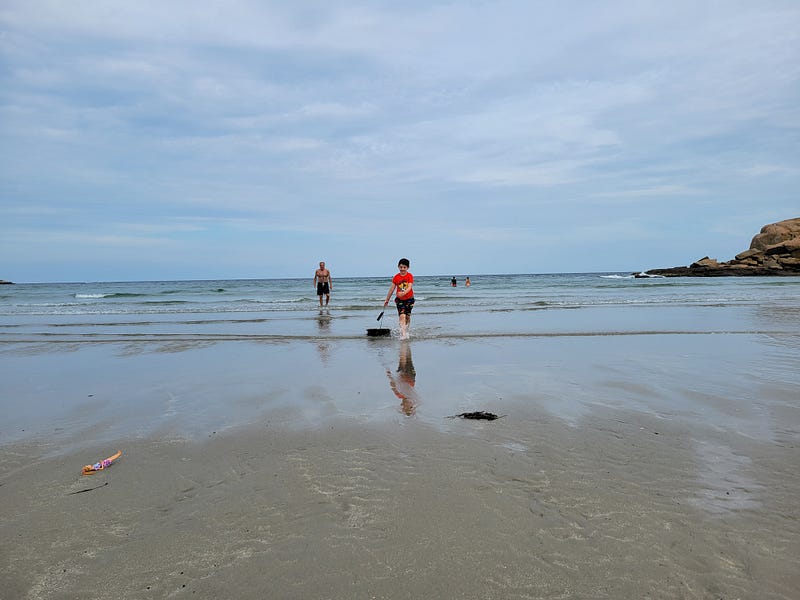
Both of us in drugstore flip-flops, sinking into deep, Etch-a-Sketch-reminiscent sand as we struggle towards the water, we look like we’re leaving last call at a dive bar. My son speeds up as the sand starts to moisten and then flatten. He kicks off his flops, grabs the boogie board from underneath my arm, and runs with it straight into the water, which is just choppy enough to call for fairly constant adult supervision. I look longingly at my beach chair, knowing that it will be at least an hour before my son becomes tired, distracted, or hungry. Maybe I’ll get lucky and an old-school ice cream truck blasting jingles will lure his attention back to dry land.
I wade in the water, up to my hips, which never quite recovered from the trauma of expelling a stubborn, 21 and ½-inch-human through them. A decade ago, remaining perpendicular to the ocean’s surface required less effort — but it feels nice to stretch my calves, nonetheless.
I concentrate on holding my posture steady as one wave after the next becomes the “biggest wave I’ve ever seen, Mom!” It fills my heart to see him marvel at nature rather than stare dead-eyed at an iPad screen. “Isn’t the ocean so cool?” I ask in all seriousness. Him being seven, I can not only get away with making very unprofound statements like this, but he actually delights in them. “Yes!” he responds. “The ocean is soooooo cool!”
I love this moment. I am in this moment. But I also wouldn’t mind an hour all to myself, to plop down in that beach chair, close my eyes, and clear some space in my head for a daydream.
I used to be an avid daydreamer when I was younger. I’d chew on my lip and turn the light off in my head during moments that required only peripheral attention to feign engagement, like basement hangouts with friends who smoked stupid amounts of pot. As they would pull bong hits and sing along to Phish, I mimicked the motions while relishing the calm, safe space where my inner monologue could roam free.
It’s been so long since I’ve had even a corner of empty space to daydream. It’s been longer since I’ve contemplated what’s missing from my big picture, as one does when you’re conditioned to think you’re entitled to an extraordinary life. (I blame Brat Pack movies and an embarrassing amount of teenage privilege for my misguided notion that the soundtrack to my life should always be blaring, never a moment to simply just hum along.)
There are plenty of things missing. Even the palm reader in town saw it: “This life is not yours,” she said. My eyes began to water at the significance of her observation, but when I looked up at her face from my palm, I realized she couldn’t have been older than 20. She wore metal braces, still had some baby fat in her cheeks, and her plastic Venti cup from Starbucks contained the remnants of a strawberry-flavored “Pink Drink.”
A more seasoned scam artist would have waited about a minute longer before moving on to her sales pitch, but she had not yet learned the power of restraint. “I can help you,” she said with confidence. “Do you want my help?”
“And what does your help entail?”
“I will meditate on your trouble tonight.”
I waited for the real answer to my question.
“$45.”
In the scheme of things, $45 would be a steal for someone to meditate my blockage away and heal my “blister” of an existence (her word, not mine), and she even promised to text me the next day with detailed instructions on how to find the — wait for it — key to unlock my — wait for it — potential.
I politely declined her assistance but noted that her reading was not wrong: Yes, I am searching for something. And I am restless. And my mind is jam-packed and soggy with to-do lists and regrets. I am gasping for air as the world flip-flops between running as usual and burning to ashes; surrounded by too much of it at only the wrong moments. There is no middle ground.
But here’s the thing, little lady: I am perfectly okay. I have enough life under my belt to value the absence of heartache and strife. And while it sometimes slips my brain, it is not completely lost on me that I’m so incredibly lucky to have these random but plentiful moments, watching my seven-year-old space invader splash about, that bring my soul peace.
My head hurts, but my heart is doing just fine.
I didn’t wear a watch in the water, but the sun’s direction has shifted enough that I know it’s been at least an hour of lifeguard duty. I tell him it’s time to eat and he claps back, “not yet,” naturally. My face falls into a familiar if not default expression — a competing mixture of scowl and smirk — and I offer him another five minutes to catch more of the biggest waves he’s ever seen.
I’m staring straight into the sun, as if dared to purposely damage my retinas by one of those YouTube punks that are perpetually in my son’s queue, when I hear my father call out from about 6 feet behind — the measure we all now associate with that of adequate social distance and at which we subconsciously and awkwardly linger in place — that he secured tickets to the Red Sox vs. the Baltimore Orioles for Sunday afternoon.
My son played Little League for the first time this past spring and liked it, but his true obsession with baseball lies more so with following player and team stats. He sponges up scores and rankings like a Swiffer Jet, even though he’s never watched a single game from start to finish. I don’t question it or mock him; the enthusiasm is impressive.
Sitting shoulder to shoulder with strangers at Fenway Park in the middle of a heat wave — not to mention a pandemic that won’t quit — is not my, nor my 73-year-old parents’, first choice of family activity. But my father is intent on making memories during this vacation, and he, too, understands the importance of keeping a 7-year-old entertained.
He sidles up to me, proud of the seats he secured through relentlessly texting a friend of a friend’s financial advisor. Apparently, men at banks are still the keepers of the best seats in the house.
“He’s having a good time in the water by himself, I see,” my father remarks.
I feel a tinge of guilt, glancing around at the many brothers and sisters chicken fighting on each other’s shoulders.
“Learning to play alone is a skill that’ll serve him well,” I respond. “His generation may end up being defined by distance.”
“We’ll stop by the new apartment on the way to the game. It’s coming along nicely.”
My parents recently moved into a two-bedroom rental apartment not too far from Boston. They left behind their dream home of 25 years in the quiet, woodsy suburbs — a symbol of my father’s 50 years of dedication to (and preoccupation with) corporate America — to embark on a new, less spacious but perhaps fuller phase of life, and one with no stairs on which my mother can lose her balance. We all become wobblier as we age, and so we adapt.
“You’re both enjoying it?” I ask.
“Yes,” he says, looking a little surprised.
“You don’t feel like you’re on top of each other?”
“No,” he says, again looking surprised.
“Good for you guys. I haven’t pooped without someone hovering outside the door in seven years.”
He pauses for a few seconds, reading between the lines that I didn’t consciously mean to draw. Then he tells me to take a break.
“I’ll get this shift; go back to our spot and relax for a bit.”
I want to throw my arms around him in gratitude, but we’re both covered with an uncomfortable, sap-like mix of sweat, salt water, and SPF 50. Later that night I’ll remember this gift of separation and rest my head on his shoulder as he reads news articles about angry anti-vaxxers in Tennessee aloud on his phone.
I practically glide back to our beach chairs, turning around once to blow him and my son a kiss. They’re both engrossed in the waves and miss the gesture.
No, this life is not just mine. And that’s perfectly ok.


