English Learners and Math:
How Adaptive Learning is Empowering ELs to Succeed Across the Curriculum


In literacy circles, English Learners are at the forefront of many educational leadership discussions: how can we provide them with the very best literacy instruction? How can we improve their English fluency, help them become comfortable with English texts, and with speaking aloud in class? How can we teach them academic language and help them meet standards? How — perhaps most importantly — can we honor their culture, their previous language(s), and celebrate bilingualism as an asset rather than viewing it as an obstacle to be overcome? In literacy, English Learners are seen as a diverse, growing, and inspiringly motivated group of learners with unique instructional needs who face educational, cultural, and social obstacles. But in other subjects, where reading fluency is not the primary learning objective, ELs can be overlooked. Their needs are not always addressed, and their remarkable language competencies are seldom celebrated. But there are some programs, and some schools, that are attempting to change that.
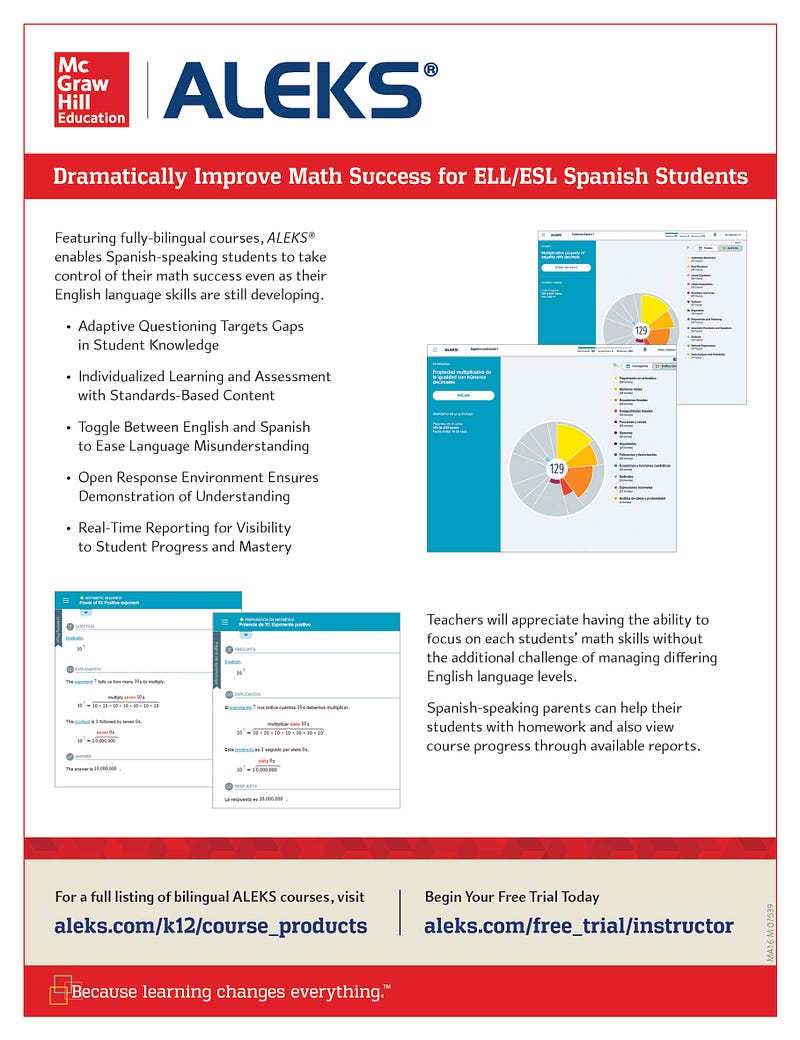
ALEKS, an innovative, research-based online math program, uses adaptive technology to address the learning needs of each individual student. ALEKS identifies each student’s knowledge gaps and designs a personalized learning pathway based on what the student is ready to learn next. But ALEKS extends personal learning beyond math to feature fully-bilingual courses, and enables Spanish-speaking students to access mathematics in whichever language they are most comfortable. ALEKS enables parents, who may also be more comfortable with Spanish, to help students with homework and maintain connections to their child’s learning progress. Instead of demanding that students abandon their first language to engage in math, ALEKS provides instruction in two languages. Such a practice impacts a student in two ways:
First, it acknowledges both the significance of a student’s culture and recognizes their remarkable achievement in working bilingualism. Math, truly, is a language unto itself. Now, imagine engaging and utilizing two more languages while you solve a math problem. It is a truly impressive feat!
Second, it demonstrates a genuine, driving effort to empower these students to succeed. Depriving them of the use of their first language while they are attempting to build core numerical competencies necessary to succeed in the classroom, in higher education and in the workforce does our young learners no favors. ALEKS provides students with every tool that they need to meet Mathematical Content Standards and to grow as learning mathematicians, all while engaging in exceptional language practice.
ALEKS is proven to have a positive impact on schools with high populations of English Learners. At Big Bear Middle School in Big Bear Lake, California, ALEKS exceeded the expectations of parents, students, and teachers. Seventh and eighth-grade math teacher Deborah Burton was faced with a multitude of challenges. She told us:
“On one end of the spectrum were kids who had holes in their foundation,” Burton said. “On the other end of the spectrum were students who were brilliant at math, but were unmotivated to do their homework. This made whole class teaching a nightmare.”
But with ALEKS, Burton saw increased engagement and motivation, boosted test scores, and independently working students in the classroom. ALEKS helped Big Bear Middle School meet the Mathematical Content Standards, and appealed to learners at both ends of the diverse learning spectrum that had previously plagued Burton’s instruction. Importantly, the program addressed the unique needs of English learners:
“Because ALEKS is also available in Spanish, English Language Learners (ELL) were able to work on problems in Spanish and then toggle over to English to show Burton their progress, allowing her to help them where needed.”
ALEKS empowered an entire school district to drive positive learning outcomes in mathematics, and didn’t leave English Learners behind. By providing instruction in both English and Spanish, students who had a greater degree of comfortability with Spanish were able to learn in an environment best suited to maximize content mastery. The toggling feature enabled students and teachers to work cross-linguistically and cross-culturally, the ultimate in collaborative and productive instruction.
To learn more about the experiences of the students at Big Bear Middle School, read more here:
To learn more about how ALEKS can empower the English Learners in your district to reach new heights in mathematical competencies while practicing biliteracy, check out the flyer below and visit the ALEKS homepage.