
Engagement

All great products have an element of magic and provide true value. They deliver highly engaging experiences. You are alone and bored one Saturday morning and thinking about what you want to do. You ponder over your choices and eventually decide to go see a movie at the theater. It has your favorite actor in it which motivates you. The movie is gripping. As you are watching the movie, there is a constant feeling of suspense. You are staying upright and you have lost sight of time and space. This type of experience is engaging. It entertains our senses and leaves us with a special feeling!
Strong products deliver such engaging experiences multiple times a day, providing inherent value. When users truly love your product, they will come back to it more often, increasing number of sessions per week (L5+/L7 in Figure 1), spending more time with it (time spent, or TS), and eventually becoming daily active users (DAU).
Such users are also highly retained, which increases a product’s retention (say, D1 and D7). And because DAUs continue to be weekly active users (WAU) and monthly active users (MAU), as well, they increase the intensity of engagement for each group (i.e., DAU/MAU and DAU/WAU). In other words, engagement drives stickiness, which drives retention — and that, in turn, drives growth.
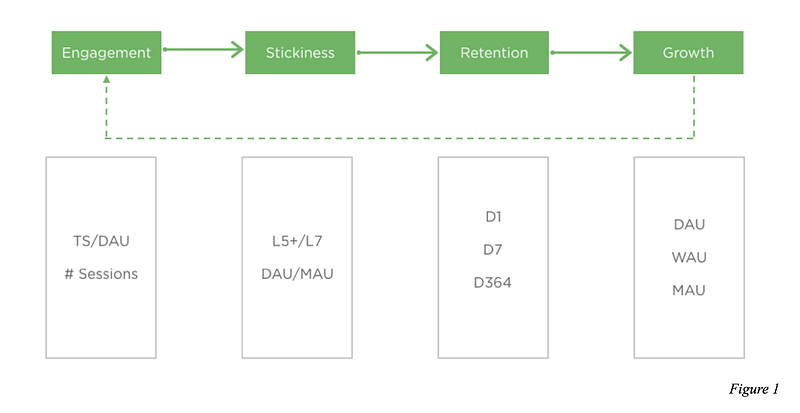
Thus, engagement is necessary to achieve both sustainable growth and true product-market fit, and getting people to truly love your product should be the goal of your Product team.
ENGAGEMENT AND PRODUCT TYPE
The nuances of engagement vary based on the type of product. For example, the production-consumption framework of user-generated content (e.g., Facebook, Instagram, Snapchat, YouTube) is different than that of professionally generated content (e.g., Netflix, HBO). Similarly, engagement for marketplaces like eBay, Amazon and Airbnb differs from engagement for messaging products like iMessage, WhatsApp and Facebook Messenger. The consumption surface (like News Feed) and device (Mobile versus TV versus Desktop) also play a significant role in engagement.
Therefore, to provide thorough guidance on building highly engaging, data-informed products, we plan to provide frameworks for understanding engagement in the context of various product types: News Feeds, Professionally Generated Content, Marketplaces and Messaging. In the next several posts, we will delve deep into News Feed engagement, Content Production, Connections & Inventory, Activity Feed Ranking, & Consumption.
This work is a product of Sequoia Capital’s Data Science team. Jamie Cuffe, Avanika Narayan, Chandra Narayanan, Hem Wadhar and Jenny Wang contributed to this post. Please email [email protected] with questions, comments and other feedback.
Originally published at www.sequoiacap.com.

This story is published in The Startup, Medium’s largest entrepreneurship publication followed by +367,690 people.
Subscribe to receive our top stories here.


