Energy Transition: Barely Begun, Nearly Over
Solar, wind, and battery equipment manufacturers face market saturation within 12–15 years. This means whoever has solar factories now, or will do soon, has already won the race to build Stage 1 of the transition — and those “whoevers” are mainly Chinese. Others will be relegated to a smaller, costlier Stage 2 of the buildout of the world’s next energy system.
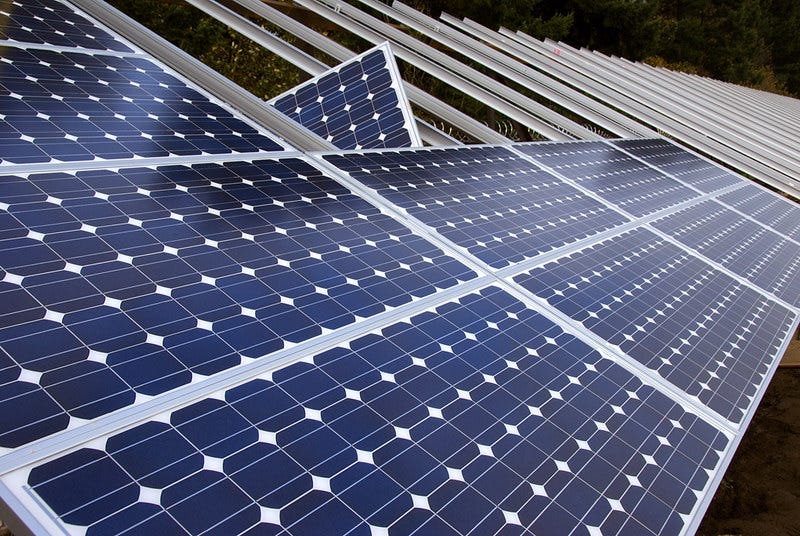
Signs that the energy transition is finally happening have become widely visible over the last year or two in the US in solar arrays on roofs and fields, wind farms dotting the landscape, and electric vehicles (EVs) on the roads. China and much of Europe are a few years ahead in the process, but not many.
Yet the “transition” — viewed as a journey to a new, largely electrified energy system, not as an end-goal — will be substantially complete within 12–15 years. That’s an incredibly short time in the world of manufacturing — less than the operating life of a factory for building solar modules, windmill blades, or batteries for EVs or electricity storage.
By the mid-2030s, renewable equipment makers will see market saturation, the same abrupt end to meteoric growth in demand for their products that Apple and other smartphone makers are grappling with today. Just a decade and a half after the first iPhone was introduced in 2007, virtually everybody has an all-purpose smart phone of some sort, so all manufacturers can do is replace existing models with something perhaps marginally better, advertised as a breakthrough. New customers have dried up. Everybody already has one.
The same will happen to solar, wind, and battery equipment makers by the 2035 target date widely set for conversion to a “zero-net emission” electricity grid. This is true even if the target is not fully met by exactly that date, and a few gas- or even coal-fired power plants are still operating during solar and wind downtimes.
Renewable electricity — along with electric vehicles (EVS) — comprise Stage 1 of the transition. Whatever ends up getting used as backup generating sources, and whatever happens with “hard to decarbonize” parts of the economy, Stage 1 is entering its final, high-growth but short-duration phase. And power generation and transportation are not only where most of the fossil fuels get used now, they are where most of the business of the transition will take place. Stage 1 is big and important.
Beyond the transition, there will be no business comparable in function or size to today’s oil, gas, and coal business. Nobody mines or drills or transports sun and wind. So the end of Stage 1 of the transition is the point at which the energy industry as a focal point of investment and jobs will start to contract in a major way. Stage 2 of the transition will still be in progress, but it involves one-third or less of primary energy, depending on how you count. It’s important, but it won’t be all that big.
Success and Its Problems
While much about the later stage or stages of the transition remains uncertain, the front-end, Stage 1 buildout of renewable generation and EVs is far enough along that its timing and technologies are clear and unlikely to change much. Solar and wind generated roughly 12% of the world’s electricity last year, and solar, especially, is expanding at a breakneck pace almost everywhere off what is no longer a tiny base.
That rapid expansion is in large part because renewables are now a cheaper way to expand power generation than new coal or gas-fired plants almost everywhere, and the cost gap is widening with every passing day. A temporary upward blip in renewables’ costs over the Covid years is over.
There is every reason to think that the 2035 goal for nearly carbon-free electricity can and will be met, and met well ahead of that date in many places. International Energy Agency Executive Director Fatih Birol tells us so in a Financial Times column saying that use of all three fossil fuels will peak this decade, much sooner than expected only a year ago. Of course, the change still isn’t coming fast enough to cap warming at 1.5℃, but the process is edging closer to that still elusive target.
All this sounds good to anyone worried about the climate, which should be everyone. In a fundamental sense, it is good.
The problem as many see it, particularly in the West and in India, is that China is way out front in the renewables transition game. Even with the hefty subsidies available to anyone who builds a solar equipment plant in the US, and various encouragements to prospective local manufacturers elsewhere, no one else can come close to catching up with China in cost terms by 2035. They sell panels cheap and their solar companies are nonetheless profitable.
Washington will have to rely on high trade tariffs if it wants to keep cheaper Chinese solar modules out of the US, and it may well do just that, even if it means substantially more polluting and expensive US electricity.
But even if the US does choose China Bashing Over Climate Saving, it may not get all that many first-generation solar plants. Each passing year brings closer the point at which companies eyeing new solar equipment factories, wherever they are and no matter the subsidies, have to wonder whether there will still be a big enough market for their products for long enough to pay off their investment.
After all, the Chinese by most calculations already have nearly enough solar manufacturing capacity operating or about to be built to supply the entire transition worldwide. Any additional Stage 1 capacity risks being surplus-to-need.
The Big Implications
That may sound like an esoteric issue. Who, other than a few large companies and maybe their shareholders, cares whether and when market saturation for solar panels and windmills arrives? Surely the important thing is to get more emission-free electricity in place as soon as possible. In fact, though, this twist on transition timing has big implications of interest to any of us who care about how our broader economies run, and how dependent our countries are on the global trading system and on China:
* First, odds are that, rather than going head-on against China during the transition itself, the West will compete mainly by developing next-generation, more efficient solar and wind equipment that can be installed after 2030 or even 2035, when much of their baseload needs are already met by solar and wind equipment that was largely made in China. This extends vital interdependency between China and the West for another decade at least — whether those two countries like it or not.
* China is also likely to dominate in production of the storage batteries being installed increasingly as a routine matter alongside solar and wind for overnight and other short-duration storage — although this sector is more fluid than solar and onshore wind, both because the technology is still changing rapidly and because the batteries used for short-term electricity storage are the same as those in EVs, which have a whole other set of uncertainties.
* Time is running out for the big Western oil majors that are still dithering over whether to aim for a second life as an “energy major” beyond the oil age. By not investing in the high-volume Stage 1 of the transition, the scope of operations open to them in Stage 2 becomes small. This includes carbon capture and storage (CCS) and so-called clean hydrogen, which will be needed only for a relatively small slice of the power generation pie if they’re needed at all. Ditto for hard-to-decarbonize industrial processes like petrochemicals, steel, and concrete. There simply won’t be enough business in those areas to keep all those giant one-time-oil companies going on top of the corporations already doing those things — many of which are Chinese state-owned.
* The US may try to take advantage of its position as the world’s largest oil and gas producer to turn CCS and hydrogen into major competitors in the longer-duration, slow-release power storage sector, as well as for heavy-duty road and water transportation. This would be problematic, since CCS is an absurdly expensive process with limited prospects for affordable success. It’s a distraction that could delay and complicate the US transition.
It would be better for the world if nations could all cheer China’s success at moving so far and fast into renewable power equipment manufacturing. Unfortunately, our world doesn’t work like that, at least not at this time of heightened animosity between Beijing and Washington. Instead, China’s lead has set up a dangerous clash in the West between climate-saving goals that require doing business with China, and economic ambitions that point in the opposite direction. We must all hope the climate wins.