

POLITICS | LITERATURE
Enemies of the State: The Politics of Nationalism in Post-9/11 Britain
How Britain came to view migrants and Muslims as threats to its national identity
“The ones we love […] are enemies of the state” — Antigone
After 9/11, #FlyingWhileMuslim and #FlyingWhileBrown were the hashtags used to expose the Islamophobia faced by Western Muslims at airports.
From being kicked off a plane for speaking in Arabic to being kicked off a plane for reading a book on Syria, the cases of racial profiling during the 9/11 decade are endless.
To this day, I still dread the airport whenever I go on holiday with my family. Because I know what’s going to happen. I know how we — along with many others like us — will be watched, singled out, and degraded.
From the targeted “random selections” to the humiliating security procedures, as a brown British Muslim, I will always be criminalized in the eyes of the law.
All because I fit the racial profile of a stereotypical terrorist.
Counter-Terrorism Law: Racial Profiling
Since 9/11, Islam has become synonymous with terrorism and Muslims have become synonymous with terrorists.
In the War on Terror, we’re all seen and treated the same: as enemies of the state.
Over the years, many discriminatory policies in the UK have continued to be justified under the guise of “national safety and security”. In a country that claims to rule via a democracy, are its anti-migrant policies really the most democratic way to tackle terrorism?
“One of the great sleight of hand manoeuvres by many democratic governments since the start of the “war on terror” has been to convince its citizens that we need to set aside our principles in the name of security.” — Kamila Shamsie, The Guardian
In the same vein, Sherene Razack in Casting Out (2008), argues how Western counter-terrorism laws “operate in a culture of exception”, where Muslims are dealt with in “place[s] of law without law”. Stripped of their basic rights, they find themselves on watch lists, under mass surveillance, held in detention, and even deported without fair legal trials.
Under Schedule 7 of the UK Terrorism Act 2000, an officer has the right to search, question, and detain for up to 6 hours (previously 9 hours) any person at any UK border. Mind you, there’s no requirement for there to be any grounds for suspicion in order for this power to be exercised. Though it provides a strict Code of Practice, the legislation has undoubtedly left migrant Muslim communities vulnerable to discrimination over the years.
“By not only ‘othering’ and singling out Muslims as a suspect community through laws such as these, but also attempting to justify it, the state is reinforcing the narratives advocated by far-right organisations: that Muslims are not treated as, and will never truly be, a part of British society.” — CAGE
In their article examining counter-terrorism laws, Basia Spalek and Bob Lambert note how the many “draconian” policies and legislations passed after 9/11 in the UK served to “justify” discriminatory practices against Muslim communities. Concluding, Spalek and Lambert call for a “more enlightened” counter-terrorism policy that “empowers” Muslim communities, rather than alienates them.
So why are peaceful, law-abiding British Muslims still being treated like criminalized citizens?
Statistics and Reports: Schedule 7
According to a legal report published by the London-based advocacy organisation, CAGE, in 2019:
“Statistics support the fact that Schedule 7 stops are based on religious and racial profiling. In 2014, a team of students at Cambridge University — named Operation Insight — found that 88% of its sample of those stopped under Schedule 7 at a particular airport, were Muslim.”
Furthermore, an analysis of the 2015 UK Stop-and-Search figures by Faith Matters found that British Asians have been disproportionately affected by Schedule 7 powers, stating:
“[British] Asians are almost 80 times as likely as a White person to be detained at an airport or port.”
More recently, the Home Office figures for 2023 so far reveal that a grand total of 2493 people have been searched and detained at UK airports. Of these people, 33% were identified as British Asian (Indian, Pakistani, Bangladeshi, etc) compared to only 20% who were identified as White (English, Irish, etc).
So how has the literary world responded to the post-9/11 decade?
9/11 Fiction: Kamila Shamsie’s ‘Home Fire’
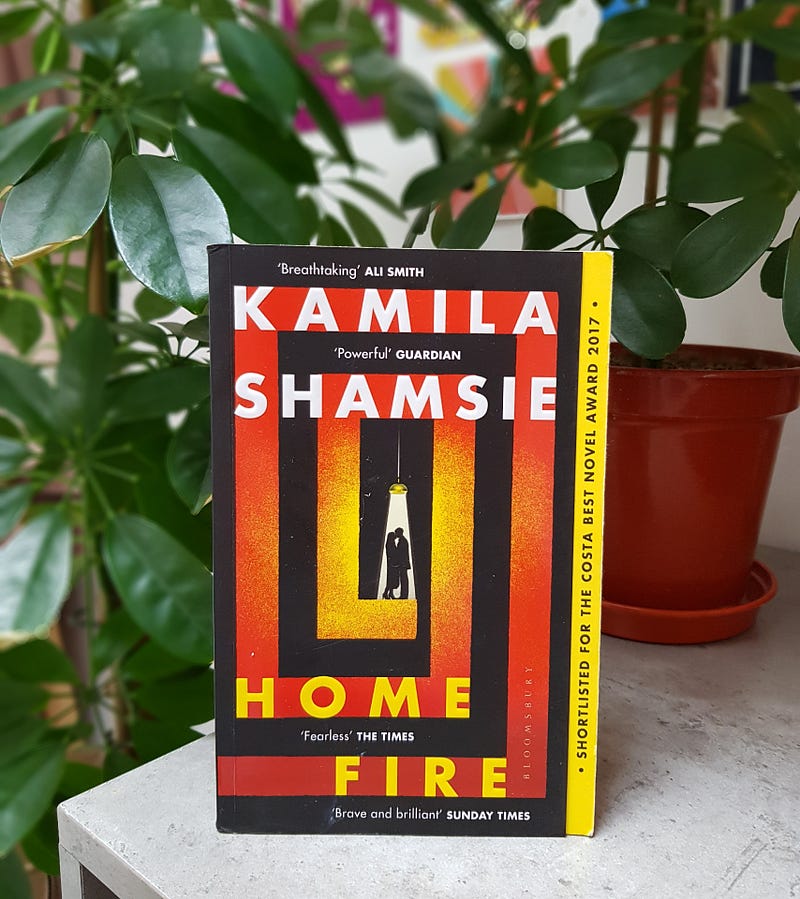
“[The system] has taken on discriminatory attitudes that exist in the culture and enshrined them in law, distinguishing between those who are “British British” and those who are British until the home secretary decides otherwise.” — Kamila Shamsie, The Guardian
9/11 permanently altered the British Muslim identity.
Writers, like Shamsie, sought to engage with the debates the decade gave rise to through literature. Such literature has since become a powerful medium, giving voice to the thousands of voiceless migrant and Muslim communities who continue to sit at the margins of global political debates today.
To better make sense of these debates, then, I’ve selected Shamsie’s award-winning novel, Home Fire (2017), for a brief analysis. As a contemporary adaptation of the Greek play, Antigone, Home Fire follows the lives of a British Muslim family wrestling with their duties to family, faith, and the state. Set against the backdrop of post-9/11 Britain, it tackles issues such as radicalism, Islamophobia, and racism amongst many others.
At its heart, Home Fire is a tale that exposes the trials British Muslims face in a country that will always see them as the enemy.
As I cannot discuss everything, I will focus on two key, clashing characters for my analysis: Isma Pasha and Karamat Lone.
Isma Pasha: a criminalized British Muslim

Though an innocent, law-abiding citizen, Home Fire’s British Muslim protagonist, Isma Pasha, is often treated like a criminal by British society.
Owing to the history of her dead jihadi father and her radicalized brother, Isma’s entire life is suffocated by a shroud of governmental surveillance. Throughout the novel, she finds herself having to relentlessly prove to the Home Office and MI5 that she is not a threat to her country’s security.
Take her airport scene, for instance; a familiar experience to many Western Muslims growing up under the shadow of 9/11.
At the beginning of the novel, Isma attempts to visit America to pursue a Ph.D. in Sociology. Her journey, however, is interrupted by a humiliating interrogation at Heathrow Airport, during which she is detained, searched, and grilled on her cultural and political beliefs. The immigration officers question her on matters relating to terrorism, such as the “invasion of Iraq” and matters relating to Britishness, such as “the Queen” and “democracy” (p. 5).
The airport interrogation prompts Isma to adopt a homogenous identity of Britishness — one that is politically correct and censored of her Muslim Pakistani background.
As a Muslim, Isma is expected to “prove her Britishness” to UK immigration before visiting the US— a national ally of Britain. By proving her Britishness to them, she will in effect be demonstrating her loyalty and allegiance to the UK, as opposed to her own religion. To the immigration officers, Isma practicing her religion is synonymous with her showing loyalty and allegiance to Islamist terrorist groups.
This black-and-white thinking is, of course, not so far removed from the attitudes embodied by many British political institutions and mainstream media today.
Karamat Lone: the anti-migrant nationalist

As the minister responsible for immigration and security in the UK, Home Fire’s Home Secretary — Karamat Lone — is a key character actively involved in policing the behavior of British Muslim citizens.
Though Pakistani and Muslim by name, Karamat does not practice nor identify with his cultural background. His British identity is essentially built upon the rejection of his Muslim Pakistani identity. To his critics, he is a “coconut”, a “sellout” and a “traitor” (p. 35).
To prove to the secular British population that he is “not like the others”, Karamat is partaking in what Sarah Ahmed in her book calls the “Neighbourhood Watch”. Commenting on George Bush’s 2001 State of the Union Address, Ahmed notes the ways in which citizenship following the 9/11 attacks became a way of “neighbourhood policing”. Good citizenship was thus demonstrated by “look[ing] out for suspicious others” who could be identified through “looking Middle-Eastern, Arab, Muslim”.
For Karamat, things are rather black and white: one is either for or against Britain. Migrants and Muslims, as such, are threats to the British identity. So, like many far-right-wing politicians today, Karamat can often be found on TV publicly scolding British Muslims for being “too Muslim”. (p. 216).
In her article, Debjani Banerjee notes how Karamat’s speeches act as the “echo chambers of Britain” which have been moving away from a “reluctant multiculturalism” to the “imposition of a homogenous British identity”.
By making light of such characters, Shamsie challenges the idea of an anti-migrant British identity and empowers multicultural British identities instead.
Today, literature like Home Fire plays an important role in shaping our socio-political conversations.
Urszula Rutkowska explains how the relationship between literature and politics is often a “synchronic” one. The contemporary novel, Rutkowska argues, engages with the world as we see it today by “staging debates” for us to resolve in both an imagined and real future. For one, Home Fire highlights the problematic ways in which institutions, like the British Home Office, continue to resort to policies that “disenfranchise racial minorities” when dealing with religious extremism in migrant Muslim communities.
Ultimately, the only way to combat radicalism, extremism and terrorism in the UK is for the government to work alongside British Muslim communities as allies, not as enemies.
If you enjoy my work, I’d love a tip of appreciation from you! Thank you ♡


