
End Game: Why The Rich Don’t Care
Only 100 million people are needed to sustain a high tech world. There are 8 billion of us.
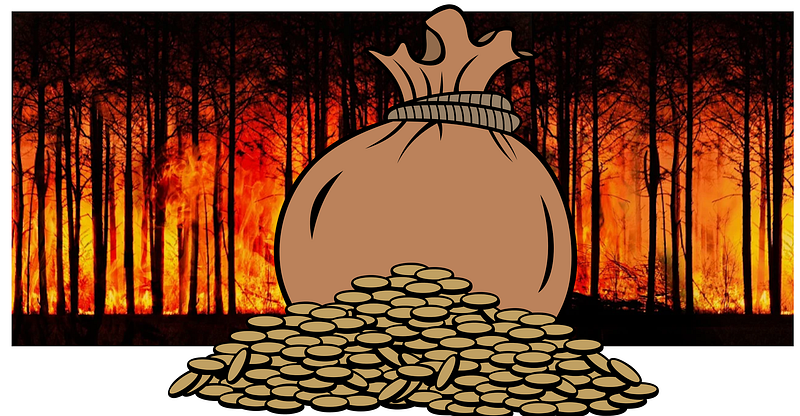
For those of us who barely get by and who are, by nature, caring of the world around us, it is difficult to understand those who have enough money to buy the moon but refuse to fix the earth. They knowingly persist in behavior and actions that continue to damage the environment, leading us all to increasing disaster. The question is why.
The world’s richest people emit huge and unsustainable amounts of carbon and, unlike ordinary people, 50% to 70% of their emissions result from their investments. New analysis of the investments of 125 of the world’s richest billionaires shows that on average they are emitting 3 million tonnes a year, more than a million times the average for someone in the bottom 90% of humanity. Source
“These few billionaires together have ‘investment emissions’ that equal the carbon footprints of entire countries like France, Egypt or Argentina,” said Nafkote Dabi, Climate Change Lead at Oxfam “The major and growing responsibility of wealthy people for overall emissions is rarely discussed or considered in climate policy making. This has to change. These billionaire investors at the top of the corporate pyramid have huge responsibility for driving climate breakdown. They have escaped accountability for too long,” said Dabi. Source
The report released Monday by the U.N. Intergovernmental Panel on Climate Change (IPCC) found that the world is likely to surpass its most ambitious climate target — limiting warming to 1.5 degrees Celsius (2.7 degrees Fahrenheit) above preindustrial temperatures — by the early 2030s. Beyond that threshold, scientists have found, climate disasters will become so extreme that people will not be able to adapt. Basic components of the Earth system will be fundamentally, irrevocably altered. Heat waves, famines and infectious diseases could claim millions of additional lives by century’s end. Source
The world is overpopulated
No doubt if we all still lived in an age of horse and carriage, the damage from fossil fuels might not be as great. However, when 8 billion people are all striving to live the American dream, things are a little different. In addition to that, the world will reach 9 billion people in fourteen years and 10 billion people in 2058.
With the weather already shaking its fists at us, things can only get worse, the more people there are. However, what would happen if, as a result of all these disasters, many millions die? In fact, what would happen if half or three quarters of the population died through natural disasters like starvation, pandemics, fires, or flooding?
At the minimum size, it’s likely in the order of hundreds of thousands of people. They would be ‘poor’ from some perspectives, but it could be fully stable. Quality of life would be comparable to industrial societies in 2020. If trying to achieve maximum quality of life per capita, it’s probably in the order of 10s of millions of people. That would be an average standard of living just slightly below the average you’d find in first world settings today, but with a quality of life that is substantially higher than average in the first world today. Source
How many people are needed to maintain the current level of technology
This is a question that is frequently asked, and many different answers are given. They range from about one million to a hundred million. For the sake of redundancy, I’ll go with hundred million. That said, the fact that this question is frequently asked on the web is scary.
My point is that many realize that death could be around the corner for either millions or billions due to climate change. They also see the possibility that without many people, it is not possible to maintain the current level of tech. That’s not something they want to contemplate, so the question is how many of us are needed to ensure that even if many people die, the standard of living and quality of life would still maintain high tech and carry on as before.
Money protects one from much
When one has a lot of money, that money protects us from the harsh side of life. When one has billions, it enables us to buy homes in any place that we consider safe, and it also enables us to produce food in high tech ways. We are also able to invest in industries to ensure that our way of life continues.
So why would billionaires care if billions of people die?
They answer is that they don’t.
They dont’ care because they have a low opinion of people who aren’t billionaires. They perceive them as stupid, lacking in ability to make money, and not worthy of life. They also realize that the world is over-populated, and that it’s quite possible to continue to use oil if there only one percent of humanity survives.
They have no problem with one percenters— after all, one percenters are also part of the elite.
Research is uncovering how wealth impacts our sense of morality, our relationships with others, and our mental health. Several studies have shown that wealth may be at odds with empathy and compassion. Wealth can cloud moral judgment. Another study suggested that merely thinking about money could lead to unethical behavior. The pursuit of wealth itself can also become a compulsive behavior. Source
Power changes perspective
When one can do exactly what one pleases, it becomes easier and easier to live in unethical ways. Ethics comprise rules that ensure the greater good of all people. Essentially, the richer one becomes, the less one cares about the lives of others.
The clients of this Geneva-based wealth manager also “believe that they are descended from the pharaohs, and that they were destined to inherit the earth”. If a poor person voiced such beliefs, he or she might well be institutionalized; for those who work with the wealthy, however, such “eccentricities” are all in a day’s work. Source
When the wealthy are revealed to be drug addicts, philanderers, or work-shy, the response is — at most — a frisson of tabloid-level curiosity, followed by a collective shrug. Source
The researchers found that unethical behavior was closely related to positive feelings about greed. Although the connection appeared to be strongest among high-status individuals, even lower-status individuals were more prone to ethical lapses if they felt that greed was good. Source
When it comes to the wealthy, research shows that they will go to great lengths to maintain their higher status. When it comes to the wealthy and privileged, a sense of entitlement, or a belief that one is deserving of privileges over others, can play an important role in unethical conduct. Privileged individuals are also less likely to follow rules and instructions given they believe the rules are unjust. Because they feel deserving of more than their fair share, they are willing to violate norms of appropriate and socially agreed upon conduct. Source
Why the rich don’t care about climate change
The rich don’t care because they think they will be safe. Added to that, they believe that with fewer people on the planet, they will be able to continue to live as they are, and the world will be a much better place.
We do not know how many millions or billions will die in the years ahead, but many scientists have speculated that humanity will be extinct within 80 years.
In 2020, Toby Ord estimates existential risk in the next century at “1 in 6” in his book The Precipice: Existential Risk and the Future of Humanity. As of July 2023, Metaculus users estimate a 3% probability of human extinction by 2100. Source
Martin Rees is Britain’s astronomer royal, a professor at Cambridge University, and one of the leading cosmologists in the world. In a 2003 book, titled Our Final Hour, he gave civilization a 50–50 chance of surviving the 21st century, an estimate he reached after surveying all the ways humanity could destroy itself. Source
Let’s not be that harsh. Let’s say that small pockets of human beings will survive. They were able to survive because they had the means to travel to geographical locations which were safer and which still provided food and water. Those places had also been designed to sustain life despite climate change. Billionaires have the kind of money to build places like that.
In all of this, it becomes obvious that climate change is not a threat to billionaires. They understand what is happening. It’s just not relevant to them.
If you find my stories informative or entertaining, please would you consider ‘buying’ me a cup of coffee at Ko-fi for $3. Writing is my only means of survival. The reason for that is I have Asperger’s (high functioning autism) and an Auditory Processing Disorder, and I would greatly appreciate your kindness. Alternatively, if you’d like to contribute to me on a monthly basis, you can do so at either Ko-fi or Patreon.