
Encounters with the Prose Poem: An Impressionistic Essay
The text-lines are straight — but the meanings are not
Often mistakenly perceived as modern or contemporary in origin and style, the history of the prose poem stretches back several centuries and across different cultures. In seventeenth century Japan, when poet Matsuo Basho dared to combine haiku poetry with prose, haibun was born. In the early nineteenth century, a small collection of French writers, heralded by the work of Maurice de Guerin rebelled against the centuries-old alexandrine structure of traditional verse poetry and created a fresher, freer form of poetry of which Charles Baudelaire’s prose poetry collection Paris Spleen (1869) is most emblematic.
The Surrealists seized upon stream-of-consciousness writing to explore sexual, moral and personal taboos in the early twentieth century, some of which took the form of prose poetry. Several decades later, the American Beat poets used similar techniques to break out of conventional verse form — with startling imagery and rhythms often inspired by the jazz movement — their work, a reaction against the ideological conservatism of the fifties.
All of these forms are known by that maddeningly contradictory term — prose poetry. Regardless of the era and cultural milieu, the prose poem genre possesses an unerringly rebellious heart and a chameleonic form. From one literary period to another it seems to taunt: you thought you knew me — well look again.
A Reader - Upon Meeting a Prose Poem
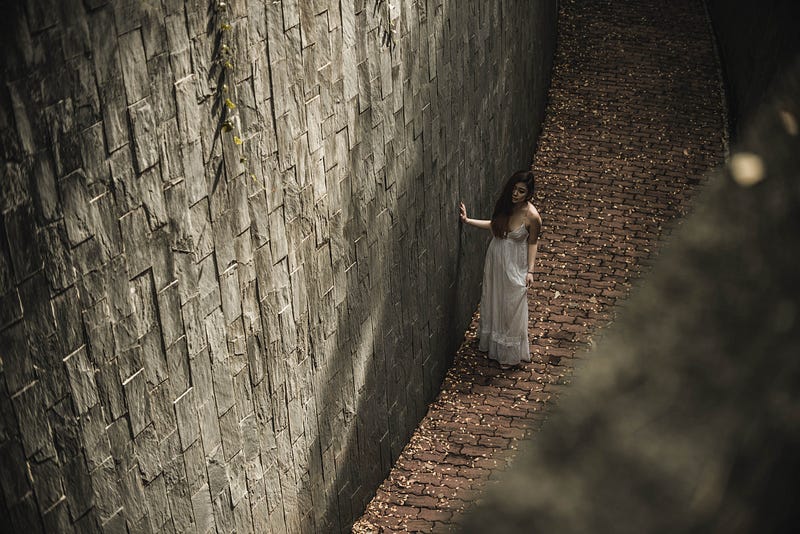
Those sentences, stacked and pruned like neat hedges into paragraphs, seem to speak of order — but hide creatures that rustle and scamper. Barbs and thorns to catch at your sleeve, scratch against bare skin, no matter how you try to keep in the centre of the path. Leaving their mark upon you. The hedges guard and border the labyrinth, paths to disorient and disorder you. Enter if you dare.
When a reader first stands in front of a prose poem, those seemingly straightforward paragraphs on the page are deceptive. They appear prosaic — promising plot progression, orderly exposition — the genteel balance of subject, verb and object. Sane sentences with a sprinkle of imagery for variety — that lead you confidently onwards with reliable narration. The reader thinks they see the writer pick up the pen, establishing themselves as the active narrator of the story.
But as they venture deeper, engaging with its content — inside those seemingly familiar blocks of text, unexpected events of meaning begin to unfold. Without the constrictive choreography of plot, language lifts from the page in a whirling dervish. Metaphors rear up like wildflowers and proliferate, spreading their pollen with fecund abandon. Perspectives become slippery — narrative contradicting, splitting or colluding against itself. Subjects may become objects, as objects become subjects.
In a prose poem, the pen picks up the writer by their fingertips, drags her through the story, an unwilling minor character in the pen’s erratic misadventures. The ink may escape and rebel in a soliloquy. The margins are not silent as they witness the writer slip by, but interject wry asides, like an oedipal Greek chorus. Sometimes, the writer’s ego slips a phrase in edgewise.
The text-lines are straight, but the meanings are not. Threads between images and ideas may skitter across and between sentences or phrases — defying the eye’s well-worn path as it moves from left to right across the page.
Adrift in a textual landscape of neither verse poetry nor conventional prose, the experience of discerning meaning is rich with possibility and — like this essay — impressionistic. The writer lays a banquet of meaning on the discursive table — then lets the reader fill their plate with what appeals and resonates.
The reader exits a prose poem the way one emerges from a carnival hall of mirrors or a labyrinth. Perspective upended. Direction distorted. Giddy and unsteady on one’s feet.
The Author — Upon Writing a Prose Poem
I crack open my head like an egg, letting the prima materia of my unconscious spill out onto the page, images gleaming and viscous like albumen, metaphors swimming in the womb of that golden, spreading, melting sun.
When writing a prose poem — or allowing a prose poem to write me — I descend into deeper layers of my mind, as if through different geological strata of a cliff-face—moving through conscious thoughts, chiaroscuro patternings of the subconscious, unconscious impulses, memories, images, associative fragments, beliefs and obsessions.
The prose poem is particularly effective at drawing unconscious elements out, as a magnet picks up iron filaments — and I only see them later, or have them pointed out to me by a reader, but by then they are reified in text — too late to take back and bury. I am found out.
I roam on the page, hauling up images, stitching them together through language in unexpected ways. In capturing an image, the way particular words re(sound) together — rhythmically, through alliteration and assonance, hard or soft rhymes, homophones, ambiguous or dual meanings — become as important as the image itself. I think of the Beat poets letting the lit smoke-swirl and mad jazz-whirl drift through the movement of their poetry. Sounds — language’s dance of rhythm and melody — manifests a distinct, yet intertwined level of meaning to the read text — as music does to lyrics.
Thus writing becomes a partially performative act, because I need to hear the words out loud after I write them down to experience their sound-sense, to tune those iterations to compliment the intended literary/literal syntax.
I feel free to tie up my Inner Censor, gleefully gaffer-taping his mouth. I revel in free-associating, like a Jungian dream, or a performing troupe of improvisational players. A panoply of literary and poetic devices clamour to be wielded in the writing — fragmentation, repetition, asides, recurring motifs, shifting points of view, extended metaphors — and yes, the dream sequence within the dream sequence.
In writing a prose poem — and I mean one where you forget you’re writing as you’re writing — you leave behind the rational mind, drift into a liminal space. Some call it flow, others call it channelling — but whatever and wherever it is, the writer surrenders to the ideas, on a level that’s almost sacrificial.
We sacrifice sense, logic, rationality — the semblance of sanity — to the force of the idea. We lay down our writerly ego upon the altar of untamed inspiration, dagger poised to slit its throat, drain it of life force so that the genius of the idea may descend onto our foreheads from the heavens. Or we build the bonfire, shed our clothes, prepared to dance all night, whirling into a Bacchanalian frenzy — not knowing if we will be the women, running and wild with carnal impulses, or the sacrificial victim, torn limb from limb by the power of desire, dangerously delirious.
Perhaps those original Greek Muses are bloodier goddesses than we imagine.
In writing a prose poem from our own prima materia, a writer experiences what it is to truly trust one’s creative impulses — to let the images fall as they will, or allow them to burn up the page. And that’s an immensely liberating experience — flowing back into and regenerating all of one’s writing.
Like the actor who changes character with the deft addition of a single costume item or prop — I don the fedora or twirl the cane — inhabiting the prose poem form — but also producing soliloquies, memoir, densely poetic fiction, ideological essays, vignettes, myth re-tellings and mad pastiches of all these forms and more.
The prose poem is a bottomless costume chest, a postmodern Pandora’s Box — swirling not with evils but creative possibilities. In comparison to writing in any other genre — prose or verse poetry or non-fiction, I’m most often taken by surprise, even mystified, by what I have written in the drafting of a prose poem. The images stare back at me defiantly, having assumed a life force all their own.
You thought you knew me — well look again.
© Melissa Coffey January 2022
NOTES: Italicized paragraphs are from the author’s works, published or in-progress. For qualities of the impressionistic essay, head here.
What would you like to know about the prose poem genre? I very much hope you’ll join me in the discussion.
Thank you to J.D. Harms and Scrittura for generously & Danielle Loewen for her constructive feedback.
Follow Melissa Coffey for thoughtful essays and provocative poetry & fiction.
My Complete Collection of Prose Poetry: