avatarTim Ward, Mature Flâneur

Free AI web copilot to create summaries, insights and extended knowledge, download it at here

4729

Abstract

2x.jpeg"><figcaption>Painting of Lance Richdale with one of his many feathered friends (my photo from the Taiaroa Head Albatross Research Center)</figcaption></figure><p id="7678">Lance became the driving force in setting up predator traps. He got the army to install fences round the bluff to keep people and dogs away. Lance even camped in a tent beside the next albatross that nested on the bluff (they have no fear of humans). He guarded and studied the birds, recording their rearing habits. Of the four nests he found in 1937, only one egg was hatched, but due to Lance’s dogged determination, that chick survived and fledged. Lance’s first scientific publication on the species was soon fledged too, launching his lifelong career studying and protecting the Taiaroa Head albatrosses.</p><p id="16fe">Eighty-five years later, some 30 pairs of albatross nest each year on Tiairoa Head, and the research station built by Lance has passed the 500 mark of birds fledged. Given that the Northern Royal Albatross are an endangered species with fewer than 17,000 adults in the world, this is a huge deal.</p><div id="961b" class="link-block"> <a href="https://albatross.org.nz/royal-albatross/"> <div> <div> <h2>Life Of The Northern Royal | Royal Albatross Centre</h2> <div><h3>Albatross are the world's largest seabirds. They normally breed on remote islands and spend at least 85% of their lives…</h3></div> <div><p>albatross.org.nz</p></div> </div> <div> <div style="background-image: url(https://miro.readmedium.com/v2/resize:fit:320/0*gB4_YxWTt4pXVqU9)"></div> </div> </div> </a> </div><p id="adfa">The Albatross Research Center monitors, protects and nurtures the young birds. They also run a fantastic “albatross experience” tours for visitors, taking them up to a glassed-in viewing station right the midst of the nests. The blustery August afternoon that I took the tour we were four large chicks visible about 20–40 meters away. Each young albatross — a ball of white fluff about the size of large turkey— waited patiently for its parents to return with fish to feed them.</p><p id="a133">According to our guide, an enthusiastic young researcher named Francesca, when fully grown, these chicks’ wingspans will surpass three meters/nine feet, and they will fly an astounding 190,000 kilometers each year of their adult lives. She pointed out the occasional adult as it soared by the viewing station:</p><figure id="af34"><img src="https://cdn-images-1.readmedium.com/v2/resize:fit:800/1*[email protected]"><figcaption>Albatross aloft, and four big chicks visible on the bluff below.</figcaption></figure><p id="2937">From the viewing station we also saw seagulls and shags struggling to fly straight in the buffeting winds, their wings all flappy-flappy. Not the albatrosses. They they soared, smooth and steady, through gusts that probably would have knocked me off my feet if I were not behind a glass wall. It was thrilling to watch them. Francesca told us to watch their webbed feet. We could see them twitch and wobble, which is how the birds to steer as they glide.</p><p id="d346">One of the coolest things about observing the chicks in August is that they are getting close to fledging, which means they spend a lot of time on the ground stretching and flapping their wings to strengthen them for their first flight:</p><figure id="2759"><img src="https://cdn-images-1.readmedium.com/v2/resize:fit:800/1*[email protected]"><figcaption></figcaption></figure><p id="3d02">Francesca explained that at this stage, the young birds weigh about 10 kg (22 pounds), and require a lot of food to keep growing. So both parents leave their chicks unattended while they search for fish. It’s hard enough for a big albatross to fly all day and feed itself. But to feed another bird nearly as big as you, one that just sits around all day in the nest playing video games and texting its friends when it should be stretching and preparing for life on the wing…well, parenting a teen albatross takes everything out of you. Literally. The young bird nuzzles the adults’ throats in a way that makes them regurgitate food. Vomited fish! Yum. Feeding goes on like this for eight full months before the day the young bird stretches its wings full, and for the first time lifts off and soars into the sky.</p><p id="622d">(You can watch the big chicks as they stretch their wings on this live cam):</p><div id="1167" class="link-block"> <a href="https://www.doc.govt.nz/nature/native-animals/birds/birds-a-z/albatrosses/royal-alb

Options

atross-toroa/royal-cam/"> <div> <div> <h2>Royal Cam: Live stream and highlights</h2> <div><h3>Watch the northern royal albatross at Pukekura/Taiaroa Head on Royal Cam.</h3></div> <div><p>www.doc.govt.nz</p></div> </div> <div> <div style="background-image: url(https://miro.readmedium.com/v2/resize:fit:320/0*Nxh1M9sUEvs-YyyV.jpg)"></div> </div> </div> </a> </div><p id="eadf">Francesca says the newly fledged birds do not return after first flight. They fly straight off to Patagonia — a 10,000 km journey — to feast on octopus and squid. They eventually fly back to Taiaroa several years later to find a mate, lay an egg, and become parents themselves.</p><p id="b26f">“So, they never even say goodbye to their parents? When they return to Taiaroa Head, do you ever see them, um, <i>visit</i> their parents?”</p><p id="3b6c">Francesca seemed confused by the question.</p><p id="1062">“No, once they fledge, there’s no bond. They just fly off and live their life.”</p><p id="9b00">Personally, I’d be pissed if I vomited into my child’s mouth for all those months and he never so much as dropped by to say ‘Thanks for all the fish.’ Hmmm…perhaps I am over-identifying with albatross parents?</p><p id="2ce7">These young birds are pretty lucky that as well as their parents, they have a team of researchers looking after them. Sometimes, if one of the parents does not return from the sea — dies, that is — the researchers will step in and hand feed it to supplement what the single parent provides. (No vomiting, though). If both parents fail to return, leaving an egg behind, the researchers have even had success fostering it with another pair of albatrosses whose egg has cracked or is infertile. Meanwhile the predator control program is a success, so much so that the local Little Blue Penguin colony in the beach below is also flourishing, too.</p><p id="b431">The albatross remains endangered, nonetheless. The hazards they face are mostly human caused. They get tangled in fishing nets, hooked by the long line fishing lines that float the oceans, and worst of all, they eat bits of plastic waste that accumulate in massive quantities in the oceans — even in the remote South Pacific. The Albatross Research Center features a grisly display of the several pounds of plastic found in a dead albatross’ stomach — everything from little plastic toys and bottle caps to a toothbrush. The plastic fills up their guts. They can’t excrete it, so they starve to death.</p><div id="56e1" class="link-block"> <a href="https://theconversation.com/plastic-in-the-ocean-kills-more-threatened-albatrosses-than-we-thought-154925"> <div> <div> <h2>Plastic in the ocean kills more threatened albatrosses than we thought</h2> <div><h3>Increasing plastic pollution in southern hemisphere oceans adds a deadly threat to albatrosses, already among the…</h3></div> <div><p>theconversation.com</p></div> </div> <div> <div style="background-image: url(https://miro.readmedium.com/v2/resize:fit:320/0*YockAfyjb0HTxON4)"></div> </div> </div> </a> </div><p id="822b">It’s easy to be cynical about human nature. We’ve done horrible things to the living creatures on this planet we share, and driven many species to the brink of extinction. Like the Ancient Mariner, we all have a dead albatross slung around our necks. But here on Taiaroa Head, Lance, and a community of people he inspired, are helping to ensure a secure future for this great bird. If there’s hope for the albatross, there might yet be hope for us, too.</p><p id="1b63">***</p><p id="376f">If you like slow travel, please check our my new book, <i>Mature Flâneur: Slow Travel through Portugal, France, Italy and Norway:</i></p><div id="9ba2" class="link-block"> <a href="https://www.collectiveinkbooks.com/changemakers-books/our-books/mature-flaneur-slow-travel-europe"> <div> <div> <h2>Mature Flâneur from Changemakers Books</h2> <div><h3>In the aftermath of the pandemic, author Tim Ward and his wife, Teresa, decided to leave their home and professional…</h3></div> <div><p>www.collectiveinkbooks.com</p></div> </div> <div> <div style="background-image: url(https://miro.readmedium.com/v2/resize:fit:320/0*YI8WpeeGXHCARrIZ)"></div> </div> </div> </a> </div></article></body>

Mature Flâneur Down Under

Encounters with Albatrosses (in New Zealand)

Where the big birds nest on the Otago Peninsula
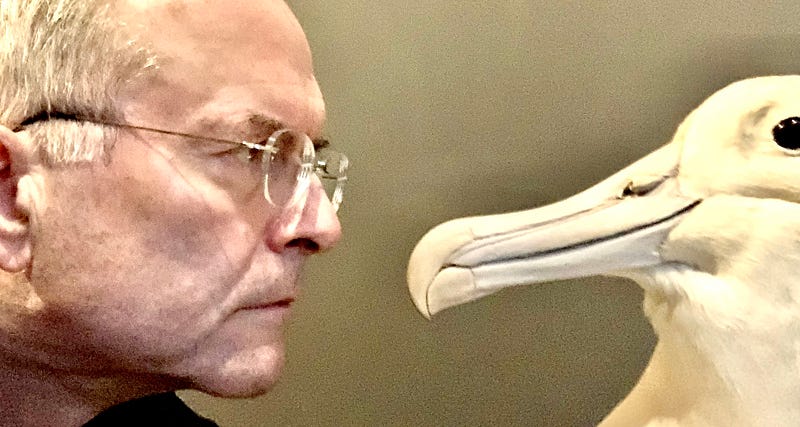
Cheek to beak with an albatross. All photos by Tim Ward (including this selfie)

Whenever the subject of albatrosses comes up in conversation, Teresa (my beloved spouse) and I look at each other and shriek “Albatross!” We do it in the distinct British accent of John Cleese. The absurd Monty Python sketch in which Cleese attempts to sell a dead albatross at a theatre as an intermission snack is seared into our memories. My one other point of reference for the bis of course Coleridge’s epic poem, The Rime of the Ancient Mariner, in which the mariner maliciously kills an albatross and is forced to wear its carcass around his neck until he atones for his crime…

Thus, none of my previous encounters with albatrosses have been with live ones. Until now.

Teresa and I stayed for three days on the Otago Peninsula in New Zealand’s South Island. Once, this whole area was a volcano that erupted and left behind a great circular cone of igneous rock. Over millions of years, wind and wave and rain wore crevasses into the rock, until it eroded into a land of fractured cliffs, dramatic bluffs, and strange geometrical formations:
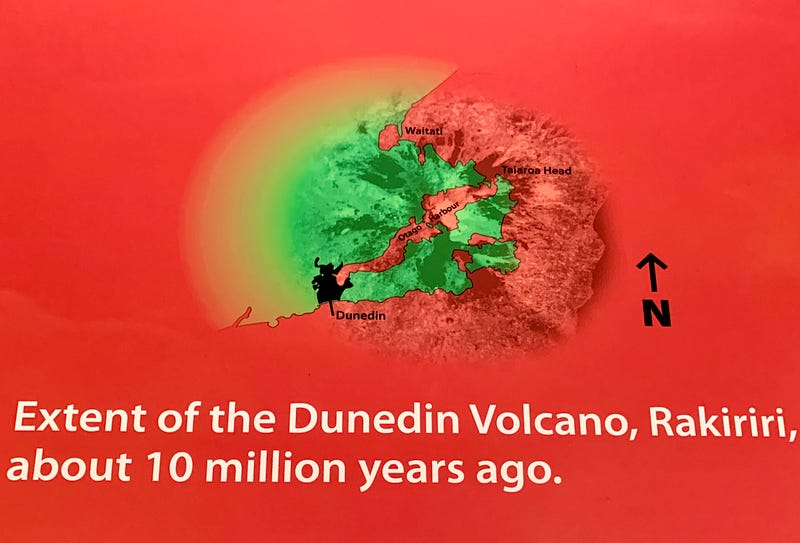
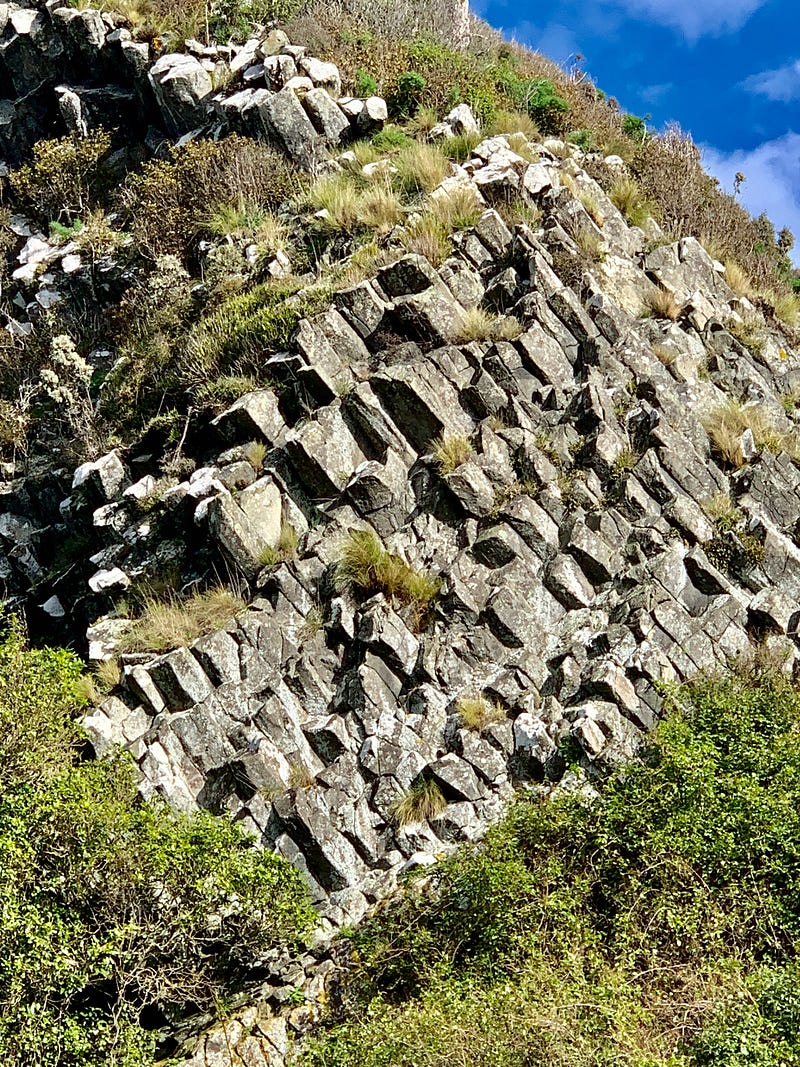
Left: The green area shows today’s Otago Peninsula superimposed on the ancient volcano. (My photo from the Otago museum in Dunedin). Right: Geometric shapes in the igneous rock formed after the eruption
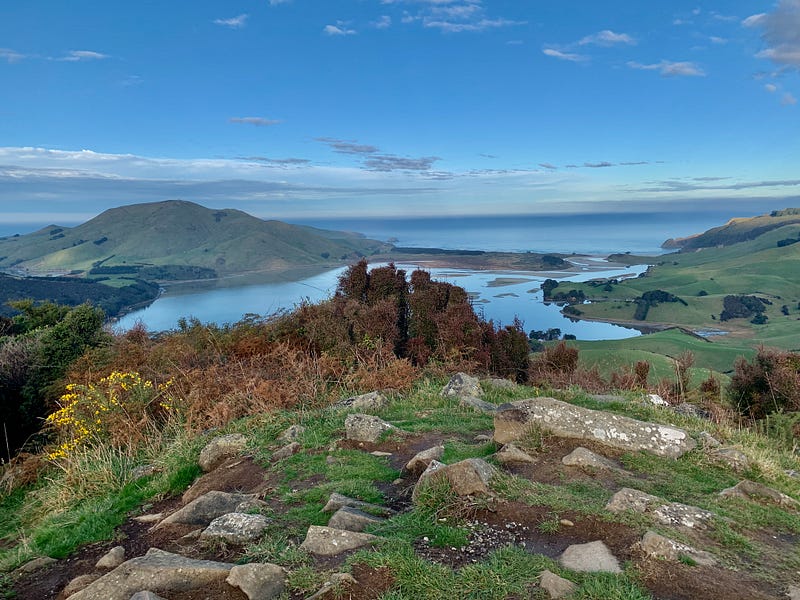
The Otago Peninsula today: a layer of grass over the remnants of the volcano

The bluff at the very end of the peninsula is called Taiaroa Head. At the top of the cliffs is a grassy slope, buffeted by perpetual ocean winds. This is the world’s only mainland nesting ground for albatrosses; most of them nest on remote island atolls, far away from humans and other predators.
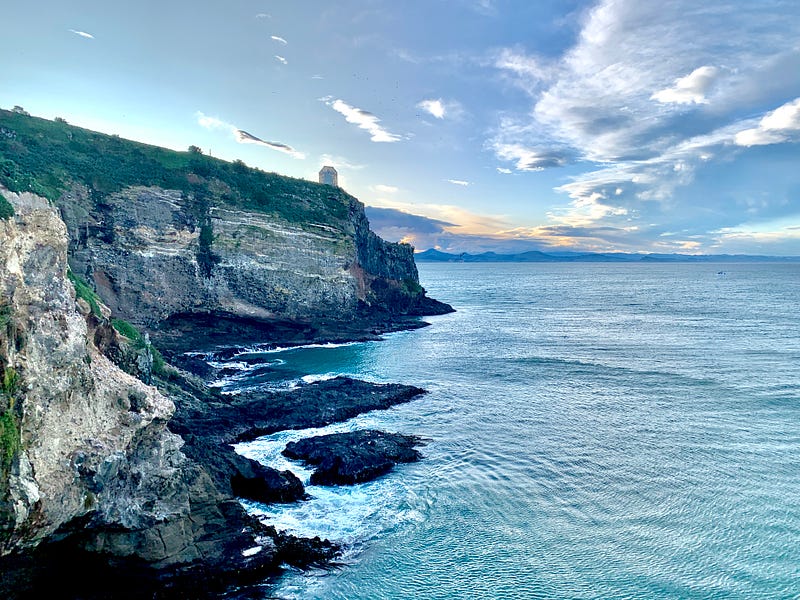
Taiaroa Head

Albatross are some of the largest ocean-going seabirds in the world. In fact, the species Wandering Albatross has the world’s largest recorded wingspan, at 12.1 feet — wider than a condor. They use those big wings to glide on strong ocean winds. The species at Taiaroa Head, the Royal Northern Albatross, made the unusual choice to nest on the bluff over a century ago, when it was a military outpost during the First World War. Of course, soldiers and animals alike ate the eggs — they were easy pickings. Yet, the albatrosses persisted until 1936, when a young biology professor, Lance Richdale, who was studying local penguin populations stumbled upon an albatross at Taiaroa Head sitting on an egg. He returned a few days later, and found the egg gone. He knew someone or something had stolen or eaten the egg. For Lance, it was a life-changing moment. He vowed to make sure the next albatross to nest of Taiaroa Head, would see its chick live!
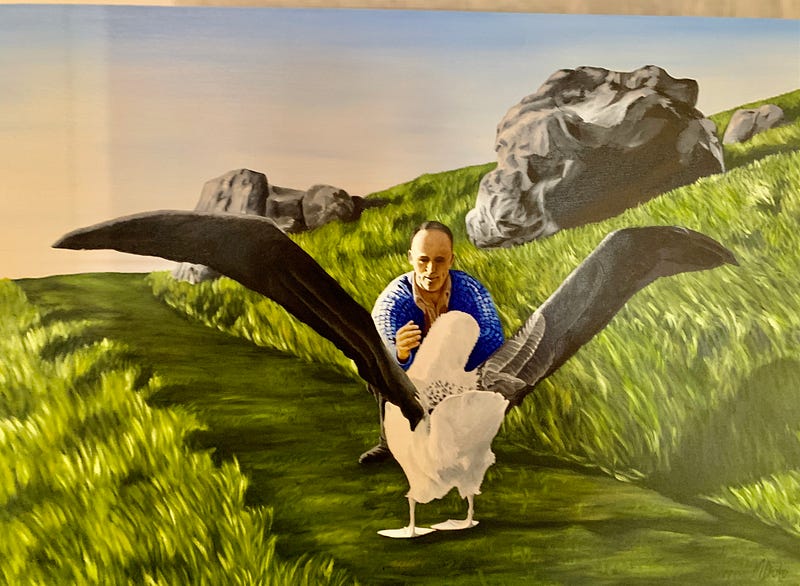
Painting of Lance Richdale with one of his many feathered friends (my photo from the Taiaroa Head Albatross Research Center)

Lance became the driving force in setting up predator traps. He got the army to install fences round the bluff to keep people and dogs away. Lance even camped in a tent beside the next albatross that nested on the bluff (they have no fear of humans). He guarded and studied the birds, recording their rearing habits. Of the four nests he found in 1937, only one egg was hatched, but due to Lance’s dogged determination, that chick survived and fledged. Lance’s first scientific publication on the species was soon fledged too, launching his lifelong career studying and protecting the Taiaroa Head albatrosses.

Eighty-five years later, some 30 pairs of albatross nest each year on Tiairoa Head, and the research station built by Lance has passed the 500 mark of birds fledged. Given that the Northern Royal Albatross are an endangered species with fewer than 17,000 adults in the world, this is a huge deal.

The Albatross Research Center monitors, protects and nurtures the young birds. They also run a fantastic “albatross experience” tours for visitors, taking them up to a glassed-in viewing station right the midst of the nests. The blustery August afternoon that I took the tour we were four large chicks visible about 20–40 meters away. Each young albatross — a ball of white fluff about the size of large turkey— waited patiently for its parents to return with fish to feed them.

According to our guide, an enthusiastic young researcher named Francesca, when fully grown, these chicks’ wingspans will surpass three meters/nine feet, and they will fly an astounding 190,000 kilometers each year of their adult lives. She pointed out the occasional adult as it soared by the viewing station:
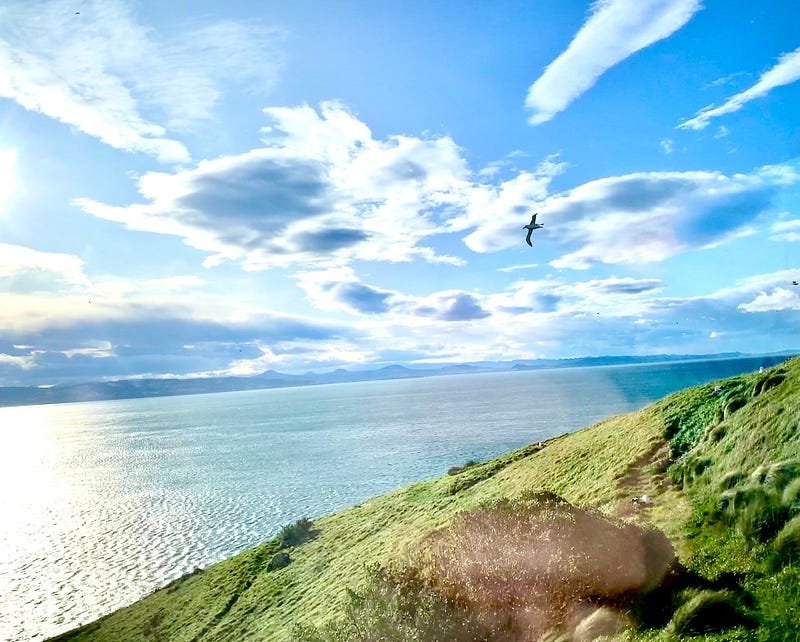
Albatross aloft, and four big chicks visible on the bluff below.

From the viewing station we also saw seagulls and shags struggling to fly straight in the buffeting winds, their wings all flappy-flappy. Not the albatrosses. They they soared, smooth and steady, through gusts that probably would have knocked me off my feet if I were not behind a glass wall. It was thrilling to watch them. Francesca told us to watch their webbed feet. We could see them twitch and wobble, which is how the birds to steer as they glide.

One of the coolest things about observing the chicks in August is that they are getting close to fledging, which means they spend a lot of time on the ground stretching and flapping their wings to strengthen them for their first flight:
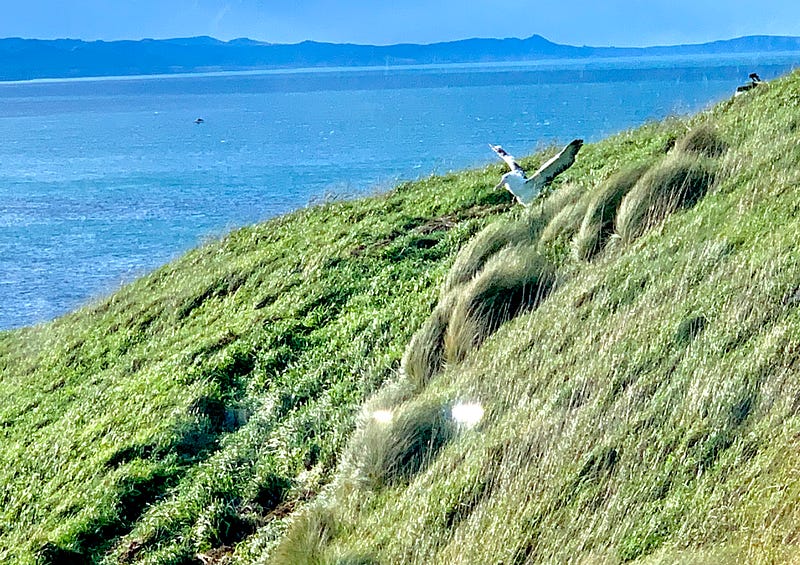
Francesca explained that at this stage, the young birds weigh about 10 kg (22 pounds), and require a lot of food to keep growing. So both parents leave their chicks unattended while they search for fish. It’s hard enough for a big albatross to fly all day and feed itself. But to feed another bird nearly as big as you, one that just sits around all day in the nest playing video games and texting its friends when it should be stretching and preparing for life on the wing…well, parenting a teen albatross takes everything out of you. Literally. The young bird nuzzles the adults’ throats in a way that makes them regurgitate food. Vomited fish! Yum. Feeding goes on like this for eight full months before the day the young bird stretches its wings full, and for the first time lifts off and soars into the sky.

(You can watch the big chicks as they stretch their wings on this live cam):

Francesca says the newly fledged birds do not return after first flight. They fly straight off to Patagonia — a 10,000 km journey — to feast on octopus and squid. They eventually fly back to Taiaroa several years later to find a mate, lay an egg, and become parents themselves.

“So, they never even say goodbye to their parents? When they return to Taiaroa Head, do you ever see them, um, visit their parents?”

Francesca seemed confused by the question.

“No, once they fledge, there’s no bond. They just fly off and live their life.”

Personally, I’d be pissed if I vomited into my child’s mouth for all those months and he never so much as dropped by to say ‘Thanks for all the fish.’ Hmmm…perhaps I am over-identifying with albatross parents?

These young birds are pretty lucky that as well as their parents, they have a team of researchers looking after them. Sometimes, if one of the parents does not return from the sea — dies, that is — the researchers will step in and hand feed it to supplement what the single parent provides. (No vomiting, though). If both parents fail to return, leaving an egg behind, the researchers have even had success fostering it with another pair of albatrosses whose egg has cracked or is infertile. Meanwhile the predator control program is a success, so much so that the local Little Blue Penguin colony in the beach below is also flourishing, too.

The albatross remains endangered, nonetheless. The hazards they face are mostly human caused. They get tangled in fishing nets, hooked by the long line fishing lines that float the oceans, and worst of all, they eat bits of plastic waste that accumulate in massive quantities in the oceans — even in the remote South Pacific. The Albatross Research Center features a grisly display of the several pounds of plastic found in a dead albatross’ stomach — everything from little plastic toys and bottle caps to a toothbrush. The plastic fills up their guts. They can’t excrete it, so they starve to death.

It’s easy to be cynical about human nature. We’ve done horrible things to the living creatures on this planet we share, and driven many species to the brink of extinction. Like the Ancient Mariner, we all have a dead albatross slung around our necks. But here on Taiaroa Head, Lance, and a community of people he inspired, are helping to ensure a secure future for this great bird. If there’s hope for the albatross, there might yet be hope for us, too.

***

If you like slow travel, please check our my new book, Mature Flâneur: Slow Travel through Portugal, France, Italy and Norway:

Travel
Albatross
Globetrotter
New Zealand
Monthly Challenge
Recommended from ReadMedium