

Opinion
You Don’t Need an LLM Agent
And what you might actually want instead
People anchor their eyes on the next shiny thing. FOMO is part of human nature. And that applies to businesses, too. Like how Data Science became a craze for every business’s analytics function, Agentic Architecture is the red hot target on most AI radars.
Have you ever considered if you actually need it though?
Hi, I am Louis Chan, Tech Lead in KPMG’s Global Lighthouse. It has been over a year since I co-founded KPMG’s Enterprise GenAI-as-a-Service Platform — KPMG AVA — servicing over 18,000 users globally on all their GenAI needs. It is a fascinating time seeing how businesses and clients catch up to the latest catchphrases — from AI, GenAI, Chat, RAG, Agent, to now Agentic Architecture.
This is an emerging field, and most of us (including me) do not know half of what we talk about. The general optimism that LLM can miraculously increase business efficiency and the fear of the impact and liability of cutting-edge technology drive the desire to gun for the next as-told, better, and more complex system.
The reality is that you don’t need an Agentic Architecture, and you will be better off not using one in your business.
LLM Agent & Agentic Architecture in 1 Minute
Before I dive into the why, let’s have a quick crash course on what an LLM Agent means.
From the perspective of Semantic Kernel orchestration, an AI agent is a modular abstraction that can possess a persona, can perform actions in response to user input, and can easily communicate with other agents.
Source: Microsoft Dev Blog
In essence, an Agent can be considered as an automaton designed to do the following using an LLM:
- Impersonate a role
- Figure out how to perform a task
- Perform the task
- Make decisions
- Communicate with other agents
In an Agentic Architecture, you will have a swarm of these LLM Agents, each with a direct line of communication with each other to crack down on a complex task. You will often need to plant in a Manager-role Agent that determines if the task has been completed or have your Agents started endless bureaucratic discussion about weekend plans or meaning of live.
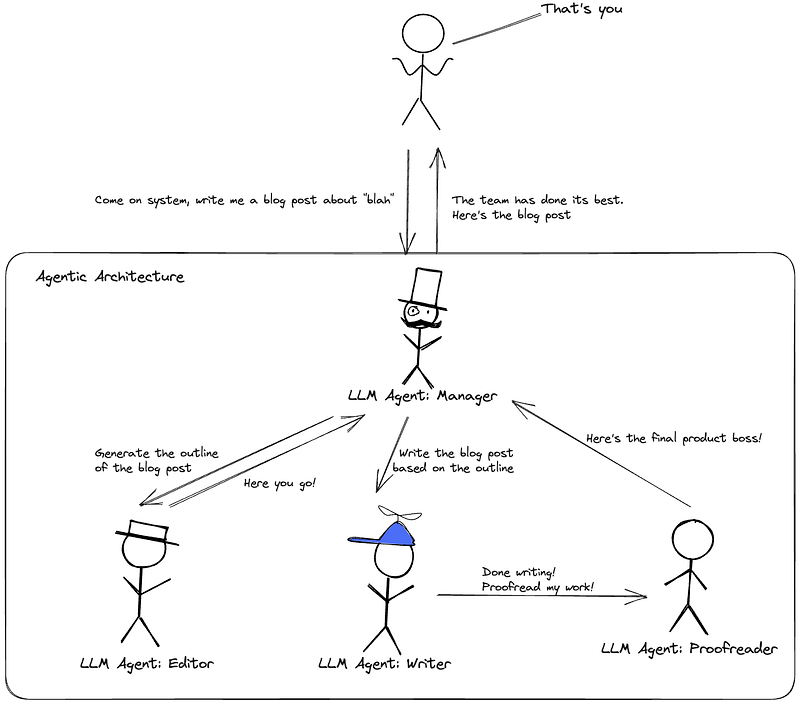
That sounds very logical at a first glance.
In fact, that’s how most team works anyway.
So what’s the problem?
Problem 1: Why don’t you have it yet?
Million dollar ideas usually start with solving our own daily pain points. If we never proceed further to implement it, that usually means one/more of the following is true:
- We don’t know how to do it. If you don’t know how to do it, chances are you also won’t know if it has been implemented correctly.
- We don’t have the time/resources to do it. Just like how I don’t need a commercial deep-fryer to make a batch of wings, you probably can get away without such a complex system.
- We don’t actually need it.
Bottom line: Don’t use a technology for the sake of using it.
If your team has been thinking about whether you need an Agentic Architecture for a while already, you probably don’t need it enough to have started developing/sourcing it. In that case, I would suggest you to hold on and don’t FOMO in. There will be a better architecture/implementation.
If you are not convinced, let’s move on the next next problem then.
Problem 2: Relying on Internet discussions to solve your business problem
LLMs are amazing because of the amount of data they have been fed.
OpenAI trained their models on (1) information that is publicly available on the internet, (2) information that we license from third parties, and (3) information that our users or human trainers provide. (Source)
While you may find a discussion online on how banks generally do their AML (Anti-money laundering) checks, you will likely not be able to find an actual audit trail of how your competitors or competitors of your clients actually run their businesses.
In other words, you will be stuck between these two options if you want to automate your business processes using LLM Agents:
- Run your businesses potentially using Internet hearsay on Reddit
- Fine-tune your own LLM using a carefully curated dataset
LLM fine-tuning deserves to be in a separate blog post. You & your business will likely need to fine-tune multiple models for different business processes. Make sure you are ready for that journey before taking the red pill.
You may say that LLM Agents are still valid options for less business-critical and lower-value tasks. But at that point, is it still worth the investment in setting up & adopting the framework when you can use LLMs with cloud providers directly?
Problem 3: Converting your business processes into dice rolls in the name of creativity
Most applications of LLMs aren’t solving groundbreaking problems
Yes, LLMs have been deployed to help explore possibilities of nuclear fusion. (Source) But let’s be realistic, if you are considering using LLM Agents to automate part of your business processes, these are likely processes you and your team have carried out before. That means there is a protocol/procedure to follow or a way these tasks have been completed.
The question we need to ask ourselves is: do we actually need LLMs’ creativity when it comes to executing the tasks? or do we actually want LLMs to follow how tasks have been done before, and automate the text/image generation at every step along the way?
If we actually want LLM Agents to figure out how to carry out a task, we will likely be presented with a creative audit trail for every execution. The sequence of execution will be different, intermediate output formats may not align, and sometimes, the Agents may even take a lot of turns to still achieve a dissatisfactory outcome. What used to be a clear protocol will become creative or statistically unpredictable.
If the plan is to start integrating GenAI into the business at a wider scale, grounding LLMs to play by the rulebook will usually yield more auditable, debugged, and stable results. If that is the case, what benefit would an LLM Agent bring? We might as well clip the wing and opt for an LLM pipeline instead.
Potential Solution: LLM Pipeline
If there is one thing the hype of Data Science has taught us, it would be the importance of operationalisation. If there isn’t a way to integrate cutting-edge analytics/technology into existing systems/processes, you will find yourself in massive tech debts and silos once the craze eases off.
While all the cyclical hypes are going on, Data Engineering, DevOps and MLOps has always stayed relevant for a reason: they are all about transparency, robustness and reliability. We should think about LLM adoption in that way too.
Convert your plan for LLM Agents into well-documented and well-tested LLM Pipelines of atomic steps each with a defined input & output data structure. That allows you to really think about how you have been conducting the tasks before GenAI became a thing. That also allows you to debug where the LLM Pipeline has gone wrong. That will ultimately reduce what was originally a massive black box of LLM Agent into pockets of probability as you have defined the high-level workflow & sequence of execution.
If you are interested in how you can convert your business processes into LLM Pipelines, I have written a guide on a simple 4-step process to get you started.
Once you have automated enough business processes into LLM Pipelines, you may find where Agentic Architecture will best fit in your business!
Let’s be daring in spirit while meticulous in choices.
A special shout-out to the team behind KPMG AVA. We won’t be where we are without all your efforts!


