
Why Amazon’s own employees are calling it out for greenwashing
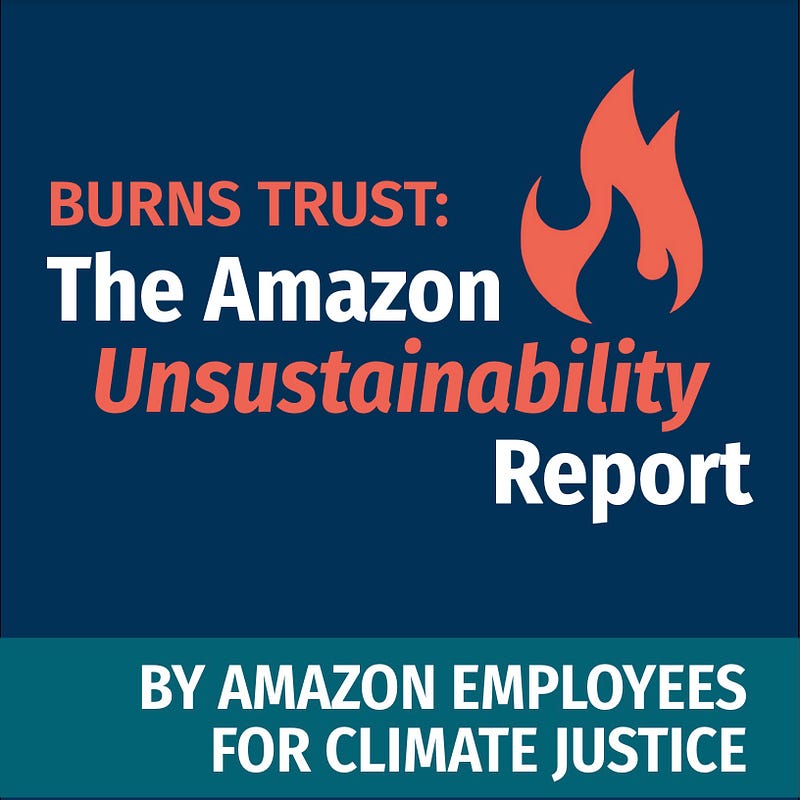
Just two days ago, Amazon’s communications department proudly announced that the company had achieved its goal of powering 100% of its activities with renewable energy — a feat accomplished seven years ahead of schedule. However, this claim was quickly challenged by an unexpected source: Amazon’s own employees.
The activist group Amazon Employees for Climate Justice swiftly countered with their own report, aptly titled “Burns Trust: The Amazon Unsustainability Report”. In it, they accused the company of blatant greenwashing, asserting that the true amount of renewable energy consumed by Amazon hovers around a mere 22% — a discrepancy far too large to be dismissed as a “small difference” or “rounding error.”
So, how do we reconcile this stark contrast between Amazon’s claims of 100% renewable energy usage and its employees’ assertion of just over one-fifth? The answer is to be found by delving into the complicated world of carbon offset credits, also known as Renewable Energy Certificates, or simply RECs. The company buys enough credits to offset its emissions, but it does not do so in a way, let’s say, “orderly”, but simply to meet the requirement and be able to affirm what it claims. Is it makeup? No, it is simply a way of using common practices in all industries (pollutants), but which are a perversion of the initial intention with which the tools were created.
RECs are designed to create a market mechanism that puts a price on emissions. The idea is to generate tangible incentives for decarbonization beyond mere corporate responsibility, in other words, companies decarbonize because it’s in their financial interest to do so. However, like many well-intentioned tools, RECs can be manipulated in ways that subvert their original purpose.
The crux of the issue lies in how tRECs are acquired and applied. Ideally, high demand for them should push energy suppliers to build more renewable infrastructure. But when companies buy “unbundled” RECs — without linking them to specific supply networks feeding their facilities — the credits often end up financing pre-existing or already-committed infrastructures rather than driving new, green developments.
This creates a paradox: a company might build an energy-hungry data center in an area where the local supplier has no plans to decarbonize. Faced with increased demand, that supplier might simply construct another fossil fuel-powered plant, negating any real progress toward sustainability.
According to Amazon’s employee platform, this is precisely what their employer is doing — textbook greenwashing. They allege that Amazon is acquiring RECs in areas with high renewable generation for use in regions where all generation is non-renewable, without specifying where or when (peak or off-peak hours) these credits are applied.
The problem extends far beyond Amazon, permeating the tech industry and arguably all sectors. It represents a systemic failure, a fundamental flaw in the design of carbon offset mechanisms. For the tech industry, with its massive energy consumption and carbon footprint — further amplified by the advent of generative AI — this issue is particularly acute. But make no mistake: this practice is likely widespread across various industries, potentially undermining our collective efforts to meet critical decarbonization targets.
How might Amazon respond to these accusations? They’ll likely claim that their emissions credit accounting aligns with generally accepted industry offsetting practices. And therein lies the real issue: the industry — indeed, all industries — appear to be playing a dangerous game of smoke and mirrors.
Does this mean we should abandon market-based emissions reduction mechanisms altogether? Not necessarily. But it does suggest we need to refine their operation, creating stronger links between credits and tangible decarbonization efforts. RECs should include not just raw data on emissions offset, but specific information on where they’re acquired and how they’re being applied. Only then can we truly align the variables that matter most in our fight against climate change.
In the meantime, by exposing Amazon’s practices, we’re putting all companies on notice: engage in these “diffuse” offsetting practices at your own reputational peril. The world is watching, and greenwashing will no longer go unchallenged.
(En español, aquí)


