
Introduction to MLOps
MLOps, or Machine Learning Operations, is a set of practices and tools used to streamline and manage the lifecycle of machine learning models. MLOps aims to ensure that models are developed, deployed, and maintained efficiently, reliably, and at scale.
Advantages of MLOps:
- MLOps is a critical practice for organizations that rely on machine learning models. One of the key advantages of MLOps is continuous training of models. With MLOps, we can set up a process for continuous training, which is important as data changes over time, affecting the model output. Continuous training ensures that models are up-to-date with the latest data, and the model output remains consistent.
- Another critical aspect of MLOps is experiment tracking. When we develop a machine learning model, we run many experiments to determine the optimal configuration. Experiment tracking helps to record the experiments automatically and saves the best configuration. This saves time and resources, as we don’t need to repeat the same experiments to find the optimal configuration.
- Data drift is another critical issue that MLOps helps to address. Data drift occurs when the data changes over time, and the model performance deteriorates. MLOps provides tools to detect data drift and take corrective action to maintain model performance.
- A model registry is another important aspect of MLOps. It is a central repository that stores all the information related to the model, including data, configurations, environment variables, model code, versions, and documentation. A model registry ensures that all key values are in one place, and everyone responsible has access. It helps to version the models and ensures faster deployments.
- Visualization is another critical aspect of MLOps. Visualization of different machine learning metrics, performance scores, and experiments helps to identify patterns and gain insights into the model performance. There are many tools available to speed up machine learning development by providing pre-built visualization.
- Finally, monitoring is a critical aspect of MLOps. Monitoring helps to collect statistics on the model performance based on live data. The output of this stage is a trigger to execute the pipeline or to execute a new experiment cycle. Monitoring also helps to track usage statistics, performance monitoring, application, and system-level logging, among other things. There are various tools available for monitoring, such as Prometheus and OpenTelemetry.
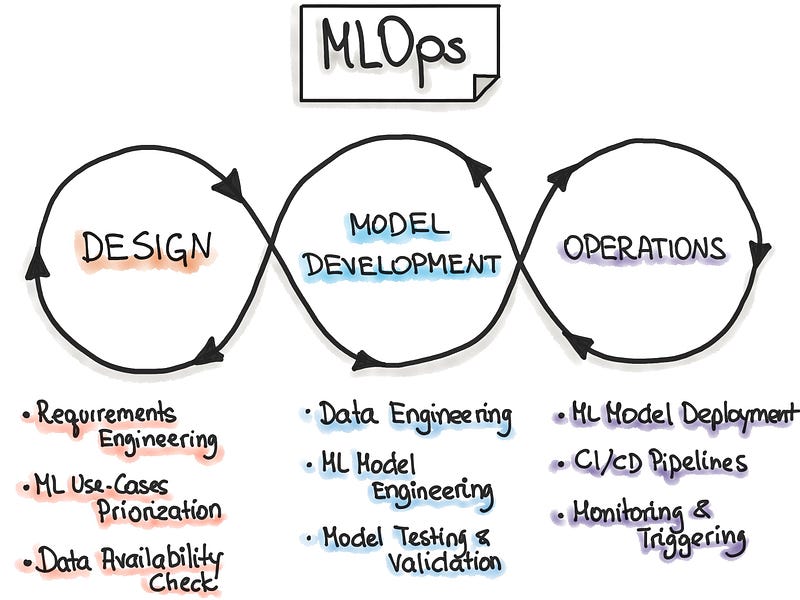
MLOps Setup:
The setup for MLOps depends on the specific requirements of the organization. However, the following steps are typically involved:
- Establishing a cross-functional team that includes data scientists, engineers, DevOps professionals, and other stakeholders.
- Defining clear goals for model development and deployment.
- Implementing tools and processes for data collection, preprocessing, model training, deployment, and monitoring.
- Establishing guidelines for version control, testing, and code review.
- Establishing security and compliance protocols for data access and model deployment.
Techniques/Features:
Several techniques are used in MLOps, including:
- Version control systems like Git to manage code changes and track model versions.
- Containerization technologies like Docker and Kubernetes to package and deploy models in a portable and scalable way.
- Automated testing frameworks like pytest and unittest to validate the functionality of the model.
- Continuous integration and continuous deployment (CI/CD) pipelines to automate the deployment process and ensure that models are deployed in a controlled and repeatable way.
- Monitoring and logging tools like Prometheus and Grafana to monitor model performance and detect anomalies.
Famous Tools
MLOps is the practice of implementing machine learning models into production environments in a streamlined and efficient manner. To achieve this, there are a variety of tools and techniques available that provide features related to
(1) metadata storage and experiment tracking, (2) data versioning, (3) hyperparameter tuning, (4) run orchestration and workflow pipelines, (5) model deployment and serving, and (6) production model monitoring.
Some of the current tools used for each of these MLOps features.
(1) Meta Data Storage and Experiment Tracking:
a. MLflow: MLflow is an open-source platform that helps manage the machine learning lifecycle, including experimentation, reproducibility, deployment, and a central model registry. It allows users to track experiments, compare results, and share models across teams. MLflow can be used with any machine learning library and in any programming language.
b. Comet: Comet is a meta machine learning platform for tracking, comparing, explaining, and optimizing experiments and models. It allows users to view and compare all of their experiments in one place and works with any machine learning library and task. Comet is suitable for teams, individuals, academics, organizations, and anyone who wants to easily visualize experiments and facilitate work and run experiments.
c. Neptune: Neptune is an ML metadata store that was built for research and production teams that run many experiments. It provides a collaborative platform for tracking experiments, sharing results, and improving model development.
(2) Data Versioning:
a. DVC: DVC, or Data Version Control, is an open-source version control system for machine learning projects. It helps define pipelines regardless of the language used and enables data versioning, replication, and sharing.
b. Pachyderm: Pachyderm is a platform that combines data lineage with end-to-end pipelines on Kubernetes. It helps users manage and version their data, while also providing scalability and reproducibility.
(3) Hyperparameter Tuning:
a. Optuna: Optuna is an automatic hyperparameter optimization framework that can be used for machine learning/deep learning and other domains. It integrates with popular machine learning libraries such as PyTorch, TensorFlow, Keras, FastAI, scikit-learn, LightGBM, and XGBoost. Optuna automates the process of hyperparameter tuning, allowing users to save time and resources.
b. SigOpt: SigOpt aims to accelerate and amplify the impact of machine learning, deep learning, and simulation models. It automates the process of hyperparameter tuning and integrates seamlessly into any model, framework, or platform without compromising data, model, and infrastructure security.
(4) Run Orchestration and Workflow Pipelines:
a. Kubeflow pipelines: Kubeflow is an open-source ML toolkit for Kubernetes. It helps maintain machine learning systems by packaging and managing Docker containers. Kubeflow pipelines facilitate the scaling of machine learning models by making run orchestration and deployments of machine learning workflows easier.
b. Polyaxon: Polyaxon is a platform for reproducing and managing the whole lifecycle of machine learning projects as well as deep learning applications. It provides support for ML pipelines, hyperparameter tuning, and model tracking.
c. Airflow: Airflow is an open-source platform that allows users to monitor, schedule, and manage workflows using a web application. It provides insight into the status of completed and ongoing tasks, as well as logs.
d. Kedro: Kedro is a workflow orchestration tool based on Python. It enables users to create reproducible, maintainable, and modular workflows, making ML processes easier and more accurate.
(5) Model Deployment and Serving:
a. BentoML: BentoML simplifies the process of building machine learning API endpoints. It offers a standard, yet simplified architecture to migrate trained ML models to production.
In summary, MLOps is a critical practice for organizations that rely on machine learning models. By establishing efficient and reliable processes for model development, deployment, and maintenance, MLOps helps organizations improve the accuracy and reliability of their models while reducing errors and ensuring compliance and security.


