
Personal Growth
Emptying Your Vessel
Making room for the future
An ancient Indian fable tells the story of a spiritual seeker who climbed a mountain to reach a legendary guru. Upon the seeker’s arrival at the entrance to the guru’s cave, the master said, “let us have some tea.” The student entered the cave and told the master how excited he was to receive the teacher’s wisdom. He then proceeded to tell him about everything he had already been studying and that he didn’t understand why he had not reached enlightenment yet.
So en rapt with his own words was the student that he failed to notice that the master had filled the teacups and was still pouring tea, which was now overflowing the student’s cup and spilling all over the floor. “Stop,” the student cried. “My cup is already full.”
“And that is your lesson,” said the teacher.
Clinging to What We Think We Know
Sometimes, we instinctively cling so tightly to what we think we know that we don’t leave any room for new growth. I think that this is one of the lessons we have all had the opportunity to learn in the past year of “letting go” of all that we thought were the foundations of our lives.
In March of last year, the pace of my life had left me feeling often overwhelmed, sometimes to the point of near paralysis. I knew that I needed to make some changes, to transition away from some facets of my life that I had once considered “foundational,” but which no longer served me. I knew that they were holding me back from building the life I was dreaming about. But change is hard.
The pandemic forced my hand in making many of those changes. While the year we have all just lived through did hold a lot of challenges, I feel like it has also offered a lot of opportunity for growth — for me and also for so many other people I have talked to about this.
The Ties that Bind You
For the last twenty-one years I have taught yoga. While in my 40s, I went back to graduate school to study the ancient texts of India, delving into yoga’s ancient origins, studying saṇskrit, trying to make sense of what it all “meant.”
After graduate school, I began teaching courses at Loyola Marymount University and for a myriad of teacher training programs. I loved it. It fulfilled me. But it left me very little time to pursue writing and photography, my other great passions.
I’d been tinkering with a book for several years, but just never had the bandwidth to finish it. And I’ve been taking photographs, occasionally selling one here or there. But I’ve never had the time to really focus on building something with my photography, although I would often lie awake at night, filled with angst because I haven’t finished that book or set up an avenue to do much of anything with my photos.
I’m sure that everyone else also has these late-night conversations with themselves too. We all have passions and dreams that, for one reason or another, we haven’t fulfilled.
Then the pandemic hit. Yoga Works, where I have been teaching for most of my career, shuttered its doors. My sense of identity was rocked.
In all honesty, in recent years I had been cutting back my teaching schedule, trying to make more time for writing. But shifting my focus to full-time writing was something I just had not been able to do.
At first, I felt very adrift at sea. The studio had been my anchor for so long. But I’ve since realized that the mental tie I had to physically teaching was holding me back from teaching in a different way — through my written words and my photography.
Cleaning out the Closets, Literally and Figuratively
My first instinct during the pandemic, and I know that I am not alone in this, was to clean out the clutter in my life, both literally and figuratively. So, I attacked my closets, which had been bursting with things that once seemed so important, but which now just created anxiety in me when I had no good place to put new things that really mattered.
It’s funny how the energy in your home, your mind and your life shifts when you clean out the old to make room for the new.
I’m not really a packrat by nature. I do have a rule that when I buy something new, I try to get rid of something old. But, still, that outfit I bought when we went to Capri ten years ago, the shoes I bought in Greece, and all of the textiles I’ve purchased on my many trips to India held an intrinsic value for me. I just couldn’t seem to let them go because they encapsulated so many memories, so many moments of my life.
But, by letting go of so many of these things, I’ve realized that the memories will always be there. And I now have room to create new memories and experiences.
I’ve purchased a professional photo printer, and I’ve turned a closet into my “modern darkroom,” filling it with all of my photography equipment (which used to live in hodge podge nooks and crannies all over the house).
And I’ve cleaned out years of teaching materials to make room for files filled with drafts of poetry and stories. I’ve categorized all of my completed pieces so that I can start making progress in that book of poetry, prose and photography.
And I feel a new lightness.
It feels so good, so cleansing, so energizing to have made space for the things that are important in this phase of my life.
It’s a Life-Long Process
I’m sure that this will be a life-long process, because we are always in transition, aren’t we? We’re not the same today as we were even yesterday.
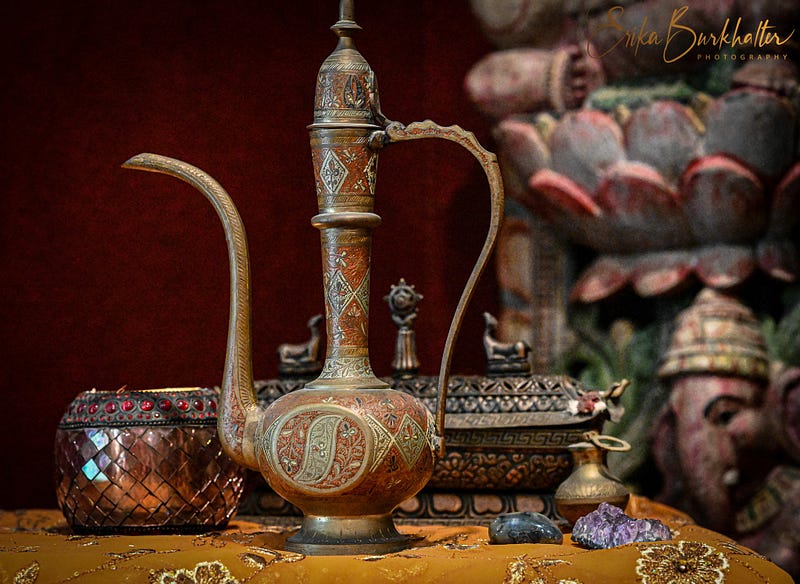
For years now, ever since I first heard the “empty-vessel story,” I’ve kept an “Aladdin’s lamp-type pot,” an old metal vessel that my great aunt Sally left me on my alter in my yoga room. It’s a reminder to me to leave room for new teachings, new wisdom, new experiences — a bit of a talisman.
It’s always a little scary to leave behind the things of our past. And it can be even scarier to forge ahead with following our dreams. But, if there is one thing that has become abundantly clear to me over this past year, it is the importance of not letting the past dictate the future.
There is only one moment in which we live. And that is now. And I would hate to be that student who is too “full” to be able to receive the lesson that is right there in front of them.
I wish for myself, and for all of us, that we are able to emerge from this time with emptier vessels, clearer minds, and new visions of the future, uncluttered by ties from the past.
Erika Burkhalter is a yogi, neurophilosopher, cat-mom, photographer, and lover of travel and nature, spreading her love and amazement for Mother Earth’s glories, one photo, poem or story at a time. (MS Neuropsychology, MA Yoga Studies). Erika is also an editor for Mindfully Speaking.
You might also enjoy:
Photo and story ©Erika Burkhalter. All rights reserved.


