
Lessons Learned The Hard Way
Empty Promises To A Homeless Man
Sometimes there is no second chance
I made a worthy stab at an 8-mile run the other day.
It began like any other run: first, the anxiety set in, then the understanding of how long it would take me to run those 8-miles, followed by a mild sense of courage, and then, like clockwork, a final bout of anxiety while I reckoned and negotiated with myself over the required effort-to-time trade-off.
I guzzled some water, took an energy goo (a sugar-loaded energy supplement with the consistency of alien blood popping with hints of strawberry, banana, and regret), and off I went.
I jogged several side streets maneuvering my way down to the local park. I stumbled onto the outer pavement surrounding the grassy interior and made note of the various people passing by, categorizing and ranking them against some vague severely subjective scale based purely on vain observations and a healthy measure of conjecture and speculation. In no particular order:
- There were parents with children; some old enough to trot merrily ahead or dragging at the heels of their exhausted parents, and some in strollers, pushers, and wagons of various sizes, colors, and outfits.
- There were duos and trios lost in the cadence of their footsteps, oblivious to all else save the conversation shared between them. Like an unwelcomed eavesdropper, I captured fractured bits of conversation as we looped by; a glimpse into their deep pasts and intertwined futures.
- I saw the serious athletes keeping time with their smart watches hoping for a PR or meticulously maintaining pace.
- I even witnessed a group of adults taking a Segway tour; visors and heavily tinted sunglasses on an overcast day, and polos tucked into jean shorts sporting the latest kicks from New Balance.
A motley crew of ethnicities, ages, phases of life, and socio-economic status common only in their shared pursuit of a happiness derivative of relationships, physical awareness, freedom, and privilege. A breaking away from monotony and responsibility. A bubble where we could all collectively seek solitude.
A little self-indulgence, I suppose.
I continued my run, trying to get lost in the tunes, but my lungs burned like hellfire. My cells frenzied for that beautiful O2 but, apparently, hours of sitting and writing and researching have ill-equipped my body.
Rather than battle-hardened Spartans or a fleet of Greek warships, my alveoli and capillaries were marching around like peasants brandishing rusty shovels and soggy clubs.
I sucked for air but my body sucked at life. Later on in life, I would come to realize I had a form of stress-induced asthma, but that’s neither here nor there.
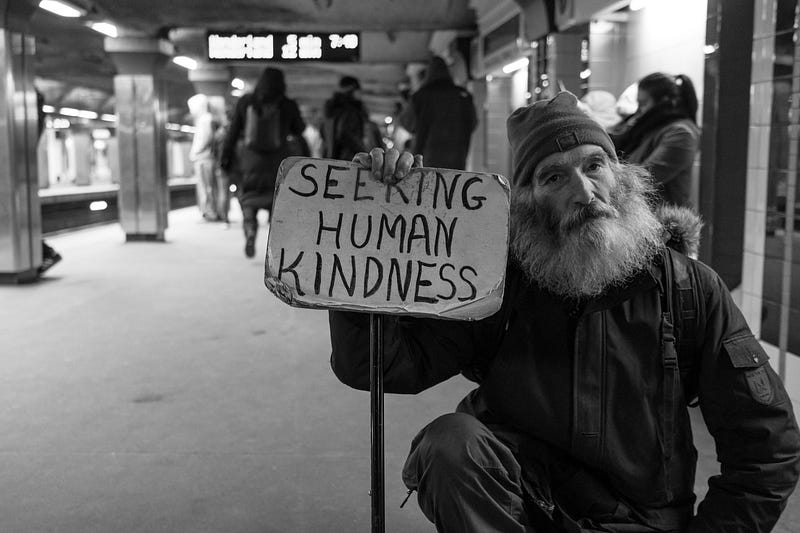
I made my way around the park crossing a bridge which, further ahead, pathed through an on-ramp to the highway. As I passed the short stretch of asphalt which joined up to the river of cars crowding the highway, I noticed a man. A sad, lanky, balding man no doubt homeless. He was holding a sign, an emblem of hope and refuge, which read:
‘Homeless, please help! No money just food.’
He was visibly malnourished, the bones of his shoulders were outlined like stone in clay and you could count the vertebrae the length of his spine from a sobering distance away. His words were scribbled in black marker on a sheet of cardboard in no better shape than he. As I approached, knowing my running path would skirt me right around him, a flood of conflicting emotions tore through me.
My brain did what all brains do when they cannot reconcile what’s before them; when they come up against something that, categorically, does not fit into the nice little compartments that define our biases, perspectives, and experiences:
How could I help this poor man? I had no money on me let alone food. What if he was an alcoholic or a meth-head? What if he had a disease? What if he was dangerous and was going to stick me with a needle or rob me or bite me? What if people saw me? What if, what if, what if…
Like the conveyor belt of cars, I rolled up my ‘window’ and continued past him. It was easier to pretend I was so into my run that I hadn’t noticed a man dying, just feet from me, screaming so silently and patiently for help.
It was easier to pretend than it was to stop and help.
We tell ourselves that in times of tragedy, in moments of heroism, we will rise and stand for one another. This is the boldest lie we, as a society, convince ourselves of. If we ignore a problem it goes away; if we can’t see it, it doesn’t exist. It worked as children why not as adults?
This man is responsible for his fate; he should have made better life decisions, gone to school, kept his job, and sought social help. It’s his fault.
Perhaps, but I like to think we are better than that; better than ritualized, blanketed, ethically devoid condemnation.
I was fortunate to have a second chance. My route brought me back around that path where the dying man stood. I stopped my run. My heart was pounding and my palms were sweaty. I had never done this before so I had no idea what to do or say.
So, I did what felt right. I put my arm around him, hugged him, and told him if he was still there in an hour I would stop by with food once I got home. I felt good about that, like I had earned some favor from Karma, or fixed society; something that felt much grander than it was.
He seemed such a shell, though, as if he’d heard those exact words a thousand times and this was the one thousand and oneth time.
I finished my run with as much energy as I could muster. I stumbled in the door grabbed my keys and ran (figuratively, of course, I had no intention to run anymore that day) to Little Caesars for pizza and the gas station for Gatorade and Gum. My spirits felt lifted as I made my way to where I had met the man.
I was going to be this man’s saving grace for the day; I was going to instill in him hope and, perhaps, a marginal bump in comfort and peace of mind for an evening. I was going to make every person sitting in their car feel terrible about what they hadn’t thought to do and, maybe, change a few misguided attitudes.
I was going to be a good human today.
He wasn’t there though. I was an hour too late and I never saw that man again.
Sometimes there isn’t a second chance to show kindness, to do the right thing, to do what you should have done the first time.
This is a hard truth; a painful truth.
An unfair truth.
But, truth nonetheless.
I hope someone snagged that poor man and gave him the help I couldn’t, or maybe he just moved on to the next spot, looking to find one person with a mind to help among hundreds barely aware of the physical reality around them. I hope that our world is more good than it is bad; more thoughtful than it is absent, more circumspect and moral and caring than it is self-indulgent.
Not all stories end the way we want them to end, though.
We live orbiting lives within and between worlds but never seem to be in the one world that matters.
The next time you come across a first chance, don’t miss it. It might be the only one you have.
Cheers, folks.
No gimmicks, no hidden fees, just writing. Subscribe to get notified when I publish.
Tony