
Empathy Is Great, But It’s Not A Verb
When deeds speak they are paid forward
Compassion
A word with active meaning. Here’s a story.
A middle-aged, very neatly dressed Eastern European woman walks into a local pharmacy. She has taken extra care to make her appearance as professional as possible. She waits her turn at the prescription counter and when she reaches the front of the line, she asks to speak directly to the “chemist”.
A balding middle-aged man wearing a crisp white lab coat and black-rimmed spectacles, arrives at the counter and asks, “How can I help you, madam?“
The woman shuffles nervously as a line of customers begins to form behind her. Speaking in stilted English and with hesitation in her voice, the woman introduces herself as Monika and explains that she has recently emigrated from Czechoslovakia. She tells the chemist that she was an educated, licensed pharmacist in her home country, but when she arrived in Canada, she’d been forced to take college courses to meet our national standards.
Monika went on to inform the pharmacist that to complete her upgrade, she needs to perform apprenticeship services for six months. “I would be grateful to do this for you”, and then blurts out, “free of charge”.
The pharmacist looks at the woman with a blank expression and says, “I’m sorry madam, I cannot allow you to work here for free.”
Crestfallen, and close to tears, the woman is about to turn away, when the pharmacist adds, “I insist on paying you to work for me, part-time. You can start tomorrow.”
Elated, Monika takes the hand of Norman, her new boss, and shakes it profusely. She then promises to be prompt every day and leaves the store with a beaming smile on her face.
Helping this stranger required no fanfare, nor self-aggrandizing for Norman. It was a simple gesture that paid eventual dividends for both parties. This is another story about my father, a man who lived mostly in anonymity, but someone to admire. It is plainly obvious that I do, though admittedly, it took me a long time to realize the impact his life had on me and so many others.
Monika received her pharmacist’s license six months later and stayed on as a valued employee for several more years. When my father retired from that store, Monika eventually became the head pharmacist and I hope, continued to prosper. I have no doubt she eventually paid it forward.
This story is only one small example of how our lives intersect and the kind of changes for the better that can occur.
Norman spent his entire working life as a pharmacist, distributing much-needed medication mostly to those who could afford it the least. He owned a pharmacy inside the giant discount store of a prominent Toronto businessman. Ed Mirvish was famous throughout Canada for his entrepreneurship, but he was also one of the few people that believed in my father’s cause.
Government regulators were largely against Norman’s philosophy of helping the less fortunate because, well, it wasn’t profitable. That never stopped him from doing what he felt was the right thing.
How many of us can make the same claim? Me included.
We were far from wealthy growing up, and luckily, we were also far from poor. Reflecting on the deeds of an individual I hold in the highest regard, I gained a deeper understanding of the planet we share with others, the vast majority of whom we’ll never meet.
Doing for others may or may not come at a personal cost, but the dividends have boundless possibilities. Givers rarely reap tangible rewards from their acts, but that’s not why they act. Compassionate acts without expectation of reward or recognition are the highest form of good deeds.
Looking out for the stranger is usually the furthest thing from our minds as we go about our daily routine. Our relentless search for prosperity sometimes tunnels our vision from the suffering of others.
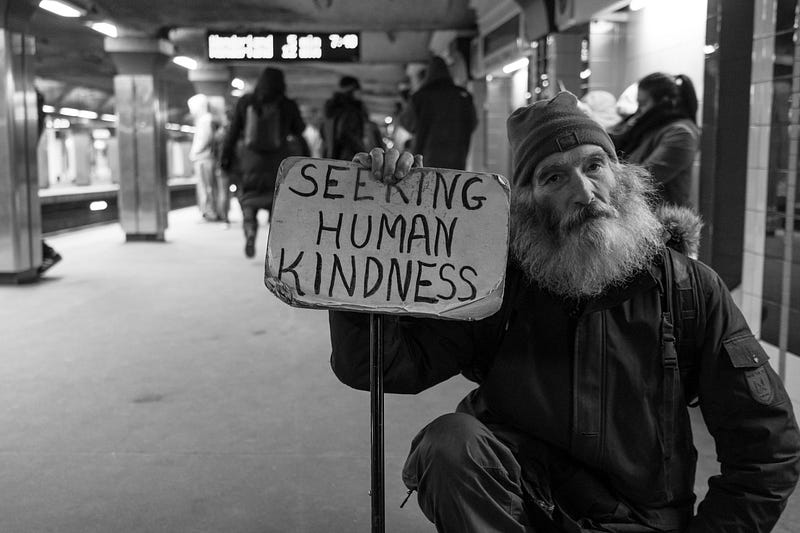
They may not even be people we see on city streets, like the man in the photograph. Is this person asking for anything unreasonable?
There are people among us right now who suffer silently, but if we look closely, the signs are there. Whether a mental health issue or financial in nature, the smallest of gestures can make all the difference.
At no other time in modern human history is it more important to make compassion a significant part of our lives. Our collective futures depend on it. If you believe you live in a bubble, it will burst on you soon enough.
Empathy is a kind sentiment that reflects no action, but anonymous deeds speak volumes to a lasting legacy. Thanks again Norm!
And thank you for taking the time. It is always appreciated.


