
Empathy in Justice: Navigating Challenges for Women and Girls, in Nigeria, on International Day of Female Judges
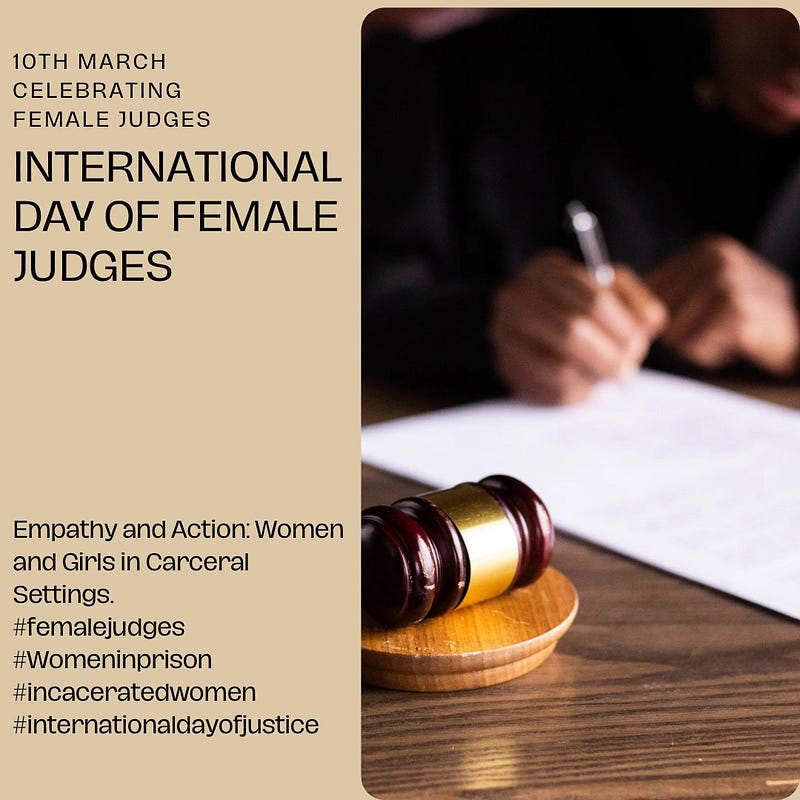
Yesterday, March 10th, marked the 3rd year that the International Day of Female Judges would be celebrated. Adopted in 2022, by the United Nations to focus on the efforts of the Global Judicial Integrity Network in addressing gender related judicial issues, this year’s theme focuses on “Empathy and Action: Women and Girls in Carceral Settings.”
This poignant theme draws attention to the unique challenges faced by women and girls within the criminal justice system in Nigeria and the important role female judges are expected to play in women empowerment. According to World Prison Brief out of a total of 77,350 inmates’ 2.2 percent (1,702) represent women and girls in prison (including those awaiting trial and convicted), in a January 2024 publication.
According to a survey carried out by Statista in 2018, the total number of judges in Nigeria stood at 991 with only 28 percent of them being women (286). Examining this distribution across various courts provides insight into the nuanced landscape of the judiciary and the need to increase female participation in the Judiciary, in order to address gender inequality issues and female issues related to the justice system.
At the Supreme Court, the highest echelon of Nigeria’s judiciary, there are only 4 females (25 percent) out of a total of 16 Judges, according to Statista. Similarly, the Court of Appeal has 27 (31 percent) female judges out of a total of 87 judges. While this number is higher than the Supreme Court it still reflects the abysmal number of female judges due to the larger number of judges at the Court Of Appeal, and thus, still has a long way to go in promoting diversity in pivotal legal decisions.
However, the High Courts, where many legal narratives unfold, demonstrate room for improvement. Only 28 percent (241) of judges at the High Court level are women, with 11 out of 39 being Chief Judges of the High Courts and 230 out of 811 being Judges of the High Courts. This further highlights a need for enhanced representation.
Specialized courts, such as the Industrial Court, exhibit progress with 38 percent (13 out of 34) female judges. Conversely, the Sharia Courts, prominent in certain northern states, display low representation of female judges, according to Honourable Justice Binta Fatimat Murtala Nyako, underscoring the importance of inclusivity in all aspects of the judiciary.
In an interview with the United Nations Office for Drugs and Crime (UNODC), she said “From my part of the country women judges are not a very common feature, and I cite my home state of Katsina, which is predominantly a Muslim state, governed by Sharia, having a total number of 3 female judges.”
With the low representation of female judges within the National Judicial system how then can the Day’s theme “Empathy and Action: Women and Girls in Carceral Settings,” adequately address the harsh reality faced by women in the prison system. With the staggering number of complaints from females behind bars, the quest for adequate prison facilities is significantly needed.
Issues such as family court, where incarcerated females face losing custody of their children and homes causing depression, including ante and post-natal treatment for new and nursing mothers who give birth while in prison, reflect the realities faced by women in prison. Such was the case for 18-year-old Kemisola Ogunniyi, interviewed by The Cable following her arrest in 2020 for her part in the #Endsars protest.
She said “No hospital, no dispensary, and no sickbay in the prison. All the time I was there, no doctor came to check me, and my baby and I was the only person pregnant in the prison. They have no special food for pregnant women.”
According to UNODC, the Federal Ministry of Health (FMoH) in coordination with the National Agency for the Control of AIDS (NACA) and the Nigerian Correctional Service, supported by the United Nations Office on Drugs and Crime (UNODC), the United Nations Population Fund, Heartland Alliance Nigeria, the National Human Rights Commission (NHRC), the Federal Ministry of Justice (FMoJ), and Society of Obstetricians and Gynaecologists of Nigeria (SOGON), in 2021, conducted a rapid situational assessment of women’s health, including sexual and reproductive health in custodial centres in Nigeria.
They found significant gaps in terms of access to public health services, such as access to adequate healthcare (counselling and medical treatment), sanitary facilities (mattresses, and clothing), and rehabilitation services (clean water, food and ventilation), being offered to women in detention.
Kemi describes the sanitary conditions as poor saying “The prison has no bed frame, only foam and it is kept on the floor. We were given one uniform each to be worn from Mondays to Fridays.”
It is worthy to note that while a high number of women start out in the legal profession many drop out of the system due to motherhood, sexual harassment, or the lack of financial gains. However, increasing the number of female judges within the national judicial system will boost efforts directed at developing gender-sensitive policies within the criminal justice system, ensuring the humane treatment of women and girls in carceral settings.
This will enable initiatives address female based issues, such as post-natal depression, because these policies will be coming from shared experiences, as women. The will also aid in rehabilitating, educating, and providing vocational training to incarcerated females and will contribute to breaking the cycle of incarceration, while offering women and girls basic amenities like healthcare, proper ventilation, food, and a chance at reintegration into society.
The mental health of women being the most common, according to the 2021 situational report, with very few psychiatrists, clinical psychologists and psychiatric nurses presently employed by the Nigerian Correctional Service shows that there is a need to show empathy and act decisively.
In addition, increasing the awareness and knowledge of infectious diseases such as HIV, Hepatitis and Tuberculosis as well as the perception of risk of infection among people in custodial centres in Nigeria, especially among females, is critical.
This year’s International Day of Female Judges sheds light on both the progress needed to be made in the judiciary’s gender representation to enable adequate policy making in respect to the pressing issues faced by women and girls within the prison system. Achieving gender equality requires not only increasing the number of female judges but also addressing the unique challenges faced by incarcerated women and girls. By fostering empathy and taking decisive actions, Nigeria can pave the way for a more equitable and inclusive justice system.