
Empathy 101. The effective 4-steps method to feel with people.
Yes, you can train it.

Dr. Thomas Gordon defines Empathy as the capacity to put oneself in the shoes of others.
In other words, to understand how they view their reality and how they feel about things.
Empathy is feeling with people
Dr. Brené Brown said.
Empathy classification
According to Kendra Cherry, there are three kinds of empathy:
- Affective empathy involves understanding another person's emotions and responding appropriately.
- Somatic empathy involves a physical mirroring of the feelings of the other.
- Cognitive empathy involves understanding another person's mental state.
Empathy is a trainable skill.
People think that empathy is an innate capacity.
They are wrong.
Everyone can train it.
Empathy involves the skill of listening to what the other is saying and taking care of the other's feelings outside of your perspective.
Theresa Wiseman identifies four attributes of Empathy:
- Perspective-taking
- Staying out of judgment
- Recognizing emotion in others
- Communicating back the feeling you see
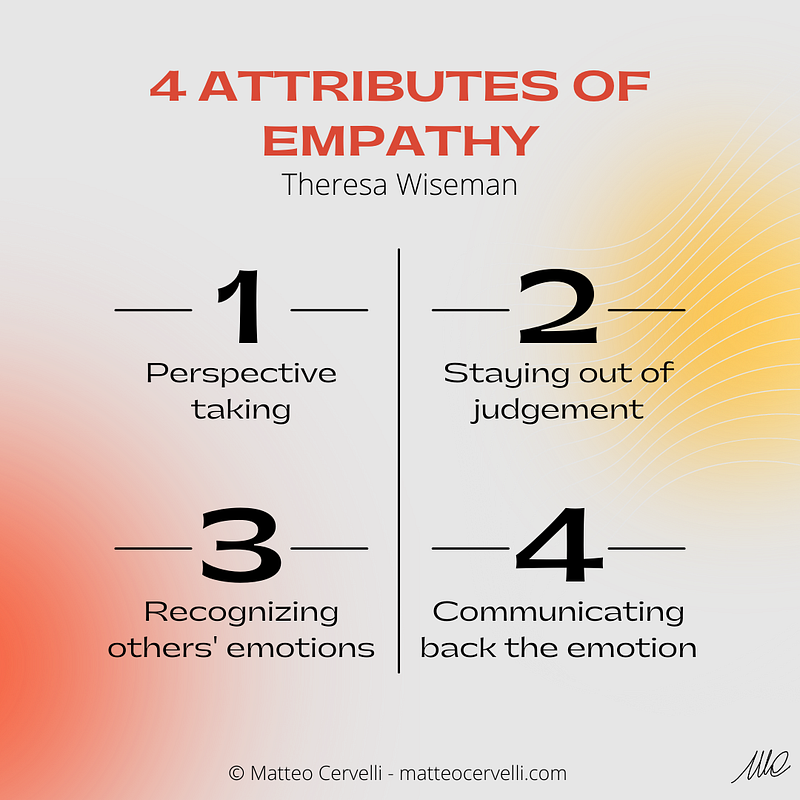
The Skills of Empathy
When you approach Empathy, you must avoid problem-solving. Or telling. Empathy involves the rough acceptance of others' feelings. The fact is you can't help people by changing their feelings.
To build your empathy skills, you can:
- Listen to people without interrupting
- Pay attention to body language
- Don't focus whether you agree or not with people
- Ask people deepening questions to understand their perspective
- Connect with moments in your life when you felt similar feelings
- Avoid minimization such as "At least…."
- Don't digress to other subjects
An Easier Approach to Empathy: Active Listening
Active Listening is the foundational skill for empathy
Active Listening provides the framework to develop a tool kit for empathy.
It is a sequential process with four main steps.
- Passive listening (Silence)
- Opening (Warm invites)
- Verification of understanding (IIUC)
- Reflective Listening (paraphrase)
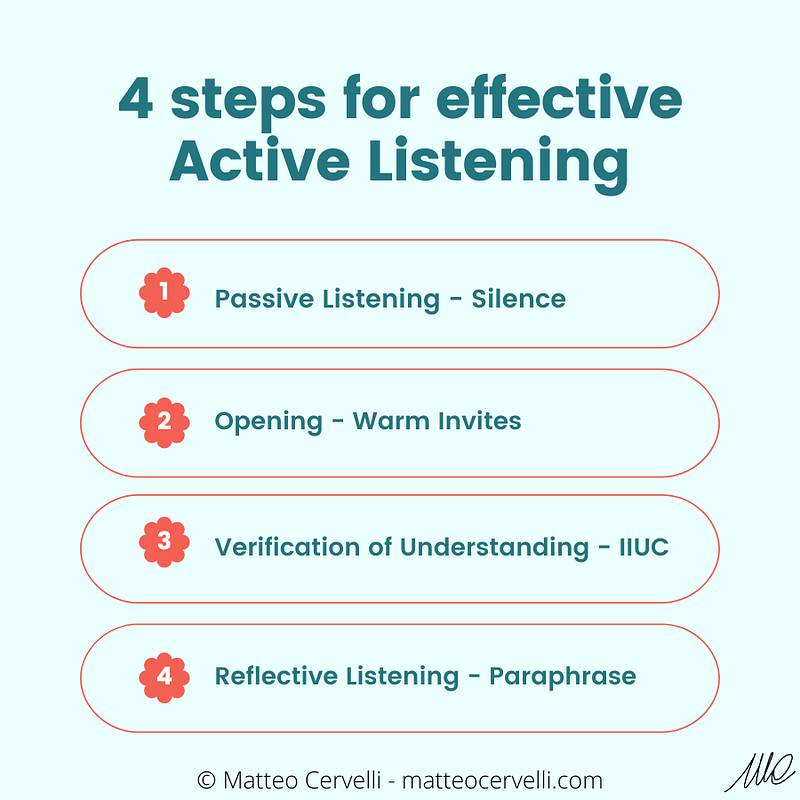
Active Listening — Step 1: Passive listening
Passive listening means being silent and listening.
You can't understand another's perspective without practicing silence.
But you must avoid prolonged passive listening.
Communication is an exchange and not reception of information.
Try to imagine going to the doctor, only you speak, and he does not ask you anything looking at you in silence.
Isn't it weird?
Active Listening — Step 2: Opening
Help the other to open up and go deeper.
Drive verbal and non-verbal messages that make it clear that you are listening.
Those warm invites are an encouragement to continue. You can use words that emphasize what is said: 'tell me, 'I understand' but nods, smiles, and looks.
Active Listening — Step 3: Verification of Understanding
It's time to activate.
You can ask questions to clarify what you understood. Repeat what you listened to creates a trusted connection.
It lets you check if you understand what you are being told.
But you must act wisely: you are a scientist, and you use your superpower:
Falsification.
A scientific experiment removes progressively any reasonable doubt. It involves:
- Being patient
- Conclusions are ephemeral.
- Forget your point of view.
- Assume the other is right and ask for help to get his perspective.
I have good news for you, there is an easy superpower.
IIUC, aka "If I Understand Correctly".
"If I Understand Correctly" are the words to break every barrier.
- IF These two letters are compelling because they instill doubt. It opens the way to an answer where the interlocutor's opinion counts. Questioning shows you are fragile, the most incredible trust that exists.
- I “We don't talk about you. The problem is me!” It is a natural sedative: "Hey, sorry, help me! Help me understand better what you just said".
- UNDERSTAND You reveal that you want to understand. "Look, what interests me is to understand your point of view better. Nothing else. Let me understand you better."
- CORRECTLY Here you are trying to clarify the content better. You show good intentions to see if your understanding is correct. Your goal is clarity. We left the judgment to others.
After starting with “If I understand correctly ..:” you can sincerely help the other clarify their thoughts, emotions, and needs behind the message.
Active Listening — Step 4: Reflective Listening
Eventually, you create reflections on what has been said.
Here is the tipping point.
Dr. Carl Rogers believed that a therapist could best determine the client's needs by listening intently.
You go over the pure mirroring, and you reframe the message.
Reflective listening involves empathic paraphrasing.
Using the exact words is helpful if you talk about facts and behaviors.
If you want to understand a person, it is best to paraphrase when he talks about thoughts, feelings, and desires.
In these circumstances, people often speak using a very personal vocabulary.
What is important to underline is that judgment and problem solving are excluded from this listening mode.
Emphatic paraphrasing tips:
- Listen for key thoughts, feelings, and statements of facts.
- Use your own words to let the other person know what you think they meant.
- Be brief — you are trying to summarize key things said, not a word-for-word account.
- Avoid interpreting or jumping too far ahead of what the person has said.
Conclusions:
Empathy is feeling with people from their perspective. The good news is empathy is trainable.
Active listening is the more effortless foundational skill to train empathy.
Active listening has four steps: passive listening, opening, understanding of comprehension, reflective listening.
"If I Understand Correctly:…" opens the door to effective listening.
Be aware: being emphatic is a long life journey. Don't forget to travel along with others or it will be only an empty technique.
Have a good listening.
I am Matteo Cervelli, the People Gardener 👨🌾.
I write about Intrapreneurship, Strategy, People Development, and Parenting.
I am in a quest to trigger talent to create a better world.
Like what you are reading? Become a Medium Member to view endless stories from many other writers and me.
Using the link above to buy your membership provides no extra cost to you and supports me as I get a portion of the membership fee.


