Emotional management is not only important for your career, but for your whole life.
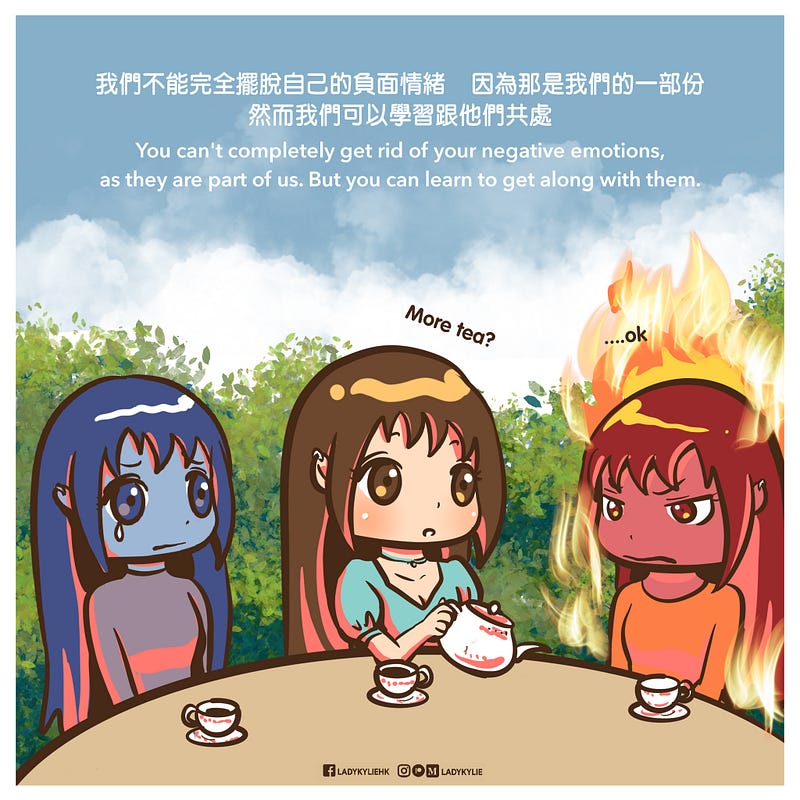
Original illustration and article on Patreon (Cantonese/English) 粵英原文在Patreon請支持圖文創作 https://www.patreon.com/posts/65552523
We have to face our positive and negative emotions since birth, and we have to learn how to control them as we grow up. As for now, I don’t think you can fully control them, so we have to learn to live with them, or at least soften them a little.
Sounds like I am just talking about “be mature” — is it that simple?
I have no objection to this conclusion, but come to think of it, you can’t just always criticise someone who are easier to get angry or feel sad as “immature”. This is because one’s growth background and primary family have a major impact on a person’s emotional response.
Some people live in a family where the parents are very emotional with mental health issues or violent tendencies, they lack a calm environment from the start and there were no positive role models to learn from, only negative ones. Compared to people who grow up from a “normal” family whose parents love each other and pay attention in emotional control, the former have much more to overcome. Also, some people take certain issues much more seriously, so naturally their reactions are bigger. You can’t just judge others as “immature” when you see an emotional reaction.
Of course, I’m not saying that you can lose your temper all the time when your primary family is difficult. It’s true that you have to put a lot more effort into controlling your emotions, but taking care of your emotions is also a responsibility to yourself and those around you.
Hongkongers are very realistic. When I first heard the word “emotion management” since I was a kid, it was a discussion/class about controlling your emotions in the workplace (to make it easier for you to get promoted or please your boss) or to improve interpersonal relationship (for job opportunity). However, I think that emotion management is not only important for your career, but for your whole life.
Learning to face your own negative emotions, coexist with them, and to understand yourself is a necessary step for self-love and to love the people around you, especially if you want to have the kids, you have to really take care of it, otherwise you will reflect emotional problems on your children.
Let’s go back to the drawing a a little bit over myself.
I drew a blue (Sadness) and a red (Anger) of myself. It may remind you of the animation “Inside Out” — this animation is a masterpiece, everyone should watch it.
I’ve been wondering what my biggest negative emotions are, and they are the very primary ones: Anger and sadness. Jealousy or fear is not so much. I have very pessimistic views on many things and I also know that I am very sentimental. I don’t get angry about a lot of things, and I am not fussy about small issues, but when I do get angry about something… I’m a gunpowder store with an explosion, plus I have a very low ignition point.
Why is that? As I grow old now, I understand that grief or heartbreak is a mechanism to protect myself.
When I’m sad I get extremely depressed and I have to let it out or I can’t go on. Be pessimistic at first because I am prepared for the worst and if bad things happen I will not break down too easily. Because I know I’m very sensitive myself, my brain (or my heart?) is psychologically forcing me to be prepared.
Anger is because of violence in my primary family. In addition to the physical violence I experienced and witnessed, I was yelled at, questioned, deliberately humiliated in public when I was a small kid. I saw parents attack each other with the worst vicious words. Probably so — it is a little too personal, so I won’t describe too much for now.
Emotion management is a tool to lead to self-love and love for those around you, it is also a protection from some who use your emotions to harm you. A lot of jerks or bitches (lol) in your life will use that moment when your emotions get out of hand to portray you as an irrational person, make you seem less reliable and use you as a stepping stone to climb to where they aim towards. Having said that, this is mostly encountered in the workplace, so the “be realistic” point of Hongkongers is actually quite correct.
After many years, I just feel like I’ve started to see a little way out in terms of emotional control. This is really a lifelong topic especially if your primary family is difficult. Gradually I feel that if you are really angry or sad, you should first back off and think of other options, or if possible walk away, best not to force yourself to face problems that get you out of control — come back and deal with them when you’re ready.
Of course it’s easier said than done.
What are your negative emotions? Is there any way to control them/live with them?
Original illustration and article on Patreon (Cantonese/English) 粵英原文在Patreon請支持圖文創作 https://www.patreon.com/posts/65552523