
Emotional Intelligence for Eggheads
In which we give meaning to the term “psychic self-mutilation”

How much money is in your pocket right now?
Most people will respond to that question by reaching in their pocket, counting their money, then saying something like: “Five dollars”.
What are you feeling right now?
Most people will respond to that question one of two ways:
- With a few sentences. “My foot hurts, I don’t know what happened to it. I went for a walk yesterday then I noticed it was hurting afterward”.
- With some off-the-cuff remark as if I had asked howyadoin? “I’m great, thanks. How are you?” Or some other programmed remark.
Note the significant difference in the nature of the responses to these two questions.
- The responder to the money question checked his pockets and responded with a few words.
- In responding to the feeling question — a not-dissimilar inquiry — there was no sincere attempt to inquire as to one’s true feelings. In the first example, a stream of thought vaguely related to the question. In the second, a pre-programmed response to any question of the “making small talk” variety.
Most of us don’t know what we are feeling. And we don’t care to.
If you really wanted to hear about another’s feelings — like, when you’re talking with a loved one who has been struggling with an emotional burden — you have to ask again: “No, really. How are you feeling?”. And then, you might get a more reflective response.
Or maybe not.
If they’re suffering, they might not be in the mood to share it with you. Or, maybe they believe it’s not safe to be vulnerable with you.
They may not even know what they’re feeling, because they’ve pushed their feelings down, away, out of sight.
When the feelings arise, they’re too intense; and who knows what might happen if they actually leaned into them rather than pushing them down?
Feelings are real. But we are taught to avoid them.
Most often, feelings are psychic triggers that something is calling for your attention. They originate in your brain. They’re called feelings because they can be felt.
But you may not know that, because your social conditioning has taught you to ignore them. To repress, suppress, hide, deny…. whatever strategy is necessary to avoid them.
“Man up!” “Big boys don’t cry”. “It’s time to move on”. “Get over it.” “He’s in a better place now.” “If you don’t stop crying, I’ll give you something to cry about”. “Quit whining.”
Sound familiar? There are numerous such everyday expressions that guide us to the idea that feelings are to be ignored. That they’re not safe. That they’re a nuisance that interfere with logic and reason. And thus, there’s no valid reason for you to give them your attention.
Our cultural programming suggests that crying may be socially acceptable behavior for women; but when a man cries he’s a wimp or a pussy.
It’s widely expected that men will get angry, but when a woman expresses anger she’s being bitchy.
Emotions and feelings are a fundamental part of who we are.
They play a huge role in our lives — whether a generally positive role when we accept and acknowledge them; or a more negative role when we ignore and suppress them.
Suppressing our emotions essentially disowns a fundamental part of Self — as much as 25% of our human capacity. It makes us more rigid, and far less resilient to life’s natural up and down rhythms. Stuffing or repressing our feelings sets us up for chronic stress — potentially leading to physical illness, chronic disease, and a shortened lifespan.
Stress — which is largely a consequence of unprocessed emotions — is called America’s #1 health problem. Up to 90% of primary care physician visits are stress-related.
When you come to acknowledge, process, and manage your stress, anxiety, frustration, disappointment, and other negative emotions you become more resilient. You unleash greater natural immunity to defend against all sorts of physical ailments. Conversely, suppressing or ignoring your emotions throughout your life can eventually make you very ill. Or depressed. Or dead before your time.
Emotions are far more “real” than our mental or spiritual capacities. Recollections of certain life events exist more vividly in our emotional body than in what we think of as our memory.
Your Whole Self
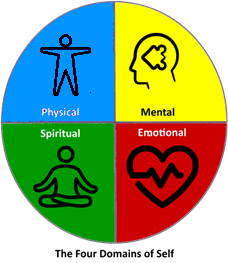
The whole self consists of four separate domains: physical, mental, spiritual and emotional. Our overall health is affected by each of these. Optimum wellbeing — a wholesome and happy lifestyle — requires that we provide some level of regular exercise to each of these domains; and maintain a balance among them.
We have some awareness of how our physical body works and what is required to maintain it in reasonable condition via diet and exercise.
We use our brain — our mental domain — every day for thinking, taking in and storing information, decision making, and remembering things.
Most of us have some sort of spiritual awareness, if only through the religion we have been born into or intentionally adopted.
Our emotional domain is the least understood, and most widely ignored and repressed among these four. And yet, it is at least equally important to maintaining our wellbeing as are the other three.
Are you Emotionally Handicapped?
Imagine for a moment having only three limbs instead of four. Could you get by? Certainly, you could — many do. We describe them as physically challenged.
Of course, anyone missing a limb adapts to their physical handicap and can do most of the same things people with four limbs can do. It’s just more difficult because they are working with fewer physical resources.
If you’ve accepted the societal notion to hide, repress and deny your emotions, you have been operating like you had only three, rather than four limbs.
You are emotionally handicapped.
Sure, you can get by in life. But it’ll be more challenging and less vibrant. You’re missing out on a huge, delicious part of the human experience.
Positive emotions such as love, compassion, empathy, and happiness tend to be available to you only to the degree to which you acknowledge your negative emotions like stress, anxiety, sadness, and fear. It’s unlikely you can attain a consistently fulfilling, vital lifestyle without acknowledging and integrating your emotional domain.
Failing to integrate your emotional domain as a significant complement to the rest of your life experience is psychic self-mutilation.
Coming into love for your self
Self-love is a fundamental aspect of achieving a happy, fulfilling life. Self-love is a by-product of self-esteem — the positive manner in which you regard yourself. Developing awareness of your emotions, and what messages they hold for you — about yourself and the events and circumstances of your life — is integral to cultivating self-awareness.
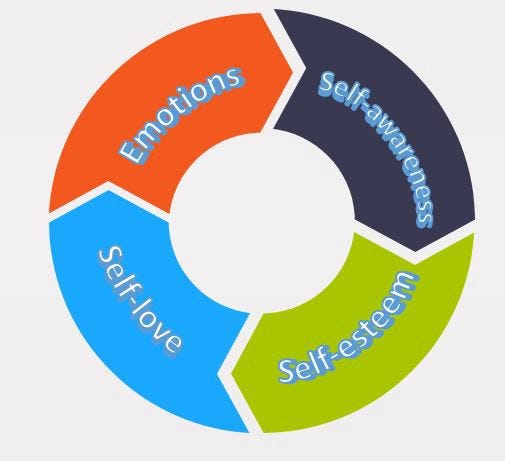
Stated another way, as this image indicates: your emotions guide you to a greater understanding of yourself (self-awareness); which leads to both a more positive view of and a greater appreciation for yourself (self-esteem); which naturally gives way to greater self-love.
Self-love is the very foundation of whatever level of happiness you experience.
As your self-love expands, you naturally want to know more about who you are and what influences your behavior — and thus, you will naturally develop greater curiosity about your emotions. The illustration indicates how these four qualities of self just naturally play on one another. To net it all out, your emotions are a gateway to self-love.
Conversely, repressing your emotions inhibits self-awareness, self-esteem, and self-love.
Have you ever:
- Felt guilty about the way you acted toward someone, and subsequently avoided any further discussion rather than admitting your error, thus preserving the relationship?
- Done something you didn’t feel good about because of peer pressure?
- Agreed with someone just to avoid conflict; while actually feeling conflicted in your body or mind?
- Been aware that you were experiencing stress and anxiety from some activity — your job or primary relationship, for instance — and simply maintained the status quo because you were at a loss for what needs to change to relieve your suffering?
- Been troubled by a behavior pattern exhibited by your partner or others but avoided examining it in order to avoid conflict?
In each of these, your emotions are trying to guide you to something that requires your attention. But you’ll lose the opportunity if you intentionally suppress or ignore your emotions. But…
The energy of your emotions doesn’t go away just because you shift your attention from them.
The emotional energy remains trapped in your body. It’s like blowing air into a balloon. When a balloon gets too full it bursts with a loud BANG!
So, too, do your unacknowledged emotions.
When you repress your emotions rather than being open, curious, and courageous enough to explore them they will eventually burst forth with a BANG! like an overfilled balloon.
But even after some energetic outburst — like raging, or a crying jag for instance — the energy of your emotions isn’t cleared. It may be temporarily relieved by your outburst; but the unexplored emotions lay buried, still awaiting your attention.
There’s another possibility, though. Rather than explode, we might develop the incredible self-control to never acknowledge our emotions — to ourselves or anyone else. Here is a real-life example of what can happen when one implodes. (Hint: it ain’t pretty).
Vulnerability
If you sometimes ignore your emotions and move on — rather than reflecting on them or discussing them with trusted friends or counselor — one reason may be that in order to explore them you would have to become emotionally vulnerable. That’s a scary word for most of us.
You would have to admit your feelings — to yourself or another — and take responsibility for them. You would have to acknowledge that your feelings are yours. That no one else “made you feel that way” — but rather, your feelings may have been triggered by another’s behavior.
Becoming vulnerable may seem scary. Because doing so runs counter to what society has led you to believe: that vulnerability equates to weakness. You may have had personal experiences where becoming vulnerable with another has led to painful experiences. Feelings shared in a vulnerable moment may have led to betrayal at a later date — by a lover, for instance.
Before baring your deepest wounds and insecurities to others it’s important that there be a reasonable degree of trust established — a safe space. You might find safety with a therapist, a minister, a good friend, your long-term loving partner, or a support group like Alcoholics Anonymous or any of the many other “Anonymous” groups that probably meet nearby you.
Is vulnerability truly a weakness?
If conventional wisdom suggests that emotions aren’t valuable, then it naturally follows that vulnerability — acknowledging and exploring your emotions — is a sign of weakness. It violates the whole Man up! Idea.
Can you imagine a film where famous tough guys like Bruce Willis, Arnold Schwarzenegger, or Clint Eastwood explore their anger and decide that it might not be working for them?
Of course not! The scriptwriters’ heads would explode trying to illustrate that someone willing to openly explore and process their feelings could save the world!
This is one more example of how cultural programming ignores the importance of the emotional domain and reinforces the cultural stereotype of the unemotional, tough, badass man.
Rather than a weakness — a choice to allow, examine, and explore your emotions is a bold act of courage.
Being vulnerable about your emotions and feelings, whether with yourself or with a trusted person or group inevitably leads to deeper understandings of self; and advances your empathy toward others. It’s a manner of healing that allows you to release the energy of stuck emotions — from five minutes or twenty years prior.
It’s not uncommon to experience sobbing or rage during a vulnerable emotional release process. If that’s your experience, allow whatever range of emotions want to express — whether that’s surrendering to the need to cry, violently hitting a pillow with a tennis racquet, or any other form of intense expression that doesn’t harm others in doing so. The more energetic the expression, the more effective is the release of the emotional energy that’s been stuck in your body.
Of course, that level of energetic release isn’t necessary for each exploration of emotions. It may help to begin more gently and slowly. Whenever powerful negative emotions present, set aside alone time to explore, reflect, excavate, and journal about them.
Why Do This?
Cultivating emotional maturity will add vibrancy to your life. As you become more emotionally aware, you develop more resilience to deal with the stressors and surprises of life. Academic research and clinical studies have demonstrated that as we develop greater levels of emotional intelligence and thus, resilience — we increase our natural immunological response to illness and chronic disease; expand our quality of life, and extend our lifespan.
How could it be otherwise? Purging the toxic residue of our negative emotions is as healing physically as it is emotionally.
As you become more aware of and inquisitive about your negative emotions and their source you become more at choice to consciously respond to challenging situations rather than unconsciously reacting.
The world will thank you.
Cultivating Emotional Intelligence is one strategy among many along the journey to a Steady State of Happiness. I have written extensively about this process — on other forums, a book… and more recently, on Medium. I write from more than 20 years of personal development experience, and thousands of hours spent in emotional support groups — in personal healing, and facilitating that of others.
Namaste!
If you’d like to receive occasional reflections about expanding your happiness and transcending your suffering, please join our growing Life as an Art Form community.


