Emotional Intelligence Explained
Why Emotional Intelligence matters more than IQ

Emotions
Life entails emotions. Our life revolves around emotions. Emotions motivate us to do things. We experience various emotions like joy, sadness, anger, and fear with varying intensity from high to medium to low. Each emotion has further nuances in it. Some emotions are so rare like;
Ilinx: The strange excitement of destruction.
Gezelligheid: Feeling snug in a homely place with friends.
Basorexia: A sudden urge to kiss someone.

While other emotions are so subtle that we don’t even know how to label them as if they have no English equivalent. Emotions come and go within the blink of an eye. We may feel joy at one second and extremely terrified at the other second. While other emotions last a lifetime such as resentment, love, and depression, etc. Emotions can either become our strength or weakness. And hence learning about emotions is of due importance.
Emotional Intelligence
Emotional intelligence means the ability to understand and recognize emotions in yourself and others and using this realization to manage your behavior and interaction with others. The terminology “Emotional Intelligence” was first introduced by the Psychologists Peter Salovey and John D. Mayer. Both of these psychologists are considered pioneers of emotional intelligence.
Daniel Goleman did extensive research in the field of Emotional Intelligence, he defines it as follows:
“The capacity for recognizing our feelings and those of others, for motivating ourselves, and for managing emotions well in ourselves and our relationships. Emotional intelligence describes abilities distinct from, but complementary to, academic intelligence.”
An Emotionally intelligent person experiences mental well-being. An emotionally smart person manages his friendships and relationships effectively. Emotional intelligence ensures professional excellence too. In fact,
EQ is so critical to success that it accounts for 58 percent of performance in all types of jobs. The link between EQ and earnings is so direct that every point increase in EQ adds $1,300 to an annual salary.
(Book: Emotional Intelligence 2.0 Authors: Travis Bradberry, Jean Greaves)
Ancient Greece and Emotional Intelligence
Emotions have been under discussion since long. In Ancient Greece, the philosophers often tried to answer, “What is happiness?”. Epicurus introduced the concept of Epicureanism. Epicureanism lays stress on enjoying the pleasures of life to achieve peace and at the same time not overindulging in it to avoid suffering and pain. Furthermore, Aristotle introduced the concept of the Golden Mean. According to his theory, there exists a balance between two extremes. For example, under the emotion of shame, one could feel shamelessness (deficiency) or bashfulness (excess), and between these two extremes there exists a golden mean Modesty. The all-time famous Stoicism also comes from Ancient Greece and was popularized by Seneca and Marcus Aurelius. Stoicism focuses on self-control and resolute to overcome the fear of suffering.
EQ over IQ
It is said that EQ (Emotional Intelligence or Emotional Quotient) matters more than your IQ(Intelligence Quotient). A person with a higher IQ can have a mundane life while a person with higher EQ can certainly create wonders in career and relationship promising long term benefits. Just as IQ test measures one’s cognitive, reasoning, and problem-solving abilities EQ test signifies a person’s resilience and ability to empathize with people.
Sometimes even the smartest people among us despite their high IQ and brilliant academic career make dumb decisions in relationships and workplace and the main reason comes out to be the inability to understand emotions within themselves and in others.
When ninety-five Harvard students from the classes of the 1940s — a time when people with a wider spread of IQ were at Ivy League schools than is presently the case — were followed into middle age, the men with the highest test scores in college were not particularly successful compared to their lower-scoring peers in terms of salary, productivity, or status in their field. Nor did they have the greatest life satisfaction, nor the most happiness with friendships, family, and romantic relationships.
(Book: Emotional Intelligence: Why it can matter more than IQ, Author: Daniel Goleman)
But the good news is although Intelligence Quotient (IQ) remains mostly fixed over a lifetime emotional intelligence (EQ) can be increased.
Pillars of Emotional Intelligence
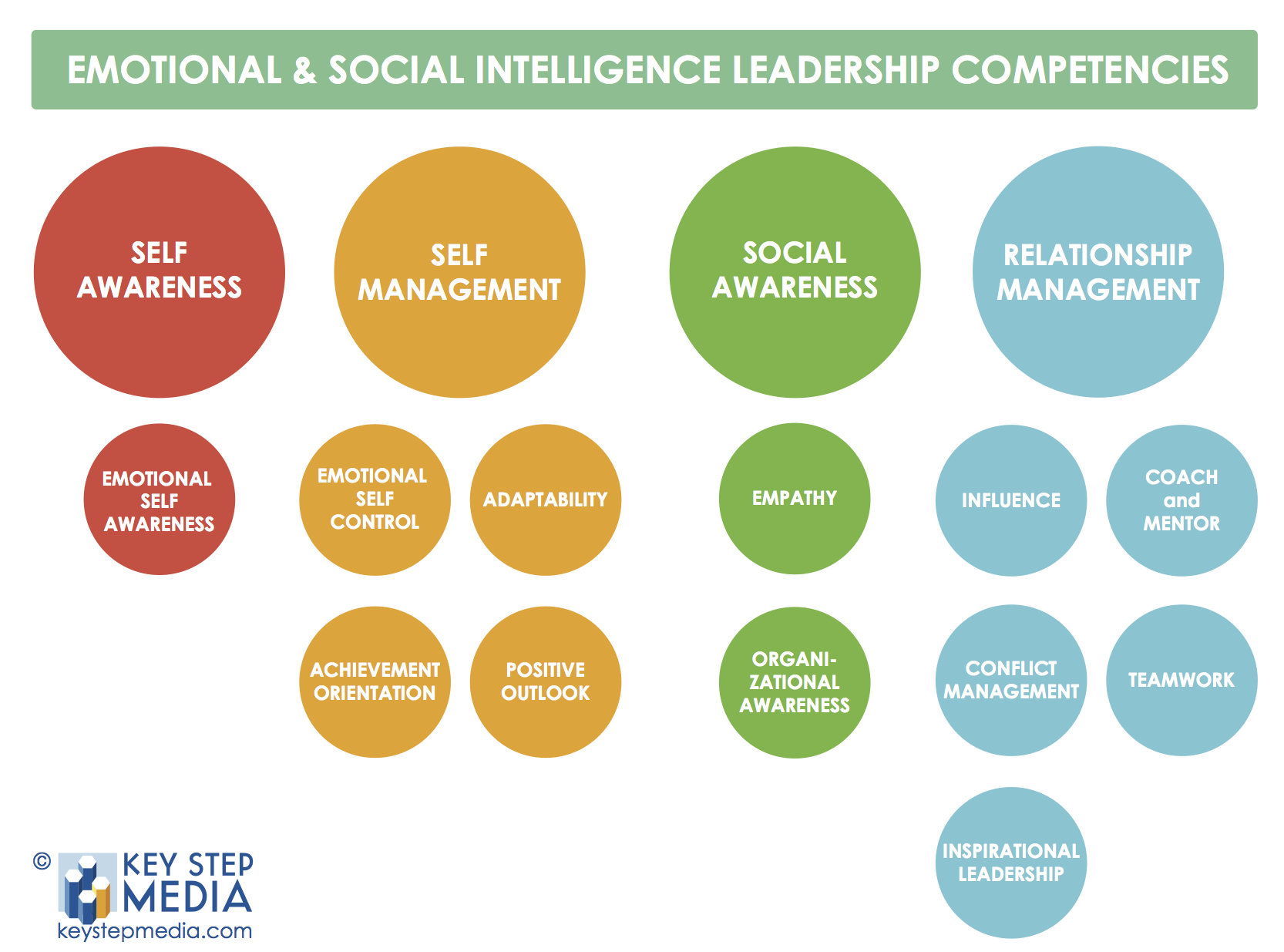
There are four pillars of emotional intelligence, which are arranged as follows:
A) Personal Competence:
- Self Awareness.
- Self Management.
B) Social Competence
- Social Awareness.
- Relationship Management.
Self Awareness
Self-awareness means that you are mindful of your current state of emotion. Highly self-aware people are quite clear about their emotions, and this mere realization can help you overpower emotions such as anger with all its intensities, and can enhance the joy of the positive experience. Self-awareness means to tune into your gut sense. Self-awareness is the primary teaching in all mystic traditions. Self-awareness can be made better through reflection and meditation.
Without self-awareness, we are as babies in the cradles. — Virginia Wolf
Self Management:
Self-management is self-awareness in action. Self-management combines emotion with reason. It consists of things to do and things not to do. Self-management is how you manage yourself when an emotional outburst occurs.
“Anyone can become angry — that is easy. But to be angry with the right person, to the right degree, at the right time, for the right purpose, and in the right way — this is not easy.”
(Book: The Nicomachean Ethics, Author: Aristotle)
Social Awareness
Social Awareness is the ability to read other people’s emotions through listening and observation. Understanding different situations during social interactions are important to connect with people. At this point, it is important to realize that human beings are way too complex, and understanding them can be difficult at times. Observation, listening, and trusting your guts are important in Social Awareness.
“You can make more friends in two months by becoming interested in other people than you can in two years by trying to get other people interested in you.”
(Book: How to Win Friends and Influence People, Author: Dale Carnegie)
Relationship Management:
Relationship management is a social awareness in action. After understanding the dynamics of social interaction one must respond to it accordingly. It harmonizes all the three skills we have discussed. As society gets more and more interconnected, relationship management becomes quite important because Man is a social animal.
“I am very fond of strawberries and cream, but I have found that for some strange reason, fish prefer worms. So when I went fishing, I didn’t think about what I wanted. I thought about what they wanted. I didn’t bait the hook with strawberries and cream. Rather, I dangled a worm or grasshopper in front of the fish and said: “Wouldn’t you like to have that?”
Why not use the same common sense when fishing for people?”
(Book: How to Win Friends and Influence People, Author: Dale Carnegie)
Building Blocks of Emotional Intelligence and Leadership
The most powerful person in the group is one to whom the people pay most attention to. Hence, how leaders are feeling about a situation affects how group members respond to it and in turn affects their performance. In a crisis, group members turn towards the leader to see his response. If the leader is emotionally strong it affects the inner emotional state of the people working with him.
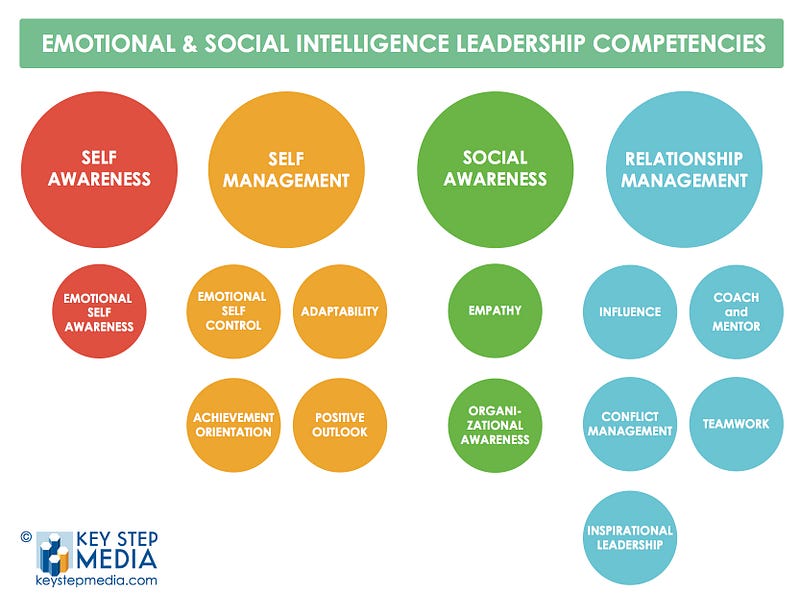
1) Emotional Self-Awareness
It means tuning into your feelings. You know what you are going through and how you are feeling. How you see yourself can creates an impact on people.
2) Emotional Self-Control
Sometimes we are tempted to react to a situation. At that moment taking hold of your impulses for long term benefit is emotional self-control. Leaders are visionary they focus on their long term goal.
3) Adaptability
Everything is evolving with time. The ability to change with changing times and situations is known as adaptability. Leaders understand and predict the trends and change their strategies accordingly.
4) Achievement Orientation
Achievement orientation means continually achieving success through emotional intelligence and at the same time continuing to do so by changing yourself according to the organizational feedback.
5) Positive Outlook
Perspectives define reality. Learning to see a positive aspect of people and situations is a positive outlook.Leaders see positive in people and events despite the crisis.
6) Empathy
The term empathy means putting yourself in other person’s shoes regarding how they feel about their circumstances and problems. Do we know how other people are thinking about a situation? Are we concerned and want to help others
7) Organizational Awareness
Organizational awareness means understanding the group dynamics, how the group thinks, and how members of the group are networked. Effective leaders drive the group.
8) Influence
Great leaders create an impact. To create a long-lasting impact on people in a meaningful way.
Leadership is influence. — John C. Maxwell
9) Coach and Mentor
People need an initial pull to do things. Coaches and mentors drive the inner emotional state of people to achieve their goals. A leader has mentoring abilities.
Outstanding leaders go out of their way to boost the self-esteem of their personnel. If people believe in themselves, it’s amazing what they can accomplish. — Sam Walton
10) Conflict Management
Getting better at emotional intelligence means the ability to resolve conflicts effectively. A leader does not try to force or control people and hence it opens the doors for communication, and communication resolves conflicts.
11) Teamwork
A leader does not command people but instead creates common and shared goals which can be achieved by coordination
12) Inspirational Leadership
To bring the best in every person to achieve common goals can be done through inspirational leadership.
Before you are a leader, success is all about growing yourself. When you become a leader, success is all about growing others. — Jack Welch
How to enhance your Emotional Intelligence
At this point, you might ask But why are we so concerned with enhancing our emotional intelligence? Because it is the key to professional and relationship success and the thing that is even more astounding is it is simple to learn yet demands continuous effort and anybody can enjoy its fruit. To become a great influential leader in your respective domain and generate massive value for mankind emotional intelligence is required.
1) Train your brain
Your brain is plastic, which means it can change and adapt itself based on experience. Our brain changes its structure and function based on the inputs it receives via our actions and thoughts. Neurons when fire together in a certain sequence, repetition and intensity tend to rewire themselves. At first, it may seem difficult but as we continue to learn and apply emotional intelligence our brain tends to rewire itself to the new reality.
Human beings, by changing the inner attitudes of their minds, can change the outer aspects of their lives. — William James
2) Hold your GRIT
Rome wasn’t built in a day
When learning social and emotional intelligence it is important to realize that it a lifelong art that demands passion and perseverance. Any art, be it learning to play guitar or singing demands continuous effort and so does emotional intelligence. By continuous effort on learning via both theory and practice, results get compounded.
Closing Statement
We are humans, and emotion is an intrinsic part of us. There must be a way to live an optimum life with these emotions, and that balance can be achieved by becoming emotionally smart in all areas of life.
When dealing with people, remember you are not dealing with creatures of logic, but with creatures of emotion. — Dale Carnegie