
Emmett Till’s Father Died For The Same Reason As His Son
Louis Till was accused of sexually assaulting two white women

I teach in a 98% Black high school in Baltimore City, and we are reading a book documenting the systemic barriers faced by a family on the South Side of Chicago, notably systemic racism. The play, A Raisin in the Sun, was a precursor to the Civil Rights movement.
On a related note, one of my students asked me about Emmett Till and information on why he was killed, and we went down the rabbit hole looking up the horrific lynching of Emmett Till. Emmett Till was infamously killed for allegedly flirting with a white woman. The woman, Carolyn Bryant, also infamously lied about the most incendiary parts of her claim.
One of my inquisitive students asked me about Emmett Till’s family. They asked me about his mother, who we researched. Carolyn Bryant is still alive, and he was wondering who was still alive? Who wasn’t? I knew Mamie Till wanted an open casket for her son so the whole world could see how her son was killed.
But then my student also asked me about Emmett Till’s father. Frankly, I never looked up Emmett Till’s father before, so we looked him up too.
We had to move on with the lesson plan eventually, but it was a shocking and chilling coincidence.
Emmett Till’s father was named Louis Till. According to author John Edgar Wideman, Louis Till was in the Army during World War II, at a time the military was still segregated. While he was not in combat, he served in a port battalion, where he and the rest of his predominantly Black unit had to move supplies. He and another Black man, Fred McMurray, were convicted by an army court-martial of raping two white women and killing another one.
Wideman does not believe the two of them were given a fair trial — after all, after what happened to Louis Till’s son, it is a very spooky coincidence.
Gail Lumet Buckley at the New York Times says Louis Till was “an abusive husband who did not really know his son.” Records seemed to be sparse and unavailable, even to Mamie Till, Louis Till’s husband, and Emmett Till’s father.
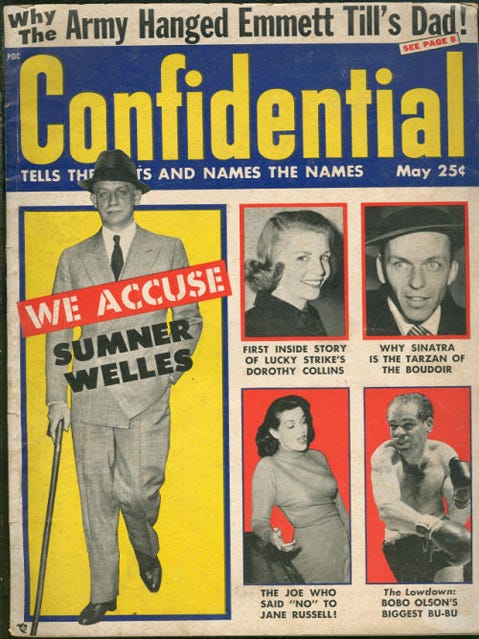
They were unavailable until the lynching of Emmett Till, where Wideman says the confidential military records were leaked to the press. During the trial of Emmett Till’s killers, a completely sham trial, Till’s killers were acquitted by an entirely white jury.
Professors Davis Houck and Matthew Grindy state Louis Till was a “rhetorical pawn” in bigger political battles, including between the north and south, black and white, and the NAACP and many citizens’ councils in the South. Some northern newspapers applauded the military service of Louis Till, particularly Life magazine.
However, after news of how Louis Till died was revealed to the public, many defenders of Emmett Till’s murderers used Louis Till’s case to justify the younger Till’s murder. The crudest of defenders exploited Louis Till’s death and believed it was a case of “like father, like son.”
Two Mississippi senators in 1955, James Eastland and John Stennis, looked in great detail at the military files. Before the two leaked information to manipulate public opinion on Till’s murder, very few people knew anything about Louis Till besides him being the owner of a ring on Emmett Till’s body. Mamie Till received a letter in 1945 that her husband died of “willful misconduct,” and when she tried to investigate his death three years later, she could not find any information.
When Louis Till died, he and his wife were separated. It was not a happy marriage — Mamie Till once received a restraining order on her husband. When he violated the order, he was given a choice: enlist in the Army or go to jail. He enlisted in 1943.
Louis Till’s execution order was signed by no other than General Dwight D. Eisenhower. He was found guilty of sexual assault and murder in Leghorn, Italy on February 17, 1945 — he was alleged to have killed Anna Zanchi, and raped Benni Lucretzia and Frieda Mari the year earlier. Till was executed on July 2, 1945, and buried in a military cemetery in France, the Oise Aisne World War I cemetery.
It’s impossible to separate the news of Emmett Till’s lynching, Louis Till’s death, and racial tensions in the South in 1955. Even to the NAACP, the Louis Till case presented a liability. Roy Wilkins, then executive secretary of the organization, was careful not to celebrate the military service of Louis Till.
Even Mamie Till, working with the NAACP, knew, in the words of Houck and Grindy, that “a death carrying the ‘willfully misconduct’ label, however indeterminate, was not a rhetorically advantageous one.” In her memoir, Mamie Till recalls Wilkins was fortunate not to have “gotten caught up in that ‘Louis Till trap.’”
None of this stopped many Mississippi newspapers from racial dog-whistling, accusing the NAACP of not checking its facts and accusing the North of an anti-Mississippi conspiracy. In particular, they cited the Life magazine article celebrating the service of Louis Till.
Despite Wideman’s research, not much is known about the death of Louis Till. Those seeking to use his example at the time mostly sought to discredit the Civil Rights movement and the “Northern media.”
Emmett Till’s death was shown to the whole world and is remembered today. Louis Till’s death was not.
Wideman did find out that Louis Till did not give a statement and did not tell two agents about the allegations. He did not provide an alibi, but he did tell one agent:
“There’s no use in me telling you one lie and then getting up in court and telling another one.”
Given the sociopolitical factors of the time, in a segregated military and the fear of Black men raping white women in the Jim Crow era, there’s sufficient reason to question Louis Till and Fred McMurray’s guilt. One prisoner who was in jail in Italy at the same time as Louis Till was the famous poet Ezra Pound, who wrote about his death in the Pisan Cantos:
“Till was hung yesterday for murder and rape with trimmings”
Professor Alice Kaplan went to visit Louis Till’s grave in France, in Plot E of the cemetery. In that plot, there are 96 markers. All soldiers in the plot were either dishonorably discharged or executed for crimes during World War II. The only American soldier executed for desertion, Eddie Slovik, was buried in the plot.
But according to Kaplan, 80 of the 96 graves belonged to Black soldiers, tried and convicted for rape and murder. The disparity is striking — in an army that was only 8.5% Black, 83% of those executed were Black.
We don’t know whether Louis Till was guilty or not, but we have enough reason to question the military court-martial of 1945, given the context and time.
Perhaps it is misleading to say Louis Till died for the same reason as his son — we know Emmett Till’s accuser lied. We do not know anything about Louis Till’s accusers.
I’ve known about Emmett Till since I was in middle school. His story is well-engrained in our history and public consciousness. But knowing about Emmett Till’s father just makes me wish we had more answers and more information.