
Embrace Takeoff To Regrettable End of Life of Angular Framework
Google started AngularJS development in 2009 hoping to create a suitable framework for its applications and bring into web development standards, which were at the time quite rare. Many small frameworks and libraries used different techniques and syntaxes, but not many of them were complete solutions for web development. Your only option was to combine them which led to problems with performance or even inability to solve some problems because of the combination. Let’s look at the rise and fall of AngularJS.

Beginnings and take-off
AngularJS was open-sourced in October 2010, becoming one of many web frameworks. Improving mistakes of others, adapting new features, but also creating it’s errors. The main new difference was the completeness of the framework. You did not have to use different libraries for different parts of the web you used one framework and added libraries as you needed.
The key difference was the backing of a large tech company, Google, that promised longevity of the framework with sustainable and responsible development in the future. With the promise of becoming something as a baseline for future frameworks and setting standards in web development. This made the framework look attractive to a wide audience. By open-sourcing the framework many developers over the world could now study the framework thoroughly and help with the development of a huge number of applications in their projects. Submitting errors back to Google (AngularJS development team). In a matter of time, this advantage boosted Angular to one of the most used frameworks in the world. Even leading to the building of libraries and bigger frameworks around it.
First roadblocks
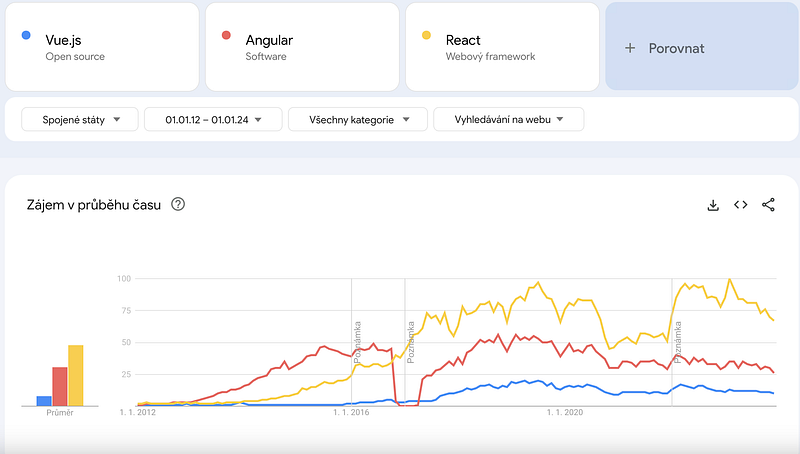
In 2014–15 Angular started to hit its first huge roadblocks to success. New standards in web development emerged in JavaScript and HTML, even in the render engines of web browsers. At this, point the team developing the framework started to reach limits on how they could improve performance, simplify the framework and, bring new web features. The growing demand and popularity started to drop as it lacked features others had (React, Vue, …). The only option was left and it was a complete rewrite, building the Angular 2.

Angular 2
The new version of Angular was renamed from AngularJS to Angular, standing almost as the new framework, because of the difference between Angular and AngularJS. This rewrite was quite controversial in web development, because at the time many applications were using AngularJS and now they should go to a newer version, but with completely different fundamentals. Meaning they would need to completely rewrite the application, because of the lack of some migration guide. Many teams quickly started to rewrite the projects to be up to date.
While applications were converting to Angular 2, there were introduced major updates to the framework. The only problem was the major updates were not compatible with older versions meaning every time something must have been rewritten. This made the developers annoyed with the framework converting to the other frameworks that were relatively more stable, such as (mainly) React.js or Vue.js.
The fall
Many new projects were not thinking about using Angular anymore shifting to other frameworks instead. New developers did not learn Angular and old ones were disgusted by the drastic changes. Reasonably popularity of Angular decreased.
Final thoughts
The team developing Angular learned from their mistakes so from version 6, they started to care more about compatibility and introducing new functionalities. Bringing Angular a bit back to its former glory as one of the biggest frameworks in the world. New libraries such as Angular Material or Angular Bootstrap emerged helping it to a more complete solution.
Even though I don’t think Angular will get back its momentum latest versions introduced are quite good, but here comes the question if we wanna again switch back to it?