
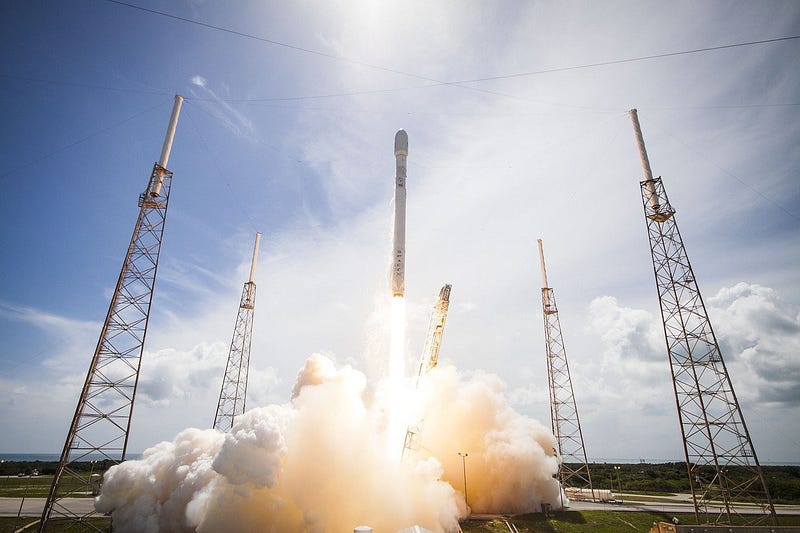
Elon Musk and Space X: actually, it is rocket science
Whenever I read stuff about people like Elon Musk, I can’t help wondering about those moments when they made key decisions, and I realize that, to get to where they have, you have to be made of very special stuff.
For me, there is a moment in this man’s life story when, after the sale of PayPal to eBay and with a lot of cash in his pocket, he decides to invest it in a new company dedicated to space exploration. If I try to imagine what would happen if I were in a similar situation, and I told my friends and family: “you know, now that I’m rich, I’m going to start a company to launch rockets into space.” I guess most would say something like “you’ve lost your mind.”
They might be right: taking on huge aerospace companies with seemingly bottomless resources in a sector that depends on the confidence you are able to inspire in public agencies such as NASA seems beyond risky and instead just downright crazy.
And yet, nineteen years later, here we are: SpaceX is the absolute leader in space exploration, having also triggered a dimensional change in our relationship with the cosmos. Today, the cost of putting a kilogram into orbit is ten times less than it was just a decade ago, and all of that efficiency gain is entirely thanks to SpaceX. The company is going to launch up to 52 rockets over the course of this year; not that long ago, a launch was a major event. The near future already resembles a sci-fi movie where rockets leaving for space with the frequency of airliners.
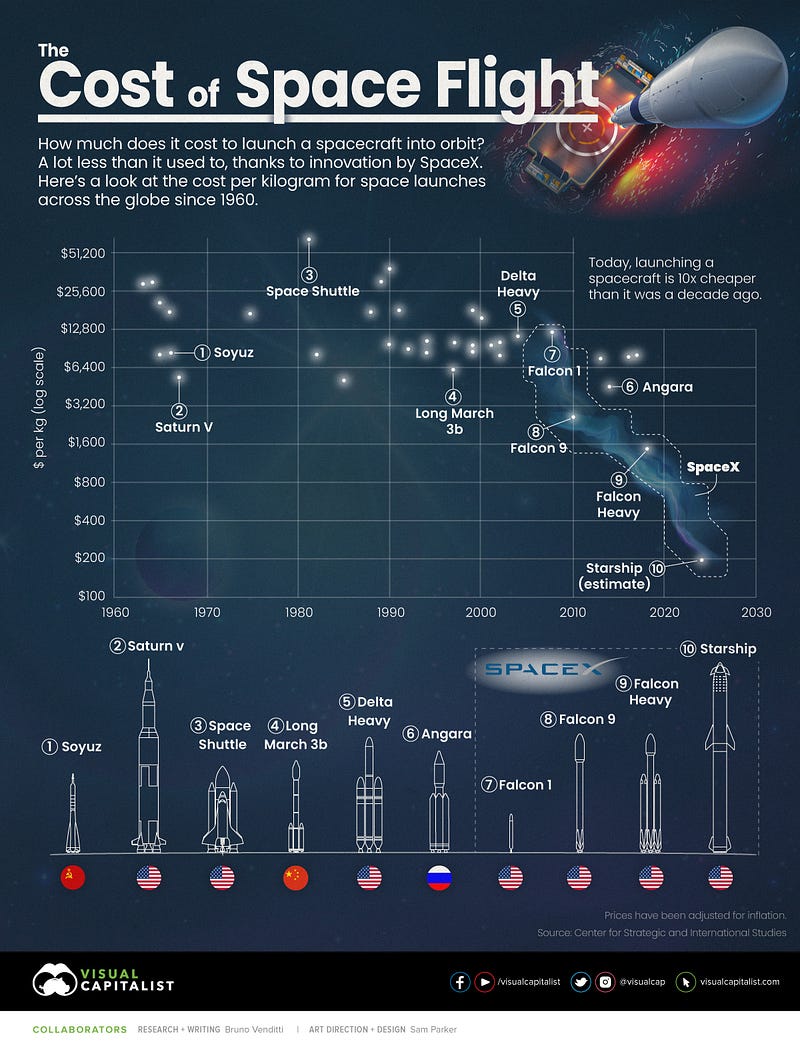
What has Space X done? Firstly, it has applied the principle of economies of scale. When Musk began looking into this industry, he realized that the cost of a rocket was only 3% of the price of a launch, and that through vertical integration it would be possible for his company to produce up to 85% of the projectile, which would be equivalent to reducing the cost tenfold and garnering a 70% profit.
If the rockets were reusable, then the savings would be even greater, the more often they could be reused. Some SpaceX rocket components have already been launched more than ten times. On a single mission, it is estimated that the company was able to save NASA more than half a billion dollars.
To avoid excessive financial leverage, Musk started with a very small rocket, the Falcon 1, which became what is known in entrepreneurship as a minimum viable product.
From then on, it’s all about reaching the desired economies of scale as quickly as possible. This requires a steep learning curve, which means as many launches as possible. We are talking about highly complex, highly sensitive and very expensive operation, so you must justify their cost.
Musk’s idea was simple: he knew that if he were going to launch a lot of rockets to achieve economies of scale and experience, he needed something that would serve a function, either to get something into orbit that someone would pay him for or a service that he could charge for. To accomplish this, he created Starlink, a satellite company intended to circle the globe and provide internet access and other services. If he were going to reduce the cost of launching a satellite by one all-important factor, he understood that he might as well take advantage of that reduction himself, especially during the period when few people trusted him or his rockets to put their very delicate and very expensive satellites into orbit.
As a result, every SpaceX launch was completely full, because all available space was packed with Starlink satellites. This has allowed the company to put more than 1,000 satellites in orbit, with the last launch on January 6, with the goal of 12,000, for which it already has a license. At the moment, it is launching them 60 at a time. But in its next rocket model, the huge Starship, it will be able to put up to four hundred into orbit with each launch. Mass-produced satellites, at a much lower cost per unit than existing satellites: after succeeding in lowering the price of rockets, Musk set out to do the same with satellites, and succeeded again.
Any problems along the way? Of course, as always with such ambitious initiatives. Some have complained that the night will never be the same, and that there are already too many objects circling the planet. But to all intents and purposes, if anyone has succeeded in bringing space exploration within human reach and making the dream of a multi-planetary civilization possible, it has been Elon Musk. And you know what they say about rocket science.
(En español, aquí)