
Ellen Pompeo’s Passive Racism Underscores the Epidemic of Iconism
Yes, “celebrity privilege” is real…and Ms. Pompeo’s sense of pompous entitlement only reflects a greater trend
Our current era sees many contentious debates over the concept of “privilege.” These are necessary discussions that require deep listening as well as robust good-faith dialogue.
Whether it’s race, sex, gender, ethnicity, age, sexuality, class, religion, disability status, perceived beauty, or political ideology — it’s totally fair to examine where in life any of us, as global citizens, have unearned advantages. And, by that same token, to be cognizant of when we’re exploited by systems, individuals, or groups within society.
But today, I’m going to look at how those good intentions and noble motives can go off the rails. One of the greatest culprits facilitating this potency is that of “iconism” — aka “celebrity privilege.”
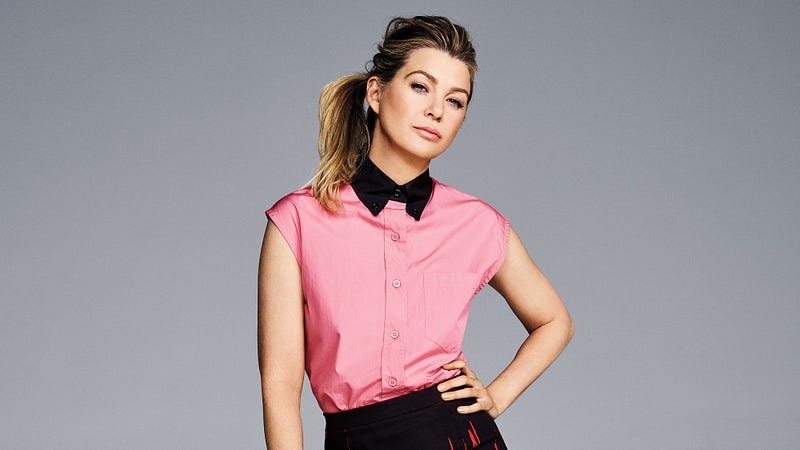
Ellen Pompeo, star of the hit medical drama Grey’s Anatomy on ABC, is one of its biggest offenders.
Last month, Pompeo interviewed former Grey’s costar Patrick Dempsey on an episode of her new podcast, Tell Me. She recounted an instance from five years ago when Denzel Washington directed an episode during Season 12.
A bemused Pompeo brought up “a Denzel story” stemming from an incident where she’d openly berated another actor, trying to direct him during their scene. She described how Washington — the episode’s actual director — intervened, and then apparently “went ham on my ass.”
To which, according to Pompeo, she shot back at Washington:
Listen, motherfucker, this is my show. This is my set. Who are you telling [what to do]? Like, you barely know where the bathroom is!
And then, added Pompeo, when Washington’s wife — Pauletta Pearson — came to visit the set later that day, Pompeo complained to Pearson about the purportedly inappropriate behavior of Pearson’s husband (Washington).
Although Pompeo tried to insist (during the podcast episode) that she had “utmost respect” for Washington, and she classified their exchange as an “amazing experience,” many listeners of her podcast episode were not amused. People characterized Pompeo as entitled, obscene, and exploitative. She got accused of being “a Karen,” exhibiting white privilege, and demonstrating what a toxic coworker she can be.
And they’d be right. But there are so many more layers to it.
YourTango editor Nia Tipton describes the power dynamics of Pompeo’s behavior: how Pompeo, as a White woman who is hired talent, tried to usurp the power of Washington, a Black man whose task was to run the production. Pompeo then turned around and used her celebrity status to try to paint herself as the victim, while basically laughing it off as a cute anecdote after the fact.
But here’s the kicker: Ellen Pompeo would be the first one to trumpet how she’s an “ally” to BIPOC colleagues, peers, and fellow citizens. How she has cast herself as this shining example for other White people on how to be “antiracist” to help empower Black, Indigenous, & People of Color.
Prior to last February’s Golden Globes broadcast, Pompeo penned an “open letter” to the Hollywood Foreign Press Association, to “White Hollywood,” and to White people in general. She rightfully called out the lack of BIPOC representation on film and television.
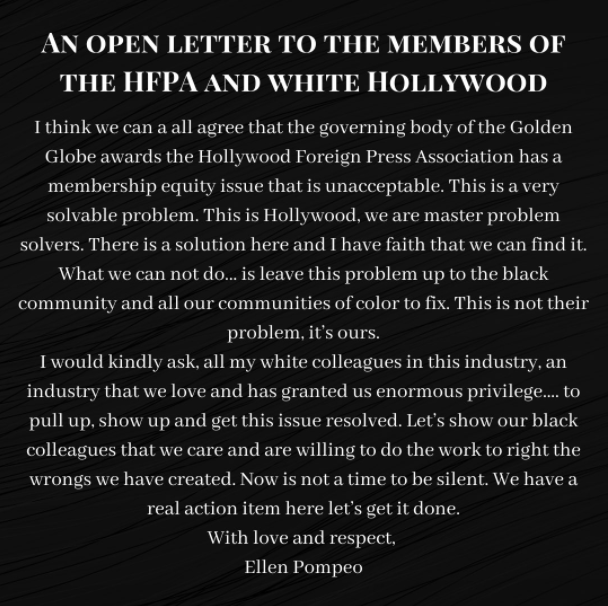
While Pompeo’s declaration was accurate in its main point, she completely missed the boat as far as encouraging actual inclusion. Her proposed solution was merely for White people to use our “enormous privilege,” “pull up, show up, and get this resolved,” and “do the work to right the wrongs we have created.”
Gee, Ellen, could you be any more vague?
Via Twitter, I’d tweeted back a response to her that she may or may not have seen (but I’m guessing she didn’t, since I’m a “nobody”…)
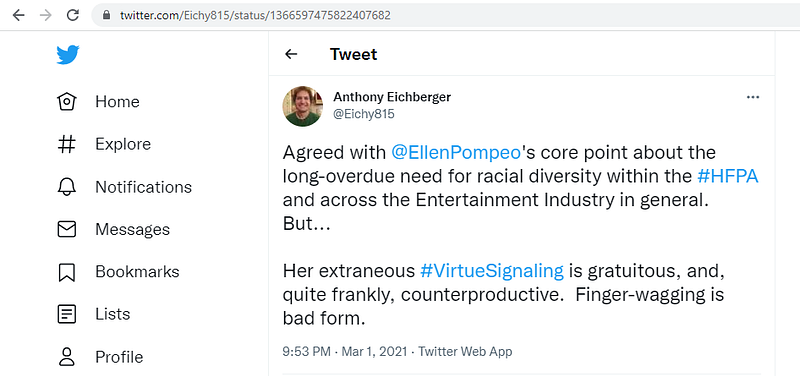
The point I was trying to make, here, was that Pompeo’s virtue-signaling is nothing more than empty platitudes. It’s emblematic of the Left’s wayward approach where self-proclaimed “allies” try to weaponize group-based guilt and blame to make themselves appear morally superior. All while putting forth very few (if any) concrete, actionable solutions for rectifying systemic disparities.
This isn’t the first time that Ellen Pompeo has publicly worn her sanctimony on her sleeve. During a November 2018 Porter Magazine photo shoot, she appeared at a DEI roundtable alongside of Gabrielle Union, Gina Rodriguez, and Emma Roberts. While accurately criticizing the lack of racial diversity in Hollywood, Pompeo droned:
As Caucasian people, it’s our job. It’s our task, it’s our responsibility to make sure we speak up in every single room we walk into, that this is not okay and that we all can do better. It’s our job, because we’ve created the problem.
Although Pompeo received kudos from journalist Jemele Hill, not everyone was so impressed with her lip service.
For example, The Root’s Monique Judge had this to say:
Pompeo rightly called out the lack of diversity in Hollywood, and everything she said is true — but are we really at the point of handing out coronations for [W]hite people when they do the bare minimum that any decent human being should do when they see a wrong being committed? Black women have been saying this for years, but as per usual, it doesn’t have any “validity” until a [W]hite woman says it — and this week, that [W]hite woman is Ellen Pompeo.
And some Twitter users had been collecting receipts on Pompeo’s behavior for awhile. As BET Online reported in its “Celebrity News” section, observers admonished Pompeo’s words for failing to match her past actions. Essence’s Kimberly Sears Allers along with Monique Judge herself have both pointed out how Pompeo has tried to hide behind having a Black husband (record producer Chris Ivery) and two biracial daughters when asked to examine her own racial biases. Back in 2016, Pompeo once railed against a Black teenager who’d questioned the appropriateness of White people using black facial emojis in their social media posts; Pompeo’s online fans then began to attack the teenager, en masse.
My qualms with this self-aggrandizing actress are two-pronged. First, it’s just plain lazy and disingenuous for Ellen Pompeo to be lecturing other White people about allyship to BIPOC communities when her own activism has amounted to barely more than hemming or hawing.
But I also reject the premise that White people need to take “group accountability” or “unconditional direct intervention” for every systemic form of racism. In some cases, a random White person in the room simply doesn’t have the power or social capital to rail against racist policy in an effective way. Furthermore, without broad consensus on the specific actions that need to be taken, the hasty or haphazard intervention undertaken by White individuals or groups could actually be deemed objectionable by the BIPOC colleagues who’d be the ones most directly and adversely affected by such behavior.
Specific actions, by the way, that Pompeo herself has failed to articulate.
This isn’t to suggest White people should do nothing. On the contrary, we should follow the lead of BIPOC innovators who craft and propose industry-specific reforms. We should help to implement them, when and where we have the opportunity to do so. But those solutions still need to be constructively evaluated, first.
And we can definitely carry out this allyship without publicly flogging ourselves in regard to our skin color. Or without bragging about the said allyship itself.
Pompeo doesn’t seem to understand the concept of healthy dialogue. Consider her social media behavior this past August, when she tried to guilt-trip a bored fan by holding them responsible for the oppression of women in Afghanistan.
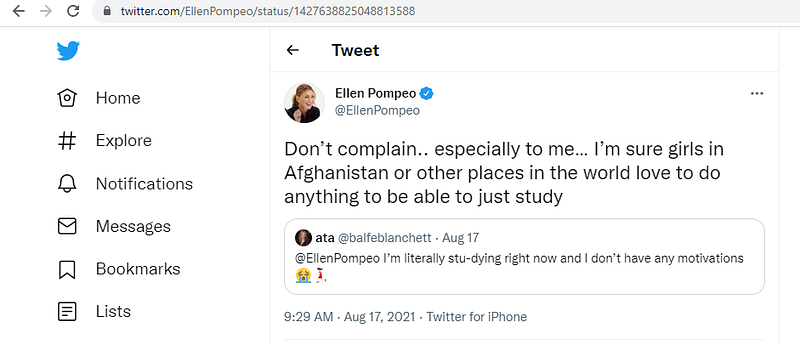
After fans called her out on her pious bullshit, Pompeo became predictably defensive.
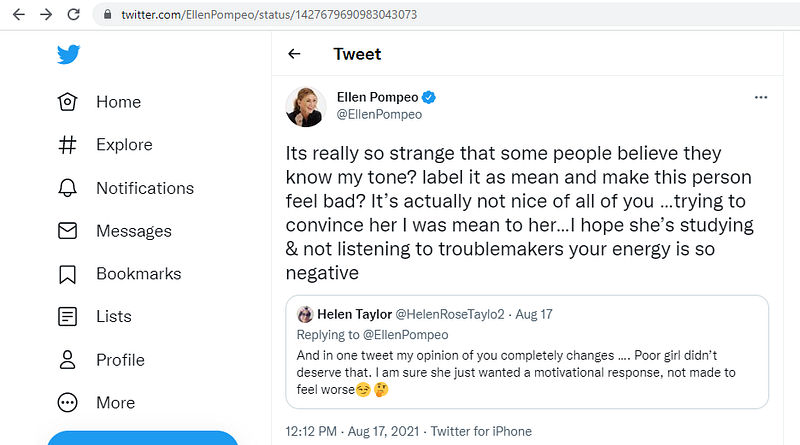
Let’s crystallize one undisputable truth: just because someone is a celebrity, that doesn’t mean we should act like zombies who bow down to them no matter what they say or do. Nobody walks on water. No public figure deserves universal deference based on their namesake or their résumé.
Not Meryl Streep.
Not Dwayne “The Rock” Johnson.
Not Madonna.
Not Dave Chapelle.
Not Al Franken.
Not Cher.
Not Tom Hanks.
Not Jane Fonda.
Not Sheryl Underwood.
Not Tom Cruise.
Not Dan Savage.
Not Terry Crews.
Not Beyoncé.
Not Bruce Campbell.
Not Will Farrell.
Not the late Cloris Leachman.
Not the late Joan Rivers.
Not the late Cicely Tyson.
And sure as hell not Ellen Pompeo, based on her sentiments that I’ve outlined for you all today.
Unfortunately, ABC appears reticent to take any disciplinary action against Pompeo. Obviously, the network’s silence is due to how much money their star headliner’s medical drama brings in for them. They want to milk Grey’s Anatomy for as long as they can — especially since creator Shonda Rhimes decamped to Netflix.
Pompeo herself certainly isn’t going to admit her flaws. Although her podcast dung-stepping had occurred during that final week of September, she spent almost half of her October 7 segment during Jimmy Kimmel Live! talking about her homemade tomato sauce. Not once did she bother to address the social media controversy in which she’d recently become embroiled.
The rotten apple doesn’t fall far from the corporate family tree, it seems. Krista Vernoff — showrunner of Grey’s Anatomy and its spinoff, Station 19 — has followed in her favorite starlet’s footsteps by making the revulatory admission that her white privilege protected her from criminal prosecution back in her teen years. In short order, Vernoff was then lauded by filmmaker Ava DuVernay — culminating in Vernoff’s creation and shepherding of the insufferable Diane Lewis character (portrayed by actress Tracie Thoms) on Station 19, who has become the genre’s very own “Mary Sue” of racial tokenism combined with meta thought-policing.
To be clear: I’m not at all suggesting we should gloss over white privilege or continue to ignore racism’s systemic manifestations. But embracing performative allyship — endlessly rambling about how “deficient” most/all White people supposedly are — won’t get the job done.
Pompeo is a multi-millionaire who says she isn’t even sure she wants to continue acting, once Grey’s Anatomy ends. She opines how she might do something in the business world.
Well, if Pompeo goes the entrepreneurship route, perhaps she could get behind agri-sustainability alongside commercial ventures that empower communities of color with food security? Some in Hollywood pay lip service to the national security threat posed by lack of access to healthy food…but even fewer of them focus on innovative production to feed (and economically strengthen) impoverished American consumers.
If Ellen Pompeo wanted to make a real difference, she might consider this type of endeavor — rather than hypocritically lecturing other White people about how to behave or think.
Hey, she could even cross-promote her homemade tomato sauce.


