Elizabeth Holmes and the Ghost of Steve Jobs
The legend of Apple’s founder made the Theranos scandal possible
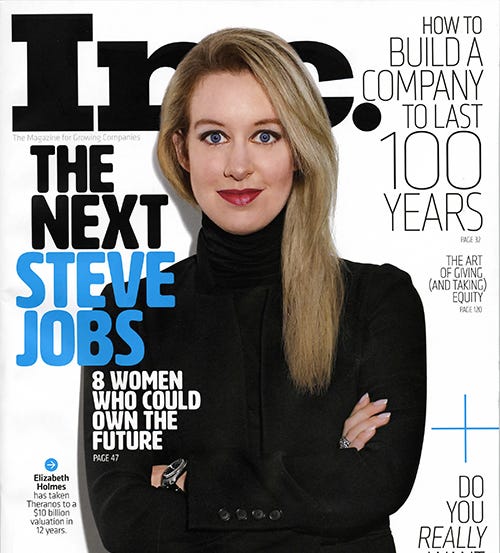
With the release of HBO’s Alex Gibney-directed documentary the Inventor: Out For Blood In Silicon Valley, the fascination with former Theranos CEO Elizabeth Holmes and the implosion of her blood testing company seems to be cresting. And why not? This is a story that appears to have everything: ambition, deception, a secret love affair, political heavyweights, media moguls, whistleblowers, celebrities, an attractive blonde wunderkind, an Oscar-winning director, a suicide, the meteoric rise and fall of a media darling, hundreds of millions of dollars, and the health of thousands of people hanging in the balance. Even a feature film about the Theranos scandal starring Hollywood’s highest-paid actress Jennifer Lawrence as Holmes is already in the works.
But even with all of these tantalizing details, there is an unseen presence that seems to hover over, permeate, and influence nearly every aspect of the rise and fall of Holmes and Theranos, as well as the entirety of Silicon Valley and everything its creations influence: the ghost of Apple’s iconic founder Steve Jobs.
Holmes’ worship of Jobs and Apple was no secret, and the seemingly conscious similarities between Jobs, Holmes, Apple, and Theranos are multitudinous. The most obvious manifestation of this was Holmes’ adoption of a Jobs-like “uniform” that she wore every day, which included black turtlenecks made by the same Japanese designer who made the black mock turtlenecks that Jobs made famous. Holmes’ decision to leave Stanford during her sophomore year to start Theranos was surely legitimized by Jobs — probably the world’s most famous college dropout — and his decision to quit Reed College in the middle of his freshman year.
An admirer of Apple’s design-first aesthetic and fond of predicting that Theranos’ never-realized Edison blood testing machine would become “the iPod of health care”, Holmes aggressively recruited Apple employees like Apple’s former chief software technology officer Avie Tevanian, and even hired the advertising agency behind Apple’s most iconic ad campaigns to do the marketing for Theranos’ initial rollout to Walgreens stores. Holmes’ intense, bullying managerial style and the expectation that her employees could accomplish the impossible are taken directly from Jobs’ infamous playbook. Even one of the more bizarre details about Holmes — that she wouldn’t blink or break eye contact when talking to people — is lifted directly from Walt Isaacson’s biography of Jobs, who taught himself to stare at people without blinking in order to gain influence over them.
If anything, the Inventor undersells the countless ways Holmes patterned herself and Theranos after Jobs and Apple. However, she is hardly alone in falling under the sway of Jobs’ life story and Apple’s successes. Throughout the Inventor, it becomes increasingly clear that the tech world, the media, and really all of us are still being haunted by the ghost of Steve Jobs. In fact, without the myth of Jobs, the lessons we’ve taken from it, and the power it has over our collective imagination, it seems clear that Holmes and the Theranos scandal would have never happened.
No Expertise Required(?)
Jobs was neither a computer engineer, a programmer, a student of computer science, or a hardware designer. However, he was fascinated with computers, recognized their revolutionary potential, and could lead, cajole, and intimidate his employees into carrying out his vision. He also had a keen sense for design, aesthetics, the roles technology could serve in improving people’s lives, and how to leverage all of this into legendarily effective product presentations and marketing campaigns.
Holmes clearly shared many of these qualities. While neither an expert in software, hardware, medicine, nor healthcare, her abject fear of needles and her experience losing her beloved uncle to cancer gave her the correct insight that the cost, discomfort, and inconvenience of traditional blood testing was preventing millions of people around the world from getting timely, effective treatment. If blood tests could be done quickly, easily, affordably, at numerous convenient locations, and utilizing only a tiny amount of blood from a finger pinprick to conduct hundreds of different tests, it would truly start a revolution in healthcare and save countless lives. Holmes learned how to effectively present this vision — utilizing her looks, confidence, poise, storytelling ability, and the manufactured imitation of an iconic tech visionary — to recruit top talent, fool the media, and convince investors to give her hundreds of millions of dollars, even though she had no idea of how her vision could be achieved.
By following Jobs’ example, it’s possible that Holmes could have succeeded in her mission to change the world by revolutionizing healthcare despite her lack of expertise in the fields that would make her revolutionary device possible. However, she somehow left out the all-important ingredient to Jobs’ and Apple’s early success: Steve Wozniak. While Jobs couldn’t build a computer or write code, Woz could do both with genius-level proficiency. While Woz was content to give the plans for the first Apple computer to a club of DIY computer hobbyists for free, Jobs recognized its potential as a consumer product that could be sold for profit if he could market it and he and his friends could build the completed computers fast enough. Eventually, Jobs would be able to surround himself with a team of Wozniaks — experts in their fields like Jony Ive (design), Tim Cook (operations), Phil Schiller (marketing), Eddy Cue (software), etc. — who could turn his ideas into profitable realities.
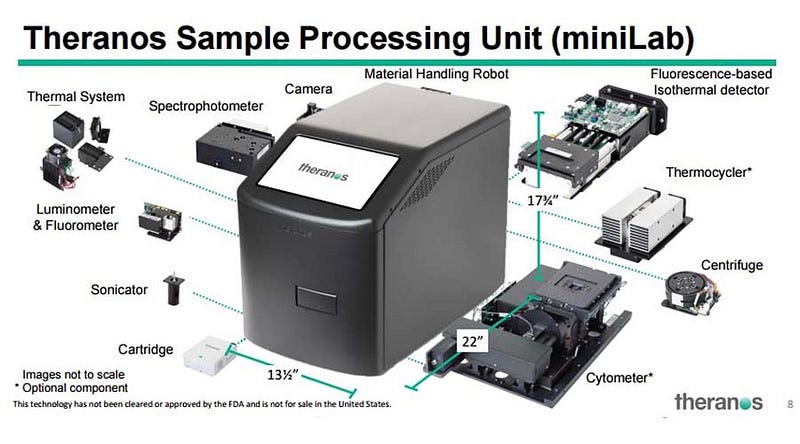
Holmes never saw an existing technology and had the vision to imagine how it could be transformed into a revolutionary product — she simply imagined a product that she wanted to exist. She never had a Woz who could make her dream of a simple, beautiful, miniature blood testing lab a reality. The best she could manage was Ramesh “Sunny” Balwani, a man with no medical or science background who would later become Holmes’ boyfriend, her enabler, Theranos’ president and chief operating officer, and the company’s flashy cheerleader, salesman, and enforcer. But when it came to making a printer-sized device that could perform hundreds of different blood tests using only two drops of blood, he was of no help at all.
If you want to be the next Jobs, you better make damn sure you have a Woz.
Faking It, But Not Making It
In the business world, it’s not uncommon for a fledgling company to claim that its product will revolutionize X industry, transform the way humans do X activity, and/or change the world, even if that product does not yet exist. This “fake it ’til you make it” attitude is especially rife in the world of Silicon Valley tech startups, where it can be hard to know which technological obstacles can be overcome, which bugs can be caught and fixed, and which features will be ready in time for launch. The thinking is that as long as your product can eventually deliver on most of its promises — even if it takes a few versions to troubleshoot, add features, correct mistakes, and refine designs — no one will know or care that you were talking out of your ass when you made your initial lofty claims. If your product goes on to be a success, the tales of your early bravado and deception will simply be amusing, endearing footnotes that need no apology.
The unveiling of the iPhone — arguably Apple’s most iconic and truly world-changing product — is an archetypal example of this kind of thinking. Now infamously, when Jobs presented and demonstrated the first iPhone at WWDC 2007 in front of an auditorium of 5,000 attendees, the prototype hardware and software were unfinished, buggy as hell, and prone to shutdowns, network disconnections, and other problems if the device was asked to do multiple functions, which would obviously be a key part of the presentation. So to make it appear that the iPhone could handle this, the iPhone team, through hours of trial and error, was able to identify a “golden path” of tasks that, when performed in a specific way and order, created the appearance that the prototype iPhone actually worked. But if Jobs deviated at all from the golden path, the device would fail.
The rest, as we know, is tech history. Jobs was able to walk this golden path and deceive the audience (and the world) into thinking that the iPhone in his hand was a fully-functioning product ready for market, in what many consider to be Jobs’ finest hour and the greatest tech presentation of all time. The fact that it took a significant amount of trickery, deception, and luck to pull it off is now just an amusing if harrowing detail, if it’s known at all. Jobs successfully faked it until Apple’s software and hardware engineers could make it, launching one of the most important products in human history.
I have no doubt that Holmes knew and probably loved this anecdote. After all, Theranos’ entire business model was that if they could trick enough people into investing in a revolutionary blood-testing device that didn’t yet exist, someday, somehow, with enough money, time, and talented people, it eventually would, and it would change the world just as Jobs did with the iPhone. “Fake it ’til you make it” is actually considered to be a quasi-legitimate business strategy, allowing a company to attract investors, create awareness, and buy time until a viable product can be completed.
However, an important distinction is that Jobs and the iPhone team knew that making the iPhone hardware and software work was an achievable goal, even if they couldn’t have a completed working prototype finished in time for the iPhone’s public unveiling. When it eventually went on sale the iPhone was slow, limited, underpowered, and full of bugs, but it would fundamentally be the product it was advertised to be, and its speed, capabilities, and reliability would greatly improve with each generation.
The problem for Holmes is that, as far as we know today in 2019, it may not be physically possible to conduct hundreds of blood tests using a single drop of blood from a fingertip, let alone conduct those tests in a box the size of a desktop printer. No amount of venture capital funding or optimism can alter this fundamental reality. But not only did Holmes tell investors, partners, and anyone who would listen that this was indeed possible, but that Theranos had invented a machine that was currently doing it, and doing it cheaper and more accurately than conventional equipment.
That’s when “fake it ’til you make it” became outright fraud, which is what Holmes has been charged with and may go to jail for. When you’re dealing with people’s health, trickery, bugs, and inaccurate results can’t be tolerated. And if you’re faking it when there’s no way to make it, you’re just lying.
Generation Jobs
One of the anecdotes from the Inventor that struck me was the story of what would happen when one of Holmes’ more experienced hires told her something she didn’t want to be true. When an older, more knowledgeable employee told her that something couldn’t be done, Holmes would often have that employee replaced with a younger, more inexperienced person who would tell her that it could be done, or would simply keep their mouths shut. While this sounds like the behavior of someone who couldn’t tolerate dissent or inconvenient truths, I think there was something else at work.
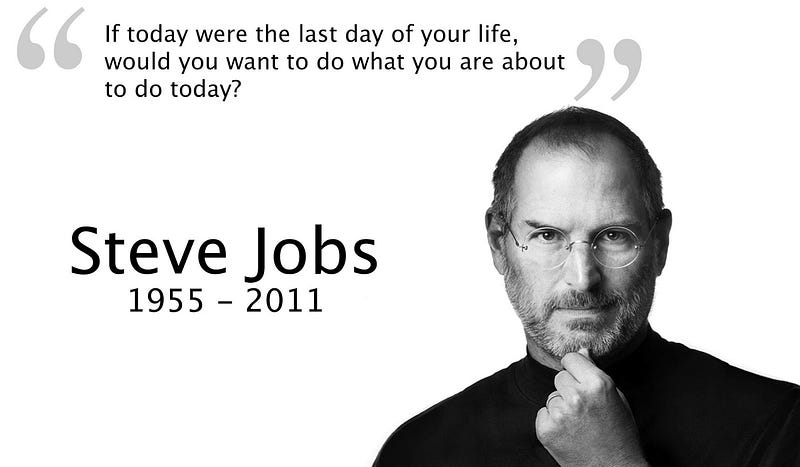
Steve Jobs was infamous for his “reality distortion field”, described as his ability to use his charisma, conviction, and force of will to bend people’s perception of reality and convince them that something they previously thought was impossible could actually be achieved. This would often lead to Apple employees working long hours and barely seeing their families for months at a time, fraying their nerves and sanity in order to achieve a seemingly absurd goal or meet an unrealistic deadline. But in many now-legendary instances, Jobs ended up being correct, and even though it could be hell on his employees, they would eventually admit that because of Jobs’ high expectations and the pressure he put on them, they were able to accomplish the best work of their careers, far beyond what they thought they were capable of. As Jobs once said, “My job is to not be easy on people. My job is to make them better.”
As someone who worshipped Jobs and read Walt Isaacson’s Jobs biography, Holmes certainly knew about the reality distortion field and almost definitely tried to implement her own version of it. And she was apparently quite good at it, convincing scores of otherwise intelligent investors, journalists, academics, and even political luminaries that she had done the impossible without providing a shred of evidence that she had. But when confronted by employees for whom her reality distortion field was ineffective, she replaced them with younger people who were not only more receptive to it, but might actively embrace it.
Young people fresh out of college who wanted careers in the tech world and took jobs at Theranos were no doubt steeped in the lore and mythology of Steve Jobs, fully aware that he was able to cajole Apple employees into achieving the impossible and, as a result, changing the world. With Holmes, they had a CEO who dozens of smart, authoritative older people claimed was the next Steve Jobs and had created a company that would be the next Apple, and were willing to bet millions of dollars and their own reputations that they were right.
For a younger person less confident in their knowledge and abilities, eager to be a part of something big that changes the world, and working for someone whom everyone was claiming was a once-in-a-generation genius and visionary on par with Jobs, would they be willing or able to tell Holmes that her vision was unachievable? More importantly, would they even want to? If given the choice, I’m sure they would much rather be told by Holmes that they were wrong and have her push them into achieving what they had previously thought was impossible until Holmes convinced them that it wasn’t.
Would you rather be another laid-off former employee of a failed Silicon Valley startup no one will ever know, or would you rather be one of the early employees (and shareholders) of the next Apple, and a supporting character in the story of the next Steve Jobs?
Steve Jobs died October 5, 2011 from pancreatic cancer, but his presence and influence still looms large over all of us as his legend continues to grow after his death. We now see him as a real-life yet otherworldly guru who could not just predict the technological future, but could clearly explain to us why that future would come to pass and could create the devices that would make that future a reality. And for those in the tech world, Jobs’ values, aesthetics, taste, charisma, eccentricities, vision, and even his flaws are things to be emulated in the hopes that it could help their products be as revolutionary and successful as Apple’s.
Yet as we approach a decade since Jobs’ death, it also feels like we are itching to move on. We want a new person who can tell us what the technological future holds, how it will impact our lives, and get us excited about it. But that person doesn’t yet exist. It isn’t Facebook’s charisma-deficient Mark Zuckerberg, who may see himself as a tech visionary and has also adopted a Jobs-style uniform, but whose signature creation is increasingly loathed, built upon unseemly and alarming personal data harvesting, and is considered a tool for spreading hate and propaganda. It isn’t Tesla’s Elon Musk, who has charisma and an inspiring goal of combating climate change by transitioning the world away from fossil fuels, but whose personality and automotive company always seem dangerously close to a meltdown. It also isn’t Apple’s current CEO Tim Cook, who was hand-picked by Jobs but has wisely delegated the future predicting and product designing to others, confident that the team Jobs assembled, as well as his legacy and the values he instilled in the company he created, will be enough to carry Apple into the future.
So with no clear heir to Jobs’ legacy, too many allowed themselves to be duped by a woman who capitalized on our yearning for the Next Steve Jobs by simply imitating the original. With Holmes following the Jobs template, the tech, media, and business worlds simply slotted her into the pre-existing Jobs narrative, with the same kind of excitement, goodwill, and credulity that would have followed if Jobs had actually returned from the dead to announce that he was starting a new healthcare venture centered around a revolutionary new melding of hardware and software. And with so many wanting to be a part of the second coming of Jobs — whether for idealistic, career, financial, or storytelling reasons — everyone from tech workers to investors to journalists to average people concerned about their health signed up to get their piece.
And the rest, as we now know, is history.