Elizabeth Blackwell: 18th century pioneer in Art, Botany and Copyright
She drew plants and tested the law
On 10 September 1734, the London Gazette published a notice about an impending bankruptcy trial. The debtor was Alexander Blackwell, a Scottish doctor who had set up as a printer in the city. Blackwell had previously worked as a proofreader for William Wilkins, a newspaper proprietor in Little Britain, an area of narrow lanes tucked away between St Bartholemew’s Hospital and London Wall. After learning something of the printing trade, Blackwell left to start his own business but soon fell into financial ruin. Unable to pay his debts, Alexander Blackwell was declared bankrupt and carted off to gaol.
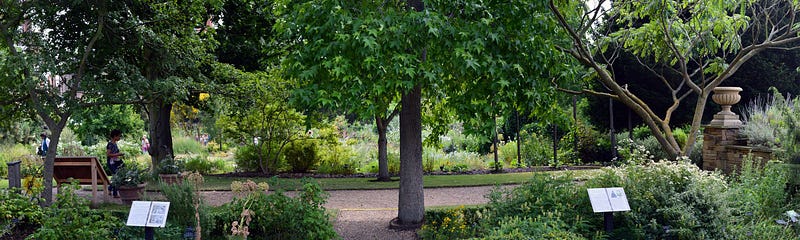
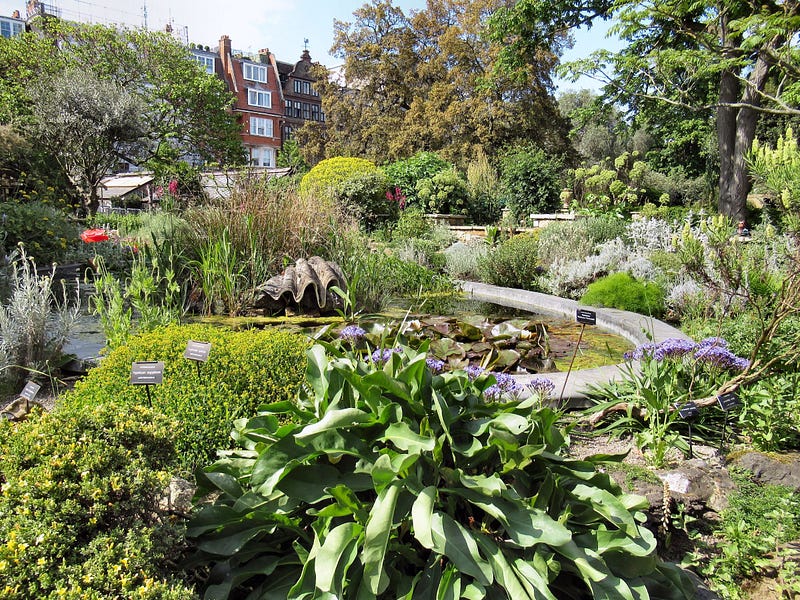
Determined to clear her husband’s debts, Elizabeth Blackwell devised a plan to raise money. As a girl, she loved plants and had been taught to draw by her father, the artist Leonard Simpson. Using these skills, she created detailed illustrations of medicinal plants — she drew and engraved them and hand coloured the prints — and issued them in instalments of four plates a week. Over four years, she produced 500 accurate engravings of species grown in Chelsea Physic Garden by the Worshipful Society of Apothecaries. These included specimens brought back from the Americas by Sir Hans Sloane. To ensure access to the plants while they were still fresh, she moved into a house on Swan Walk adjacent to the garden.
The collected prints were published as A Curious Herbal in two volumes endorsed by prominent men including physician Dr Richard Mead and apothecary Isaac Rand.
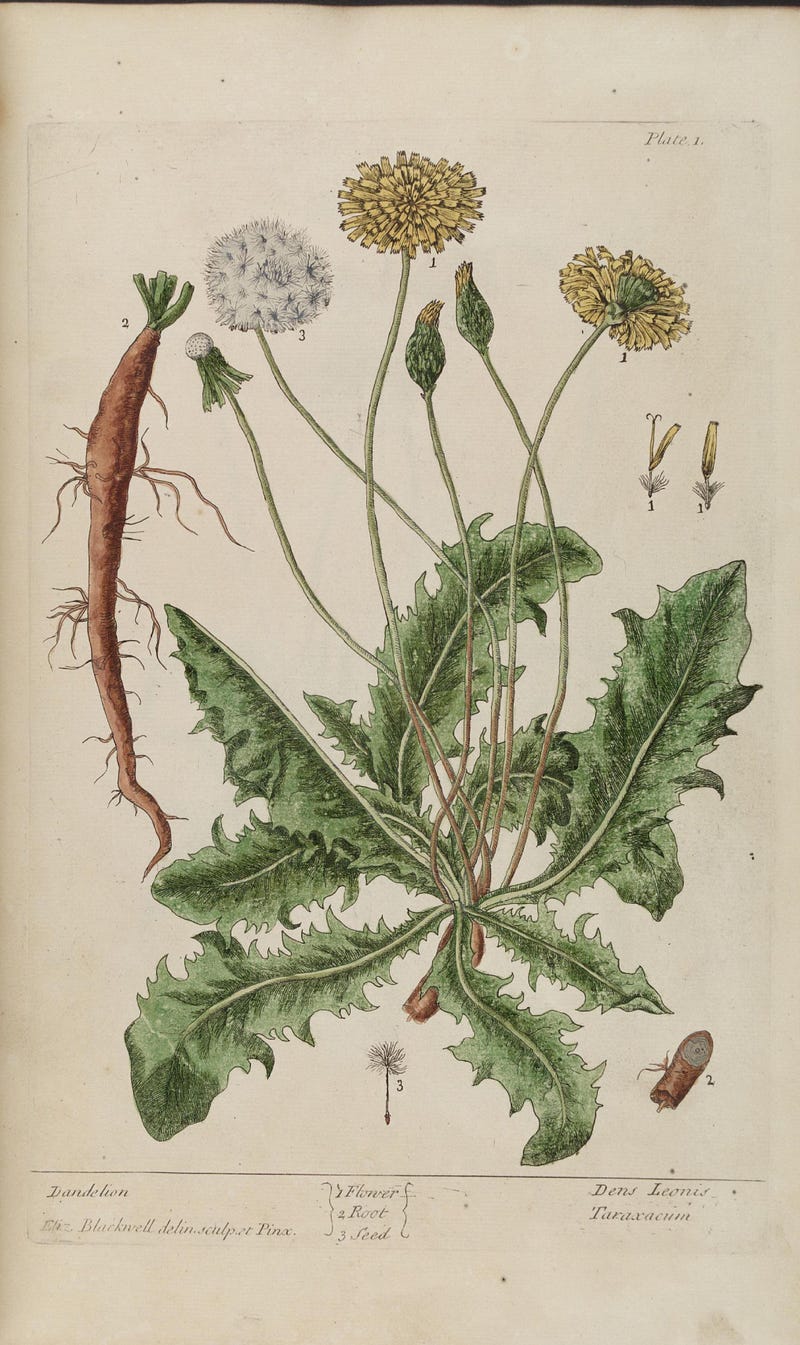
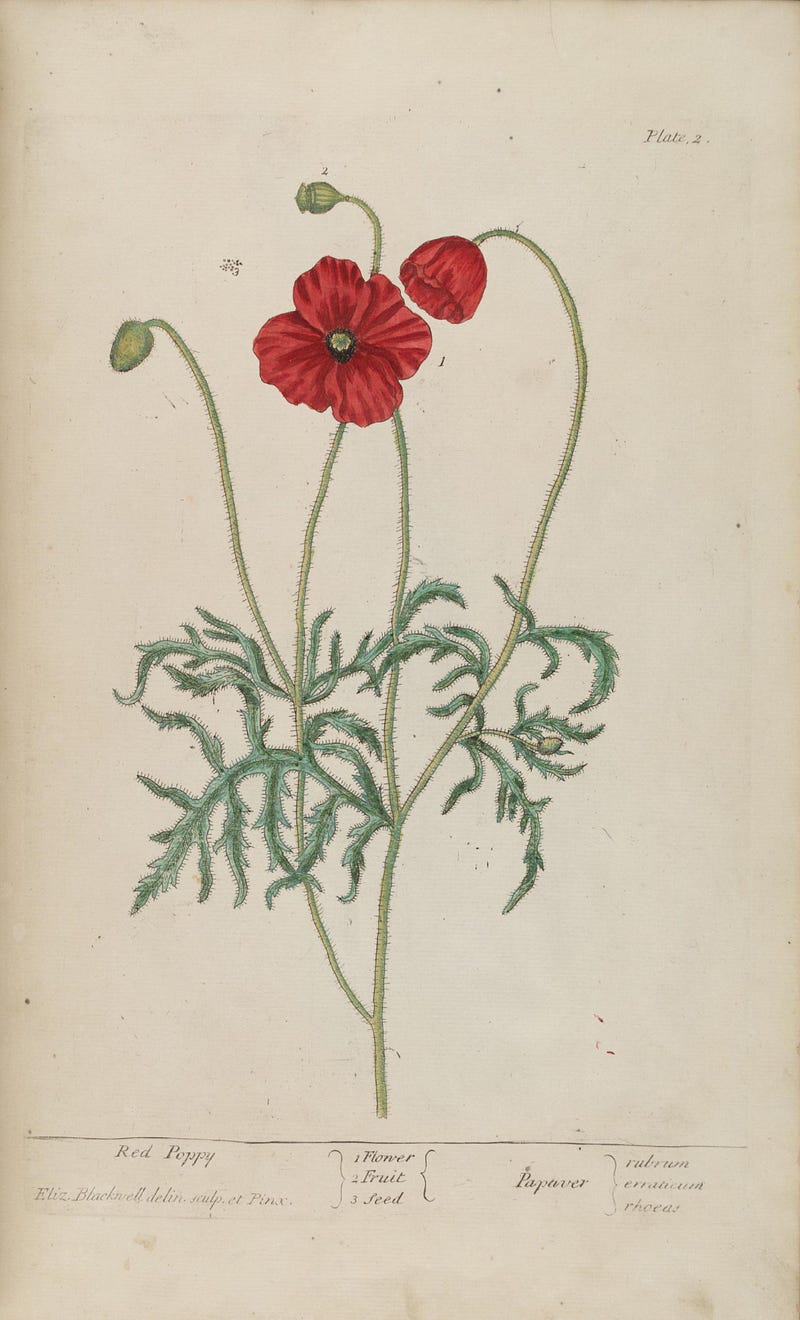
A Curious Herbal was so sucessful that it led to the first test of Britain’s copyright laws. When a coterie of printers copied and published four of her engravings without permission, Elizabeth took them to court. On 9 March 1738, she began proceedings against them under the Engravers’ Copyright Act 1735, known more formally as An Act for the encouragement of the arts of designing, engraving, and etching historical and other prints, by vesting the properties thereof in the inventors and engravers, during the time therein mentioned, 1735, 8 Geo. II, c.13.
Most of the defendants immediately folded and pointed the finger at George Bickham the Younger. Bickham, printmaker and satirist, regarded himself as a maverick and delighted in cocking a snook at authority. Despite all the snook cocking and satire, he took his art seriously. An advertisment for his work read:
Where all Sorts of Picture-Work, as well as Writing and Shopkeeper’s Bills, are executed in a neat Manner, and at the most reasonable Rates. Authors and Booksellers may have Frontispieces and Cuts, for Books, design’d, drawn, and engraved in the best Taste, and printed in the cleanest Manner, to produce a beautiful Impression, at the lowest Prices: As also Pictures neatly framed and glazed: Where all Gentlemen, Merchants, City and Country Shopkeepers, and Chapmen, may be furnished at the best Hand.
Bickham ignored the allegations for as long as he could. When he finally responded, part of his defence rested on the interpretation of invention and design, key components of protection under the Act. His argument was that prints must involve significant creative input to be covered. Merely reproducing what was present in nature required no invention or design — no artistry or interpretation. It was simply copying. So when he made entirely independent engravings of the same species, of course they looked identical.
Among the witnesses appearing for Elizabeth was William Hogarth, a much better known artist, satirist and commentator than Bickham, and one of the people who had pushed for the Engravers’ Act to be passed by Parliament. Hogarth testified as an expert witness, offering the opinion that Bickham had, indeed, copied Elizabeth’s work.
At the trial’s conclusion it was determined that artworks not wholly or substantially created from the imagination were protected under the act. The design and invention required for protection also included drawings made from life. Elizabeth won her case.
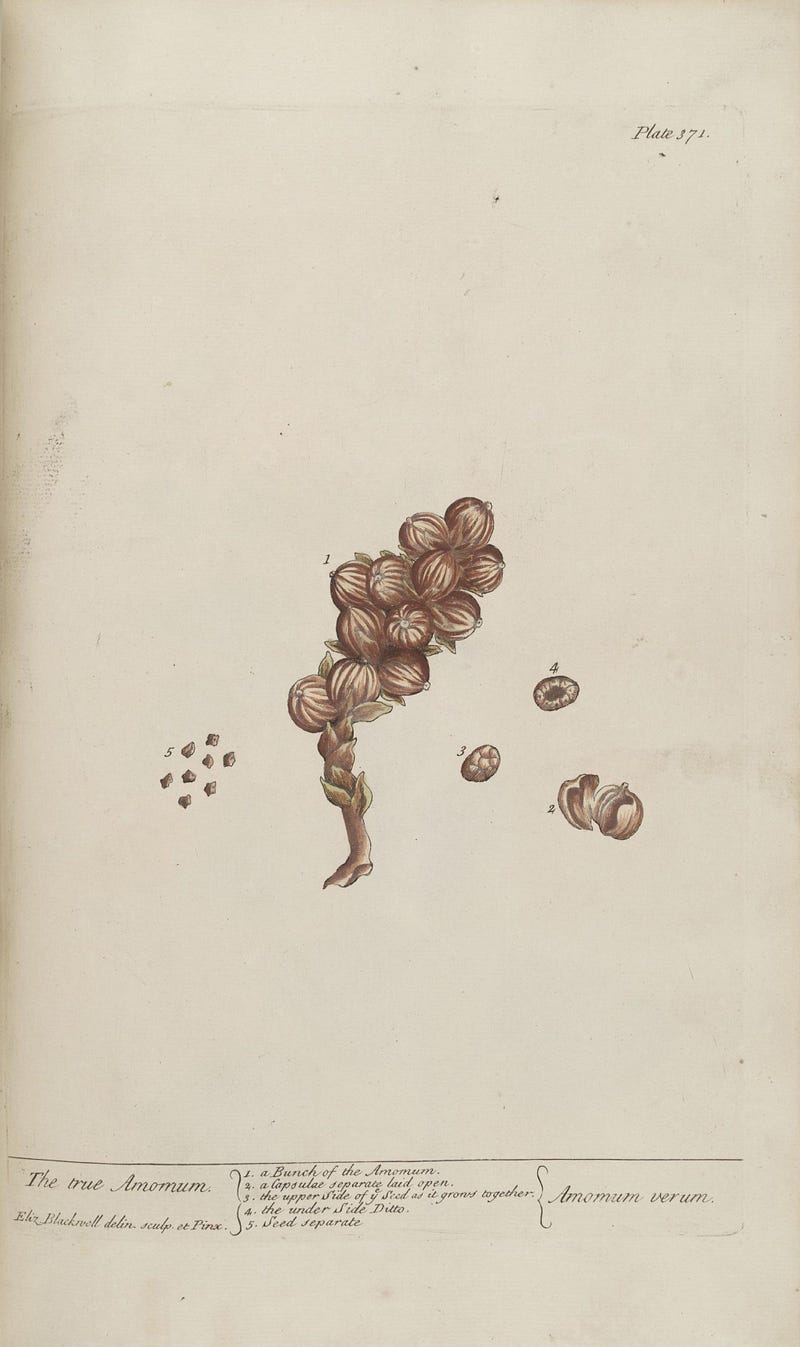
Elizabeth had another first to her name. Among the species depicted in A Curious Herbal was a type of cardamom, which Elizabeth called Amomum verum. This was a new species but that meant little in the 1730s. The rules of plant nomenclature were not established until 1753, when Linnaeus introduced the binomial system in Species Plantarum. It marked a threshold in botanical taxonomy. Only names published after this are considered available and Elizabeth’s A Curious Herbal was too early.
The illustration was republished in 1757 in a German text called Herbarium Blackwellianum. This multi-volume work was an annotated version of A Curious Herbal and used her work, but since it was not covered by British copyright Elizabeth Blackwell could neither stop its release nor receive income from it. But the volume containing ‘the true Amomum’ appeared after the taxonomic threshold. Elizabeth Blackwell became the first woman to name a new species of plant. Amomum verum was indelibly associated with her.
And what of her husband? Alexander Blackwell had one more brush with the law. In 1742, he moved on his own to Sweden where he was — through a circuitous route — appointed physician to King Frederick I. That did not last long and he returned to one of his other roles, that of agriculturalist. Predictably, that did not last long either. Then Alexander became involved in political intrigue. Whether a real conspiracy or something dreamed up alone by Blackwell, the Swedish Court believed that he intended to bring about a situation where the Duke of Cumberland would take the throne.
In 1747, as Elizabeth was about to join him in Stockholm, she received word that Alexander had been arrested for treason . He was executed soon after. Elizabeth died eleven years later in 1758.