
The Deeper Functioning Parts of a Story
How to make your fiction stand out from other writers by using literary storytelling elements
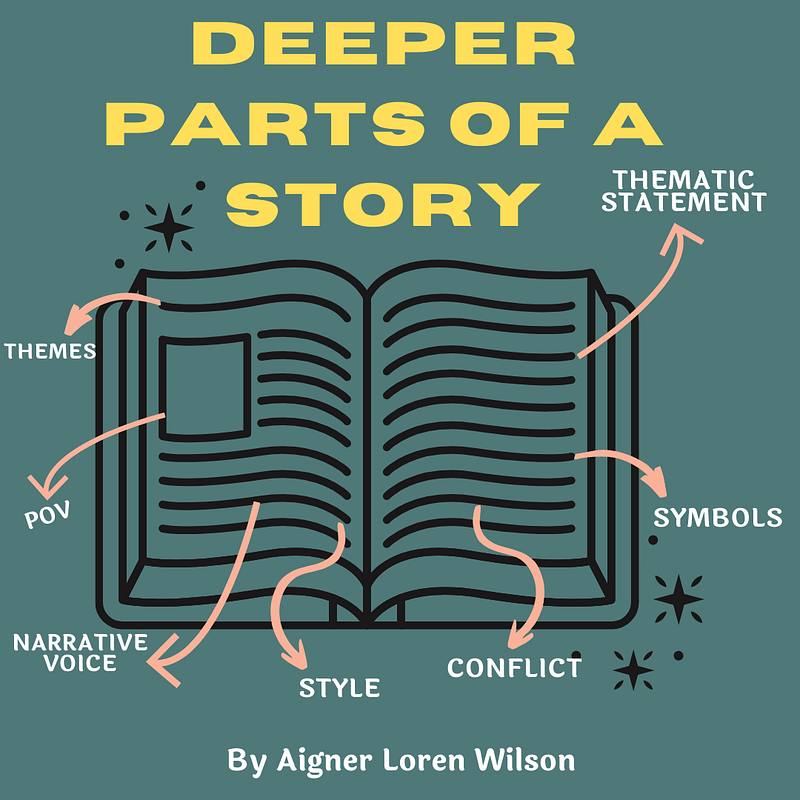
Story Elements to Write By
Plots are big overarching beasts, but there are smaller parts of a story that help strengthen the plot. The basic ones we’ve already gone over (character, setting, scenes, chapters, etc.). But there are even smaller ones than those that build our full story.
They are point of view, style, themes/symbols, thematic statement, conflict and resolution, and narrative voice. The more connected all of the elements of your story, the better the piece will resonate with your readers and create a sense that you have a full understanding and control over your story. This authorial control will foster trust between you and your reader.
Pro Tip: For writers wanting to go the traditional route and hook an agent, editor, or publisher, lacking authorial control in all elements of your story is one of the biggest reasons you’ll get rejected.
Point of View
- first-person POV: using the ‘I’ to tell the story. Great for immersive storytelling when you want there to be little between the character and the reader. Also can create an unreliable narrator storyline easier than the other POVs.
- second-person POV: using ‘you’ to tell the story. This is an odd and often frowned upon POV choice for a novel because of how unique and unfamiliar it is for the reader. But there are books that do this well. Great for distorted or experimental fiction. This can also be done in an implied way where the character is talking to the reader as the ‘you.’
- third-person POV limited: using ‘he/she/they/it’ or another personal pronoun to tell the story. This is a common choice for stories and can produce close to the same effects as first-person in terms of immersion. The narrator is usually someone else and doesn’t know what the character is thinking or their internal emotional workings.
- third-person POV omniscient: using ‘he/she/they/it’ or another personal pronoun to tell the story except the narrator has access to the internal workings of the characters.
Use deep immersion in all POVs to create a smaller bridge between the story and the reader. Do this by removing dialogue tags and filler words that keep the action or setting from the reader. Add more emotion and descriptors to the sentence to really set the stage. Truly understand your characters and the world. Depending on what POV your book is in, use either the narrative voice or the character voice instead of your own.
Style
When we talk about style, what we are really talking about is the writer’s choice of words, sentence structure, and paragraph structure. Is the book told in a lot of sharp short sentences that drive the telling forward or is it more laborious with longer sentences and paragraphs that go on for pages?
Our style sets the tone and atmosphere. We can strengthen it through the same factors we use to distinguish it. If you want to make the style in your book darker, find words that carry that tone and weave sentences that shock and disrupt the reader by writing a variety of sentence lengths that always change, sometimes without warning.
Style can also be a template. Have you ever heard of some stories or books being referred to as resembling another writer or story’s style? That’s a writer who has used, either knowingly or unknowingly, a template for their style.
To strengthen your style, study and practice syntaxy and grammar rules regularly. Learn the rules of the language you are writing in so that you can subvert them or use them to build your story.
Themes/Symbols
Themes are the small elements and topics your book is about that are outside the regular synopsis. Friendship is a theme. It’s a common one in lots of stories along with love, hate, gluttony, and any other topic you can dig up.
Symbols are the archetypes or objects we use to strengthen our themes and thematic statement. A story about friendship may have a bridge as a symbol if the theme is related to connecting to someone else. Symbols can be reoccurring or appear only once in your book.
The more a particular symbol or theme shows up, the more weight it will carry in your story.
Thematic Statement
Try not to confuse your themes with your overall thematic statement. A thematic statement is the one driving force behind your book. It’s the argument behind the text and what the themes, symbols, and other storytelling elements all pay homage to.
You might be writing a story about two friends climbing to the top of Mount Everest, but what is happening beneath the page? Is this really a story about survival only being won through community and support? Or maybe it’s about how love can weather the toughest moments?
Stories and books don’t have to have an overarching thematic statement, but I have found it to be a helpful guide that allows me to create a multilayered story that resonates and carries a lot of weight with the reader.
Conflict and Resolution
Conflict can be negative or positive. It is simply the friction that is created between characters and the other elements of your story. Characters can be in conflict with each other or the setting or even the themes of the story.
Resolution is the ease of tension created by the conflict. It often gives an answer and a step toward the next conflict or beat in the story.
Conflict without resolution will often hang around in the reader’s mind in a negative way if there aren’t other satisfying conclusions and resolutions given. It can be dynamic to give resolution to one conflict during another conflict.
The way to take your fiction from ordinary to extraordinary lies in how you layer your conflict. A conflict in one scene develops a character and leads to another conflict between a set of characters or events in the story that connects elements of your story to create a sense of importance and wow in your reader.
Narrative Voice
If the narrator of your story is separate from your character, then give this narrator just as much back history and development as your character so that their voice is unique and creates an extra texture to the story. You don’t have to give any of this narrator back story on the page, just use it to weave their voice.
Your narrative voice can be a mirror into the story and not call attention to itself, as well. If this is the effect you want, lean toward a more sparse narrative description void of emotion and flashy words.
A Practice to Level Up Your Writing Today
Find a book that was published within the past 5 years. It doesn’t have to be your favorite, but it should be one you’re willing to study and be immersed in for the day. I prefer to stick close to my subject matters and topics that’ll help me develop my knowledge in those areas, but you can choose whatever you like.
Read the first 50 pages (more if you have the time and space). During your first reading don’t worry about taking notes or anything like that. Focus on the story and how the words affect you. If something really hits you or moves you, underline it or note it, but don’t turn on your analytical brain until the second reading.
Go back to the beginning and begin identifying the above deeper elements of story at work in the book.
- What is the book’s POV?
- What style is it written in?
- Identify a few of the themes and symbols the author is using
- What is the book’s thematic statement?
- What is the overarching conflict at play and what are the smaller conflicts that fall under it?
Ask and answer these questions and more of the text. Study the book. If you feel like you can’t identify the parts, then read deeper into the text for what you are missing. Explore other avenues to see if you truly understand storytelling elements.
Then do the same thing to your current writing project. Is your story well-developed with all its functioning parts? Or is it lacking in several areas?
Aigner Loren Wilson (she/her) is a SFWA, HWA, and Codex writer who writes poetry, nonfiction, and games, alongside her fiction. She is an associate editor and copy editor for Strange Horizons and the horror podcast NIGHTLIGHT. Her work has appeared or is forthcoming in Lightspeed Magazine, WIRED, The Writer, and many more. She served as guest editor for Apparition Literary’s Contamination issue and Fireside Magazine’s 2022 winter issues.