avatarScienceDuuude

Summary

The undefined website content presents a poetic exploration of elemental science through haikus and accompanying explanations, focusing on the fundamental nature of atoms and the formation of elements, particularly hydrogen, in the universe.

Abstract

The undefined website features a creative blend of science and poetry, encapsulated in the #30DaysOfScikuChallenge, which encourages the composition of science-inspired haikus (sciku). It delves into the quantum mechanical nature of atoms, describing the probabilistic behavior of protons and electrons that define the elements. The article emphasizes the importance of hydrogen, the universe's most abundant element, which was formed shortly after the Big Bang and is crucial to the life cycle of stars and the creation of heavier elements. The text is complemented by captivating images and additional readings on the subject, inviting readers to reflect on the intricate beauty of the cosmos and our elemental origins.

Opinions

  • The author likens the classical model of atoms to childhood science projects, highlighting the contrast with the more complex quantum mechanical model.
  • Electrons are described as having a strobe-like existence, without a definite path, challenging the traditional view of their movement.
  • The article conveys a sense of wonder at the dual nature of subatomic particles, which exhibit both wave-like and particle-like properties.
  • It is suggested that the interactions of protons, neutrons, and electrons give rise to the solid and deterministic world we perceive.
  • The poetic tribute to hydrogen acknowledges its role as a foundational element, essential in the formation of stars and the subsequent creation of heavier elements.
  • The text references Carl Sagan's concept of "stardust," implying that the elements within us are the products of stellar evolution and supernova explosions.
  • The website encourages further exploration of science-inspired poetry and learning through the #30DaysOfScikuChallenge and other related articles.

#30DaysOfScikuChallenge

Element Scikus

A couple of elemental science-inspired haikus.

Elementary

Proton, electron Probabilistic dancers Define elements
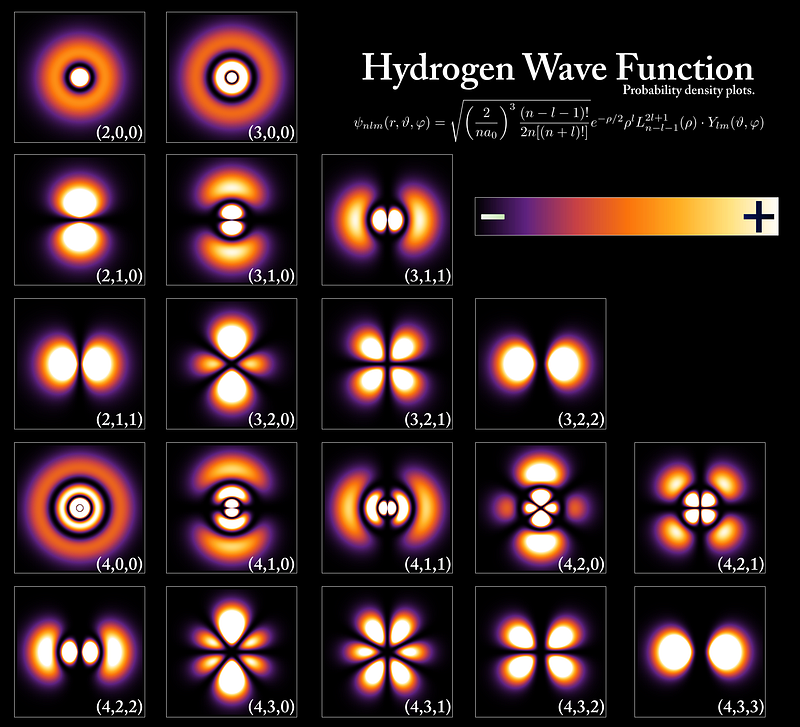
Atomic orbitals of the electron in a hydrogen atom at different energy levels. The probability of finding the electron is given by the color, as shown in the key at upper right. (Image and text by PoorLeno, Wikimedia Commons)

We think of protons and electrons arranged like miniature solar systems of wire and Styrofoam balls, circling endlessly in our childhood science projects. But at the atomic scale, it is probability, not graceful arcs and loops, which define how electrons move about their suns made of protons and neutrons. More like how a moth would appear flitting about a flickering light, a stroboscopic existence with no path through space between each flashing appearance. Protons, neutrons, and electrons behave as both particles and waves, bending our minds and collectively giving us the illusion of a solid and deterministic world. That probabilistic dance between these sub-atomic partners is the basis for all the elements that build our universe.

Hydrogen

One and one make one Condensing from the Big Bang Our World’s pioneer
Pexels.com

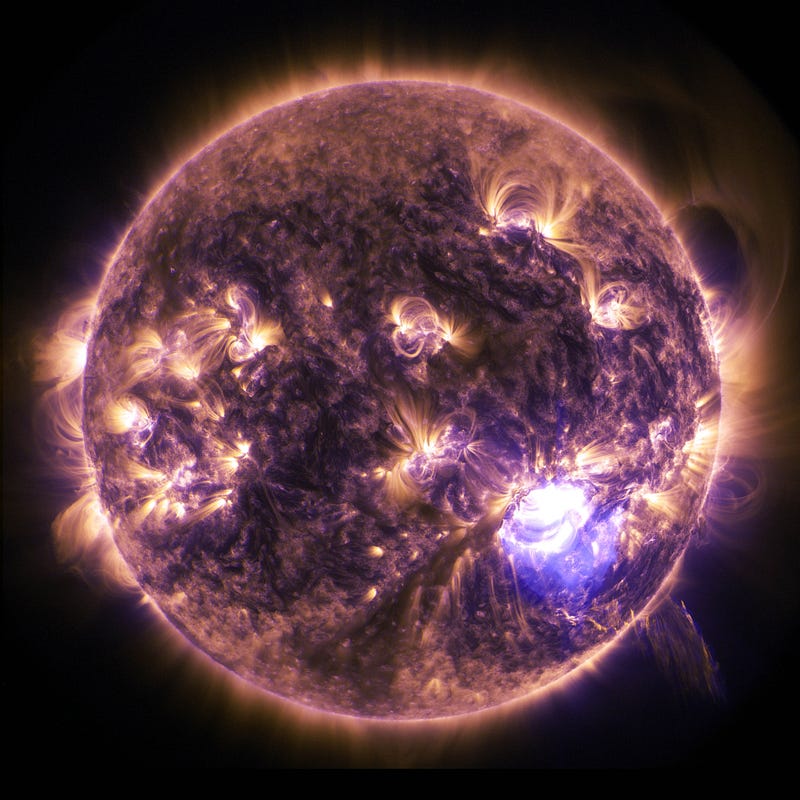
One proton and one electron make one hydrogen—the first element to condense out of the fiery subatomic blast following the Big Bang. Hydrogen remains the predominant element making up our universe. The biggest bodies in our solar system, the sun, and the gas giants Jupiter and Saturn are mostly hydrogen. The first suns to ignite from the hot haze of hydrogen filling our earliest universe were immense, massive stars hundreds of times larger than our sun. By force of gravity, these massive stars forged heavier elements from hydrogen, and their supernova explosions seeded the universe with our first elements bigger than helium. Eventually, a range of stars evolved, the smaller ones dying in less spectacular ways than the short-lived massive supernova stars. But all contributed the elemental products of their stellar forges, from these elements, the stardust that Carl Sagan spoke of, that we and our world are made.

For more on the #30DaysOfScikuChallenge — science-inspired haiku (or #sciku):

What next from ScienceDuuude :

Science
Poetry
Haiku
Culture
30daysofscikuchallenge
Recommended from ReadMedium