
Electrifying Everything Everywhere All At Once Is Key Climate Wedge
Burning ~20 billion tons of fossil fuels a year for heat, movement and electricity throws away two-thirds of their energy as waste heat while creating ~40 billion tons of CO2
In our future economy, any economic value chain that can go from wind turbines to wires to energy services without going through molecules will win. It will be vastly cheaper. It will be vastly lower carbon. It will be vastly more efficient.
And the degree of electrification that’s possible and probable is likely to astound you. This series will dig through all of the energy requirements of a modern economy and point out the reasons why radical electrification of everything, everywhere, all the time is our future.
Let’s start with an excellent visual, the Lawrence Livermore National Laboratory energy flows Sankey diagram.
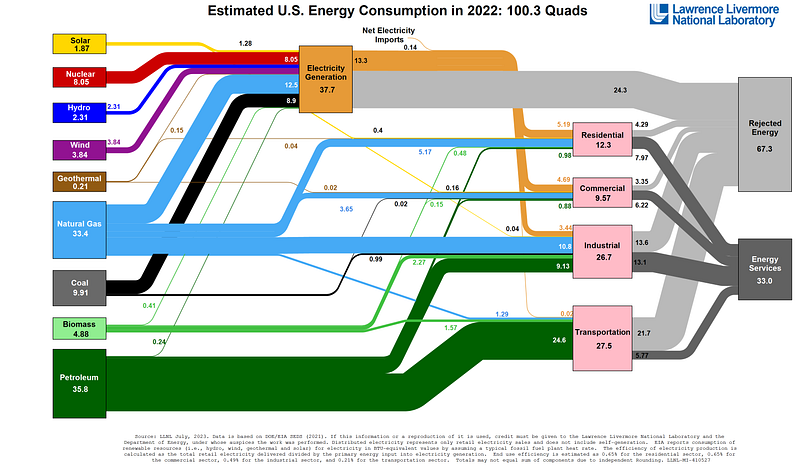
Spend a minute looking at this diagram. Most countries in the world have variants of this. The International Energy Agency maintains its own versions for the world. Most of them aren’t as good as the LLNL one. They are eye charts and they understate one of the big problems, rejected energy.
That’s the gray bars and big gray box. That’s energy that comes into the economy on the left from coal, nuclear energy, natural gas or renewables and then turns into waste heat that just evaporates into the sky.
It’s a very clear indicator of inefficiency. We have been able to afford throwing away two-thirds of all energy in modern economies because fossil fuels are dirt cheap and we were able to use the atmosphere as a dumping ground without consequences.
In the future, we won’t be doing that. We’ll be making low-carbon electricity only on the left, and getting rid of the big gray bar of rejected energy from burning coal, gas and oil to make electricity. We won’t be making molecules like hydrogen or synthetic natural gas to burn for electricity because that will be vastly less efficient and so much more costly.
We won’t be burning coal, oil or gas for heat. The low-carbon electricity will be used directly for all of our heating and cooling requirements in industry, commercial buildings and our homes. Turning low-carbon electricity into molecules which we then burn for heat doesn’t make economic or environmental sense if there are alternatives, and there are. All of our warmth in the winter, hot water for our baths, fuel to cook our food and high-temperatures for industrial processes will be via direct use of electrons.
We won’t be burning gas or diesel in anything that travels across our roads and rails. Everything that moves around on the ground — cars, pickups, motorcycles, trucks, buses and trains — will be running on electrons too. Gasoline and diesel engines are incredibly inefficient compared to electric motors, and making synthetic gasoline or diesel throws away a lot of low-carbon electricity in the process. That means fuel costs will be triple or more if molecules are involved. So they won’t be.
Every boat and ship that isn’t crossing oceans will be running directly on electrons. That’s a remarkable amount of water shipping that’s going to be quieter, much more efficient and less polluting near people. It’s already started, although like a lot of things it’s invisible to most people. A recent example is a pair of 700-container battery powered ships that are sailing a 1,000-kilometer route along China’s Yangtze River.
And every airplane that isn’t crossing oceans will be running on batteries as well. Once again, that’s a lot of passenger kilometers.
In fact, crossing oceans is the only place where there will be molecules required for energy, and we won’t be making those molecules from scratch. Making hydrogen from low-carbon electricity or natural gas with carbon capture and then combining it with carbon from carbon capture to make synthetic fuels like methanol or e-diesel is a pathway full of rejected energy. It’s deeply inefficient compared to making biofuels from our rather ridiculous amounts of biological waste, for example, the full third of food that gets landfilled annually, about 2.5 billion tons.
We’ll have the same lifestyle, comfort and economic value we have today, but it will take only about half of the energy to achieve that. Yes, 50% of the energy. For the USA, that means only about six times as much low-carbon electricity as the country already generates annually will power the entire economy. Six times as much wind and solar is pretty easy to achieve in the coming decades, and it will be mostly wind and solar energy.
And so, a new series starts. This one is the radical electrification of everything. Looking back at the Sankey diagram, I’ll be starting at the bottom with transportation. Watch this space.


